
CAN-SPAM compliance for US restaurants and venues
Why this matters for your venue
Email marketing drives return visits. A single well-timed campaign to a verified list can fill a quiet Tuesday or promote a new menu to customers who already know your brand. The risk is real too: each commercial email that violates the CAN-SPAM Act carries a penalty of up to $53,088. In August 2024, the FTC issued its largest-ever CAN-SPAM fine - $2.9 million against the security company Verkada. That number lands very differently when your finance director sees it.
But the bigger risk is not the fine; it is the deliverability trap. If you email people who never asked to hear from you, some of them will mark your messages as spam. Gmail and Outlook track that signal. Once your spam complaint rate climbs above 0.1%, inbox placement drops for your entire list - including the customers who genuinely want to hear from you. You damage your sender reputation, and rebuilding it takes months.
The solution is not merely compliance; it is building an opt-in list based on active choice from the very start. When a customer logs in to your WiFi and actively ticks a box to receive your emails, you have verified first-party data. That customer knows your venue, has visited in person, and has chosen to stay in touch. A list like that will always outperform a bought one. Purple Engage automates this process at scale.
The law, unpacked
The Controlling the Assault of Non-Solicited Pornography And Marketing Act (CAN-SPAM) was passed in 2003 and is enforced by the FTC. It applies to every commercial email sent to US recipients, regardless of where the sender is located. There is no minimum-volume threshold - a single non-compliant email from a one-site restaurant is subject to the same rules as a multinational chain.
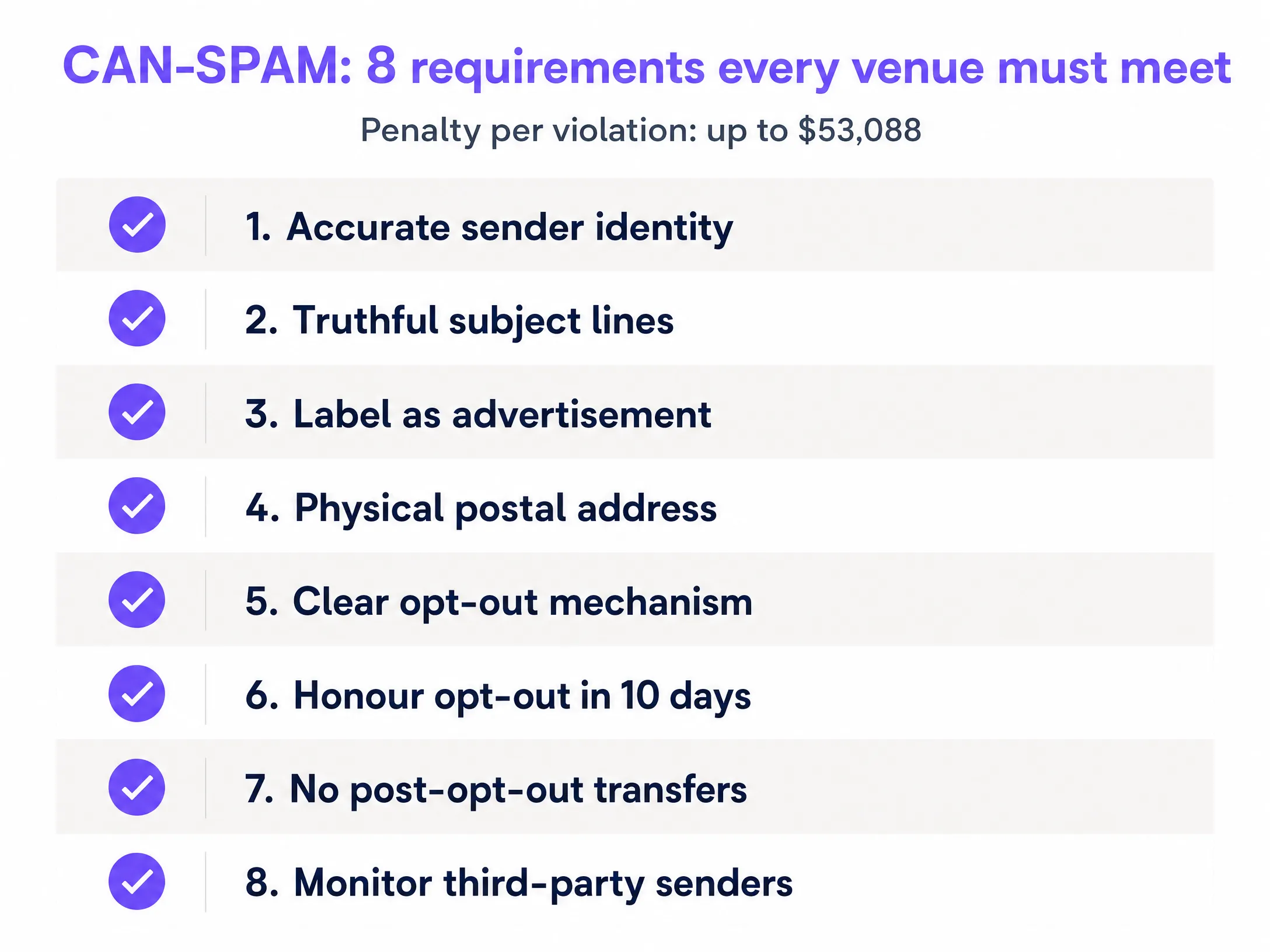
The Act has eight core requirements. Your "From" and "Reply-To" information must accurately identify your business. Your subject line must reflect the actual content of the message - "Your receipt from last night" on a promotional email is a straightforward violation. You must identify the message as an advertisement, include a valid physical postal address, and provide a clear, simple opt-out mechanism. You must honour opt-out requests within 10 business days. Once someone has opted out, you may not sell or transfer their email address. And if you use a third-party agency to send on your behalf, you remain legally responsible for their compliance.
CAN-SPAM is, technically, an opt-out law. That means you can email people who never explicitly agreed to sign up, as long as you provide a way to refuse further messages. This is where most venues make a strategic mistake: they treat the legal minimum as the operating standard. It is not.
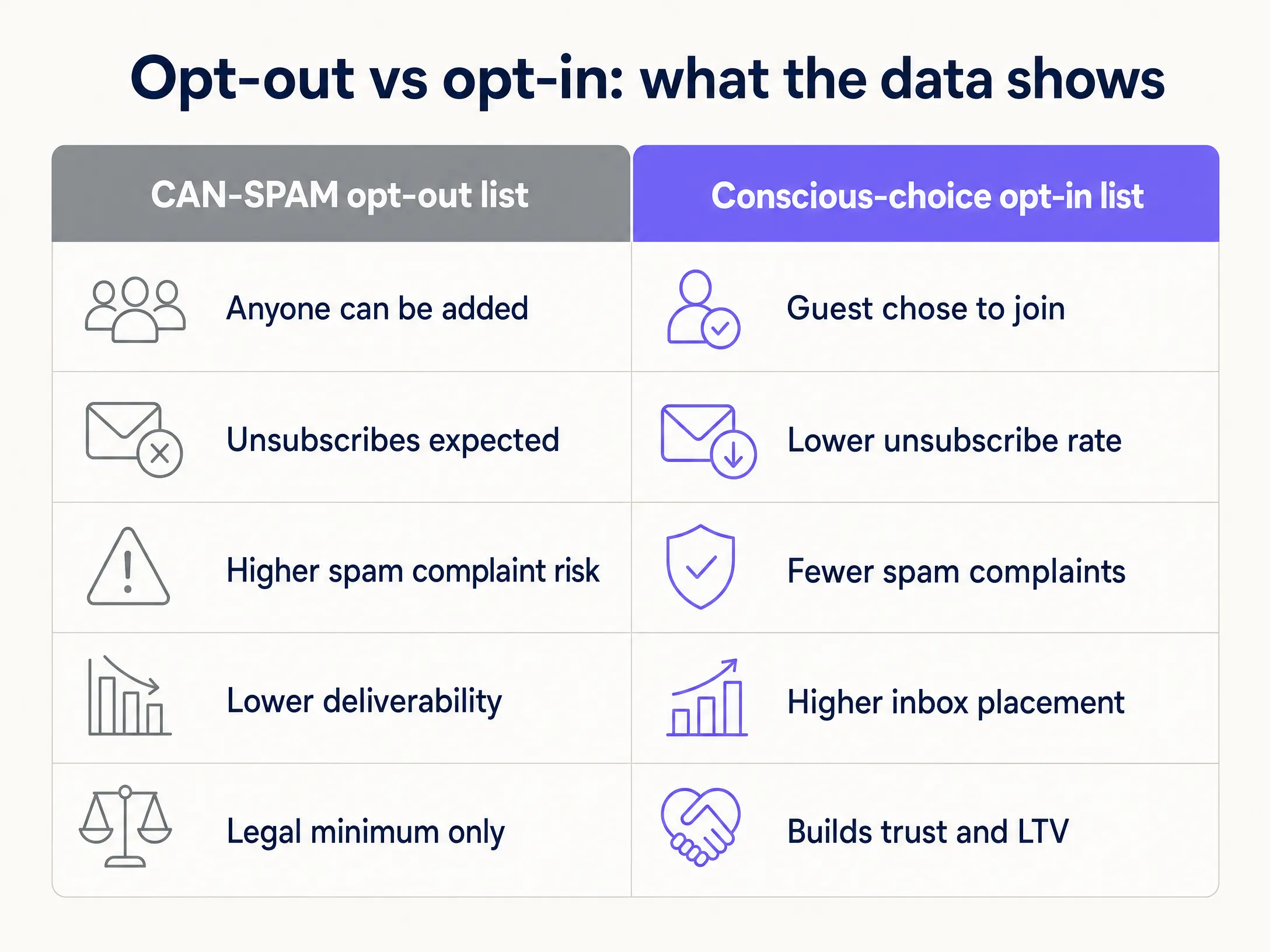
An opt-in list built on active choice - where customers deliberately choose to subscribe - performs dramatically better. Mailchimp benchmark data puts the average open rate for restaurant and food-service emails at around 28-32%. Lists built through verified opt-in at WiFi login consistently beat that benchmark, because the contacts are warm, recent and location-verified. The customer was physically in your venue when they signed up, and that context is irreplaceable.
How to achieve it with your guest WiFi
Your physical venue is your best acquisition channel. Every customer who walks in and connects to your WiFi is a potential verified subscriber. Guest WiFi from Purple captures that data automatically.
When a customer connects to your network, Purple presents a branded captive portal - a login page that sits between the customer's device and the internet. The customer enters their email address and sees a clearly labelled, unticked box for opting in to marketing communications. When they tick it, you have a verified, consented contact. The data syncs to your CRM or email platform automatically, with no manual exports and no data-cleaning backlog building up.
This process satisfies CAN-SPAM because the customer actively chooses to subscribe. It also satisfies GDPR for EU customers, because the consent is explicit, granular and timestamped. Purple operates across more than 80,000 physical venues worldwide and processed 440 million logins in 2024. Consent records are built into the platform.
Generic email tools such as Mailchimp or Klaviyo handle the sending of campaigns, but they do not build the list. Purple builds the list through verified in-venue interactions, then connects to those platforms for sending. That is the crucial distinction.
What to send and when
Timing determines whether an email drives a visit or gets ignored. For most venues, these three automations deliver the highest return on investment.
The first is the welcome email, triggered shortly after a customer's first WiFi login. Thank them for visiting, introduce your loyalty programme or upcoming events, and give them a reason to come back - a discount on their next visit, a free item, or early access to a new menu. This email arrives while your venue is still fresh in their memory.
The second is the re-engagement campaign, triggered when a customer's device has not connected to your network for 60 days. A simple message - "We've missed you" - paired with a relevant offer is enough. Because Purple tracks device reconnections, you can measure precisely how many of these emails convert into return visits.
The third is the segmented promotion, sent according to the customer's visit frequency or time of day. For example, a customer who always visits on Friday evenings is the right person to receive a weekend-special reminder on Thursday. A lunchtime visitor, on the other hand, is the wrong audience for a late-night cocktail promotion.
Every email must include your physical postal address and a clearly visible unsubscribe link. Under CAN-SPAM, these are non-negotiable. Automate your suppression list so unsubscribes are processed automatically within 10 business days, with no manual intervention required.
See what to email guests after their first visit
Measuring results
Open rate is the starting point, not the conclusion. A 35% open rate means nothing if none of those people visit again. The metric that actually matters is the return-visit rate driven by email.
Because Purple tracks when devices reconnect to your network, you can close the loop between an email send and a physical visit. Send a campaign on Tuesday. Measure how many of those contacts connect to your WiFi within the following seven days. That is your true conversion rate, and it is the number to report to your finance director.
Track these four metrics for every campaign: open rate, click-through rate, unsubscribe rate and return-visit rate. If the unsubscribe rate on any send climbs above 0.5%, something is wrong with the content or the audience segmentation. Fix it before the next send.
Revenue per send is the executive-summary metric. Divide the incremental revenue from return visits attributed to the campaign by the number of emails sent. For a mid-sized restaurant group, a well-run opt-in programme should be producing measurable revenue per send within the first three months.
Where to start
- Audit your current email list. Remove any address you cannot verify as a confirmed opt-in. A smaller, clean list will outperform a large, unverified one.
- Set up your guest WiFi captive portal to collect emails with a clearly labelled, unticked-by-default opt-in checkbox.
- Review every email template for CAN-SPAM compliance: physical address, unsubscribe link, accurate sender information, truthful subject line.
- Build the three automations: the welcome email, the 60-day re-engagement, and the segmented promotion.
- Connect your WiFi data to your email platform so return-visit attribution is tracked automatically.
- Monitor deliverability weekly. If spam complaints rise, act immediately.