
Email capture rate benchmarks for venues
This guide sets out what a healthy email capture rate looks like for physical venues and shows how branded guest WiFi login pages lift it. It covers benchmarks across hospitality, retail and events, explains why first-party data captured at the point of WiFi sign-in outperforms every other acquisition channel on cost and quality, and gives marketing directors a practical playbook for deploying, measuring and activating the data.

Why this matters for your venue
Every day your venue is open, guests walk in, spend time with your brand, and walk out - and the vast majority of them remain anonymous to your marketing team. No email address, no consent, no way to bring them back. A low email capture rate represents this gap, and it costs you directly. A guest who visits once and never hears from you again is just a one-off transaction. A guest whose email you have, and who receives a timely re-engagement campaign, becomes a regular customer.
The statistics prove this very clearly. According to industry data published by Forbes, email marketing returns an average of £36 for every £1 spent. According to Stripo's restaurant email marketing analysis, returning customers spend 67% more than first-time visitors. Yet, according to Revinate's 2025 Hospitality Benchmark Report, only 34% of guest records in the average hotel database in EMEA have valid email addresses. This means two-thirds of guests become invisible to your marketing team the moment they walk out of the door.
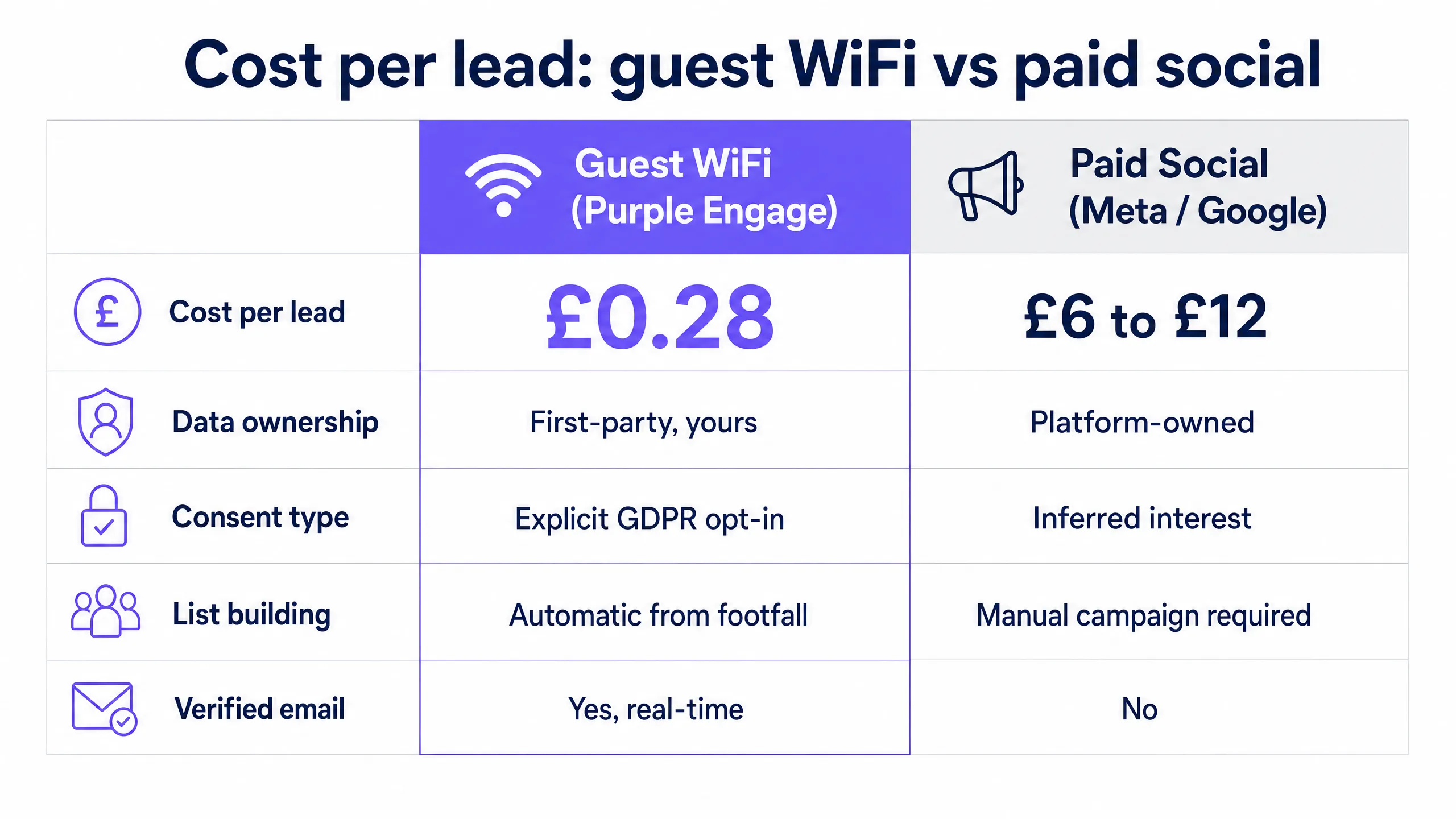
The mechanism to bridge this gap is already available in your venue: the guest WiFi network. When a guest connects to your Guest WiFi and consents to marketing, you capture a verified, contextual, and consented record of a real person who has chosen to be in your venue. This is not just a casual website browser. This is a physical visitor who has already demonstrated intent. Across Purple's network of 80,000+ venues, the average cost per lead via a Captive Portal is £0.28 (Purple internal data, 2024). In contrast, paid social leads in retail and hospitality typically cost between £6 and £12 per lead. That is a 25 to 50-fold difference.
Generic email tools like Mailchimp and Klaviyo send campaigns. They do not build lists. Purple Engage does both.
The approach
The primary method for this is a Captive Portal - a branded login page that guests see when trying to connect to their WiFi. To gain internet access, they provide their email address and explicitly tick an unticked box to consent to marketing communications. This conscious choice meets GDPR requirements and builds a list of verified, active contacts.
This is completely different from website pop-ups or social media lead forms. Those channels capture people who are browsing. A Captive Portal, however, captures people who are physically present in your venue. This means the intent signal is much stronger, the data is verified in real-time, and the consent is explicit. Purple Engage's branded, streamlined login pages achieve around 50% higher opt-in rates compared to other channels (Purple internal data, 2024).
The table below shows how the email capture rate benchmark varies by venue type, based on Purple's platform data across 80,000+ venues.
| Venue type | Typical email capture rate | Notes |
|---|---|---|
| Hotel | 30% to 40% of connections | Longer dwell times help capture richer data |
| Restaurant / Bar | 25% to 35% of connections | Shorter sessions; keep forms minimal |
| Retail | 20% to 30% of connections | Shoppers move quickly; mobile optimisation is essential |
| Airport / Travel hub | 35% to 45% of connections | Longer dwell times; travellers actively seek connectivity |
| Stadium / Event venue | 40% to 55% of connections | Highly engaged captive audience |
For context, according to data from EasyApps Ecommerce, the average e-commerce website's email capture rate is 1.95% of site visitors. A well-deployed Captive Portal captures ten to twenty times that rate from physical visitors.
How to do this with your guest WiFi
Purple Engage works as a cloud overlay on your existing network hardware. You do not need to replace your access points. The platform integrates natively with Cisco Meraki, HPE Aruba, Ruckus, Juniper Mist, Ubiquiti UniFi, Cambium, Extreme, and Fortinet. This deployment is simply a configuration change, not a hardware project.
The capture flow runs automatically in five stages.
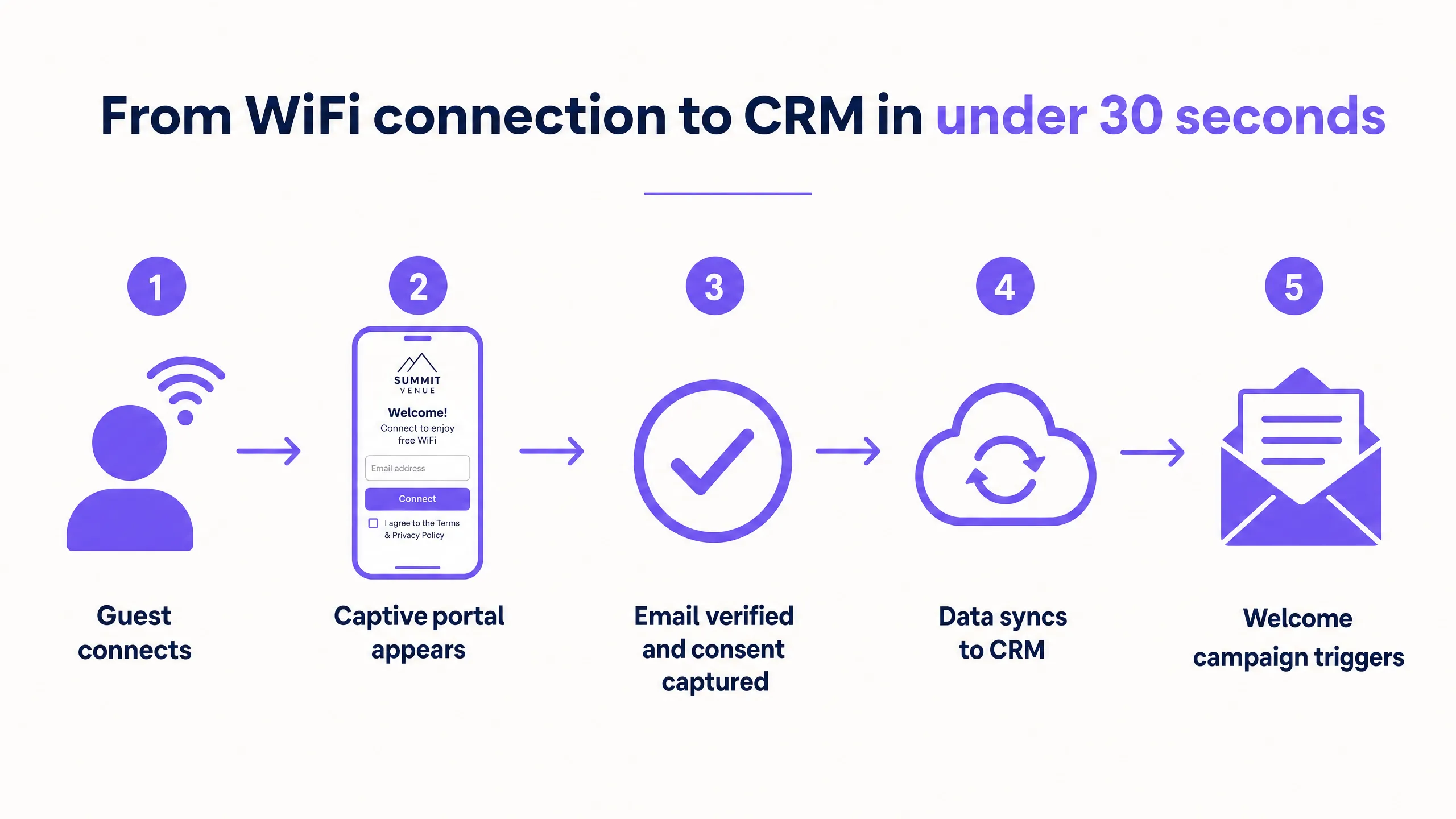
First, guests select your venue's WiFi network. Second, a branded Captive Portal appears on their device. Third, they enter their email address and tick the marketing consent box. Fourth, Purple Engage verifies the email address in real time, rejecting disposable or invalid addresses. Without verification, around 17% of captured addresses are likely to be invalid; with Purple's Verify add-on, database accuracy improves by 83% (Purple internal data). Fifth, the verified, consented data syncs instantly to your CRM.
Purple Engage provides native connectors for HubSpot, Salesforce, Microsoft Dynamics 365, Mailchimp, Klaviyo, Iterable, Braze, Marketo, Pardot, and Bloomreach. For anything else, Webhooks handle the job.
Two GDPR points that venue management often overlooks. First, legitimate interest does not cover marketing emails. You require explicit opt-in. Second, pre-ticked boxes invalidate consent under GDPR. Marketing opt-in must be a conscious action by the guest.
What to send and when to send it
Capturing emails is the first step. Its value comes from activation. Because the data is linked to physical visits, your campaigns can be highly context-relevant and therefore significantly more effective than sending generic broadcasts.
The welcome email is your highest-performing email. Guests have only just visited your venue. Your brand is fresh in their minds. Send it within 24 hours of their first visit. Include a small incentive to return - a discount, an invitation to register for loyalty, or any special offer. This single automation typically delivers open rates far higher than the hospitality industry average of 20.39% (Mailchimp industry benchmark).
Beyond the welcome, the following automations are standard practice for venue operators using Purple Engage.
| Automation | Trigger | Purpose |
|---|---|---|
| Welcome | First WiFi connection | Introduce the brand, incentivise return |
| Re-engagement | No visit in 60 days | Win back lapsed customers with targeted offers |
| Milestone | Birthday or anniversary | Drive high-conversion celebratory visits |
| Post-visit survey | 2 hours after leaving the venue | Gather zero-party data, prevent negative reviews |
| Loyalty registration | Third visit | Convert regular visitors into loyalty programme members |
| Cross-venue | Visit to a new location in the estate | Introduce the wider brand and drive exploration |
For retail operators looking to build on this foundation, see our guide on turning retail footfall into an email list.
Measuring what works
Do not measure success by open rates alone. Open rates are a useful indicator, but they are not an ROI-proving metric. Apple's Mail Privacy Protection has made open rate data less reliable as a standalone measure. The metrics that matter are those tied to business outcomes.
The primary metric is the email capture rate: the percentage of total WiFi connections that result in a verified, opt-in email address. Track this weekly and compare it to the venue-type ranges in the table above. A rate below 20% indicates friction in the portal - usually a form that is too long, a non-mobile-optimised portal, or an unclear value exchange.
The secondary metric is cost per lead (CPL). Divide the monthly cost of your WiFi marketing platform by the number of verified emails captured in that month. The average for Purple venues is £0.28. If your CPL is significantly higher, the portal design or hardware configuration needs attention.
The business outcome metric is the return visit rate: the percentage of captured contacts who return to the venue within a set period, typically 90 days. This is the metric that proves email campaigns are working. Harrods tracked this chain precisely to report a 57x ROI from their guest WiFi marketing programme - connection, capture, campaign, return visit, revenue (Purple customer data).
Finally, track revenue per send: the incremental revenue generated by a specific campaign send, measured via loyalty programme transactions, booking data, or point-of-sale integrations. This is the figure that justifies the investment to the CFO.
Where to start
The checklist below gives you a systematic path from zero to a working email capture programme.
- Audit your existing network. Identify your current hardware vendors (Cisco Meraki, HPE Aruba, Ruckus, etc.) and confirm whether you currently have a Captive Portal deployed. If you have an open, unmanaged network, you are not capturing any data.
- Design the portal. Create a clean, branded Captive Portal using Purple Engage. At this stage, ask only for an email address and a marketing consent tick-box. Do not ask for name, date of birth, or postcode.
- Configure the sync. Connect Purple Engage to your CRM. Test the data flow end-to-end before going live.
- Set up the welcome automation. Create a single automated email triggered within 24 hours of the first visit. This is the most important automation you will build.
- Establish your baseline. Run this for 30 days and record your email capture rate, CPL, and the number of welcome emails sent.
- Measure and optimise. Test different variations of the portal - different copy, different incentive offers - and track the impact on the capture rate. Aim to reach the benchmark range for your venue type.
Purple Engage is available on Capture and Engage plans. To see how the platform works on your specific hardware estate, contact the team at purple.ai.