
Revenue per send: the email metric venues should track

Why this matters for your venue
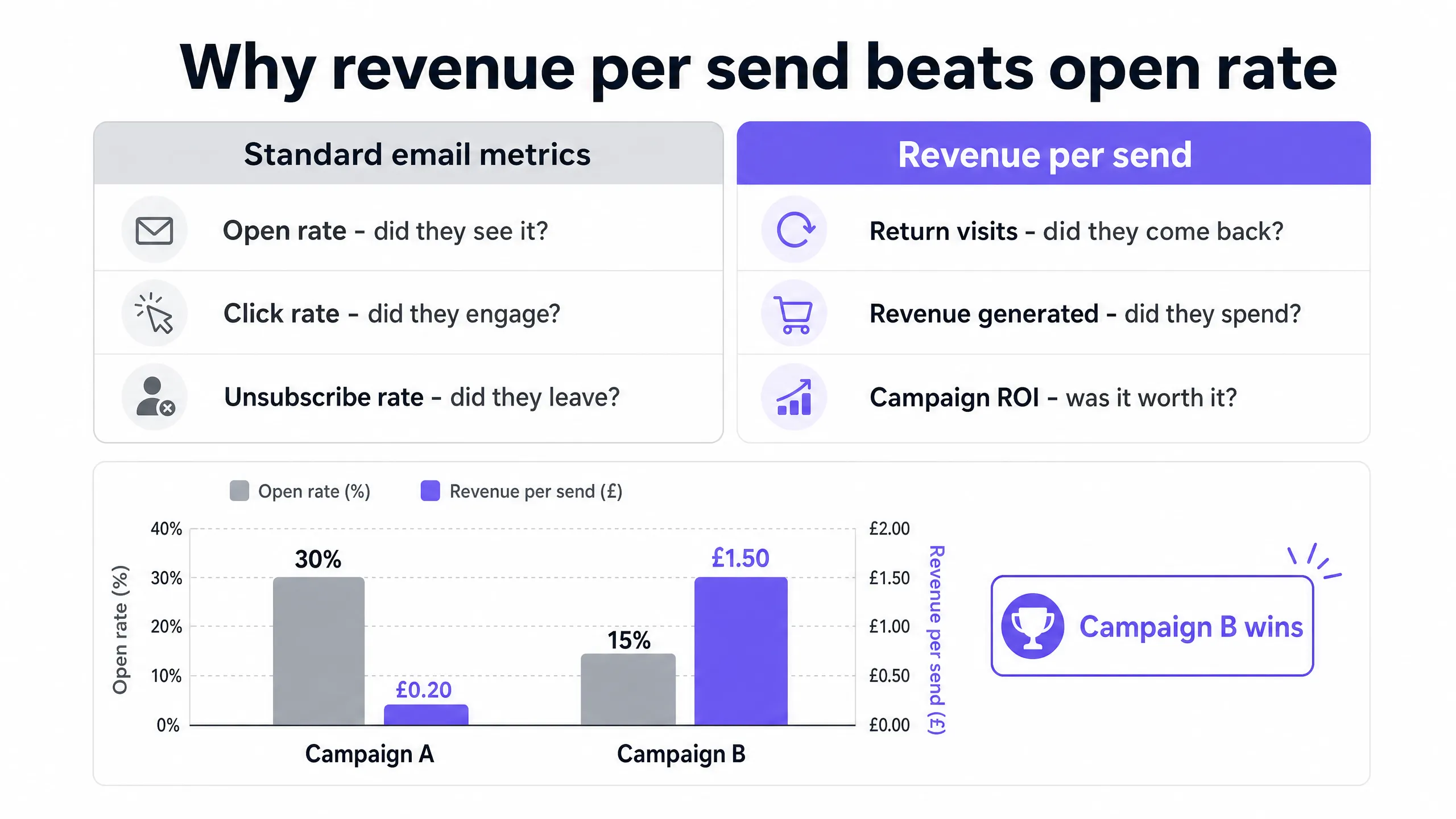
Open rates and click-through rates are only proxy metrics. They tell you whether someone looked at your message, but not whether that customer actually walked through the door and spent money. For physical venues, the only metric that truly matters is revenue per send.
The cost of ignoring this is very real. Generic email tools such as Mailchimp or Klaviyo only send marketing emails; they cannot build your list. More importantly, they cannot close the loop. If you send 10,000 emails offering half-price appetizers, a standard tool will report a 20% open rate. But it cannot tell you how many of those 2,000 people actually visited your restaurant, logged in to your WiFi, and spent $50 on dinner.
Revenue per send shifts the conversation from "did they like the email?" to "did the email generate revenue?". For a marketing director fighting for budget in a board meeting, that is the only conversation worth having.
How to implement it
Revenue per send connects a digital action (sending an email) to a physical outcome (a visit and a transaction). The mechanism relies on a single, persistent identity thread.
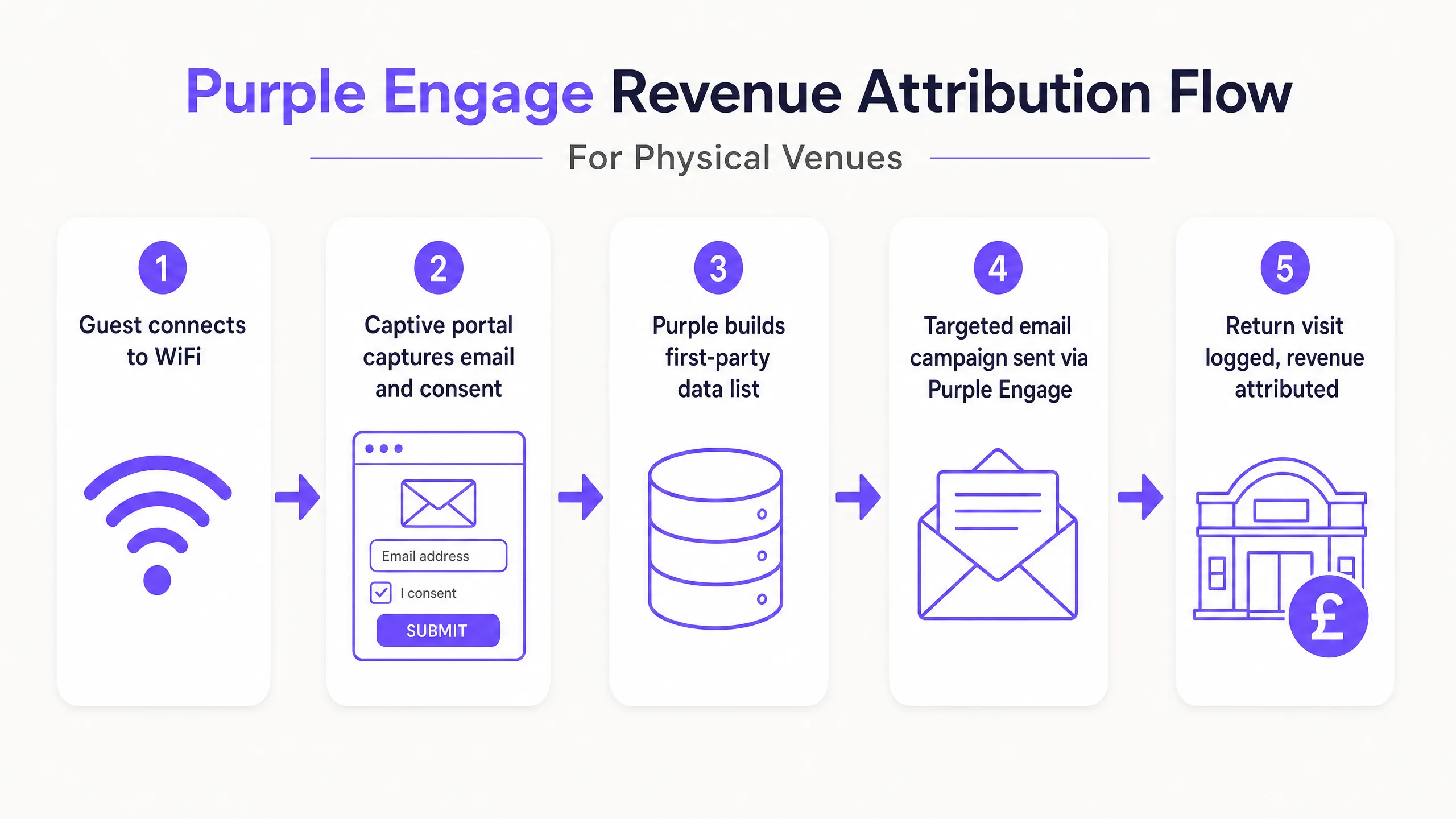
When a customer visits your venue and logs in to the guest WiFi, they provide their email address. This is opted-in, first-party data, fully compliant with GDPR. Purple captures that data and builds your customer list automatically. When you send a campaign through Purple Engage, the system tracks the recipients. When that customer visits again and their device reconnects to the WiFi, Purple records the visit. By applying an average spend per head, you can calculate the exact revenue the campaign generated.
This is not an estimate. It is a verified figure, based on real network authentication data from more than 80,000 real venues and 440 million logins in 2024 (Purple internal data).
| Metric | What it measures | What it misses |
|---|---|---|
| Open rate | Did the customer see the email? | Whether they actually visited |
| Click-through rate | Did the customer engage digitally? | Whether they actually spent |
| Revenue per send | Did the email drive visits and revenue? | Nothing - this shows the complete picture |
How to achieve this with your guest WiFi
Purple Engage automates the entire process. The customer list builds itself through guest WiFi logins.
First, configure the captive portal. This is the login screen customers see when they connect to the network. Set the authentication method to require an email address, ensuring you capture verified first-party data alongside an explicit GDPR consent checkbox.
Next, build a campaign in Purple Engage. Define the audience using the data collected through the WiFi network. Target customers who have not visited in 90 days, or those who regularly visit on Tuesday afternoons.
Finally, publish the campaign. Because Purple operates at the network layer, return visits are monitored automatically. When a targeted customer walks back into the venue, their device authenticates on the network. Purple records the return visit, attributes it to the specific campaign, and calculates the revenue that email campaign generated.
Purple integrates with Cisco Meraki, HPE Aruba, Ruckus, Juniper Mist, Ubiquiti UniFi, Cambium, Extreme and Fortinet hardware, so you do not need to replace your existing infrastructure.
What to send, and when
Timing and audience segmentation are critical. Sending the same email to your entire database dilutes your revenue per send. Segment your audience based on customers' physical behavior.
Lapsed customers: For customers who have not visited in 60 days, offer a strong incentive to return, such as a discount, a freebie or an exclusive experience. The goal is to get them back through the door.
Regulars: Reward frequent visitors with exclusive perks or priority access to events. Do not waste discounts on people who would have visited anyway.
Event attendees: Send follow-up emails to customers who logged in during a specific event or promotion. They have already demonstrated an interest in that type of experience.
Automation ensures these messages reach customers at exactly the right moment. Trigger an email 24 hours after a customer's first visit, thanking them and offering a discount on their next spend. If a regular has not been seen for 30 days, trigger a re-engagement email. For a deeper look at building these segments, see our guide on segmenting venue customers using dwell time and visit data.
Measuring success
To measure email ROI accurately, establish a baseline average spend per head for your venue. If you run a bistro, that might be $15. If you run a hotel, it might be $150.
Once you have that baseline, the calculation is straightforward. If a campaign goes to 1,000 people, 50 of them return within 14 days of the send, and your average spend is $20, the campaign generated $1,000 in revenue. The revenue per send is $1.00.
This metric lets you compare campaigns objectively. A campaign with a 15% open rate but $1.50 revenue per send is worth significantly more than one with a 30% open rate but only $0.20 revenue per send.
An important note on attribution windows: for most venues, an attribution window of 14 to 21 days strikes the right balance. Too short, and you miss delayed conversions. Too long, and you attribute visits that had nothing to do with the campaign.
Where to start
- Audit your captive portal. Make sure your guest WiFi requires an email address for authentication and includes a clear CCPA/CPRA consent statement.
- Establish your baseline. Determine your venue's average spend per head, broken down by daypart if spend varies significantly across the day.
- Define your segments. Build distinct audiences in Purple Engage based on visit frequency and recency. Start with lapsed customers - they have the most to gain.
- Launch a test campaign. Target one specific segment with a single, clear offer. Keep the creative simple.
- Track return visits. Use Purple Engage to monitor how many recipients return to the venue within your attribution window.
- Calculate and report. Divide total attributed revenue by the total number of emails sent. Present this figure alongside open rates in your next campaign report.
For more detail on configuring your network to capture this data, explore our guest WiFi capabilities and the full Purple Engage feature set.