
The TCPA and CAN-SPAM and the soft opt-in: email marketing rules for venues
This guide explains what the TCPA and CAN-SPAM require for venue email marketing and why the soft opt-in exception is structurally insufficient for physical venues. It shows how capturing explicit, timestamped consent at the Guest WiFi login - using Purple Engage - provides a safer, broader, and more scalable basis for email marketing than the narrow soft opt-in, which only covers prior customers.

Why this matters for your venue
For physical venues, foot traffic is your primary asset. A guest walking through the door only generates revenue for that single visit. To increase lifetime value, you must reach out to them after they leave and give them a reason to return. Email marketing remains the most effective channel for this, but in the United States, it is strictly regulated. The FTC and state attorneys general enforce the TCPA and CAN-SPAM alongside the CCPA/CPRA. Sending marketing emails without valid consent or a legal exception risks heavy fines and reputational damage.
Many venues try to rely on the "soft opt-in" rule to send emails to past customers. While this works for e-commerce, it is structurally flawed for hospitality, retail, and events. If a table of six dines at your restaurant and one person pays the bill, you only have the opportunity to collect one email address. The soft opt-in leaves the other five guests anonymous. Worse still, if you try to email that paying guest about a different service - such as a hotel stay instead of dining - you will violate the strict conditions of the soft opt-in.
To drive repeat visits and maximize revenue per send, venues need a list that builds itself from verified, opt-in first-party data. Standard email tools like Mailchimp or Klaviyo are built to send campaigns, but they rely on you to provide the list. Purple Engage collects explicit, timestamped opt-in consent at the point of WiFi login, converting anonymous foot traffic into a compliant, scalable marketing database. To understand how data capture works from start to finish, see our guide Guest WiFi email capture: how it works and what to expect.
The mechanics: the TCPA and CAN-SPAM and the limitations of the soft opt-in
Under federal law, you cannot send unsolicited marketing emails to individuals without specific consent. The only exception is the soft opt-in, which allows you to email existing customers without explicit consent if - and only if - you meet four strict conditions:
- You collected their contact details in the course of a sale or negotiations for a sale.
- The marketing is only in relation to similar products or services.
- You provided a simple way to opt out when you first collected their details.
- You provide a clear opt-out in every subsequent message.
For a physical venue, the soft opt-in is a fragile foundation. It limits you only to past buyers, excluding browsers, companions, and prospects. The "similar products" rule restricts cross-selling across different types of venues or brands within your portfolio. Proving that you offered an opt-out at the point of sale is often difficult when relying on point-of-sale systems or third-party booking platforms. The FTC and state attorneys general have fined companies - including a US retailer fined $150,000 in 2024 - that sent marketing emails to unsubscribed customers and argued a soft opt-in justification that the company could not actually prove (FTC Enforcement Register, 2024).
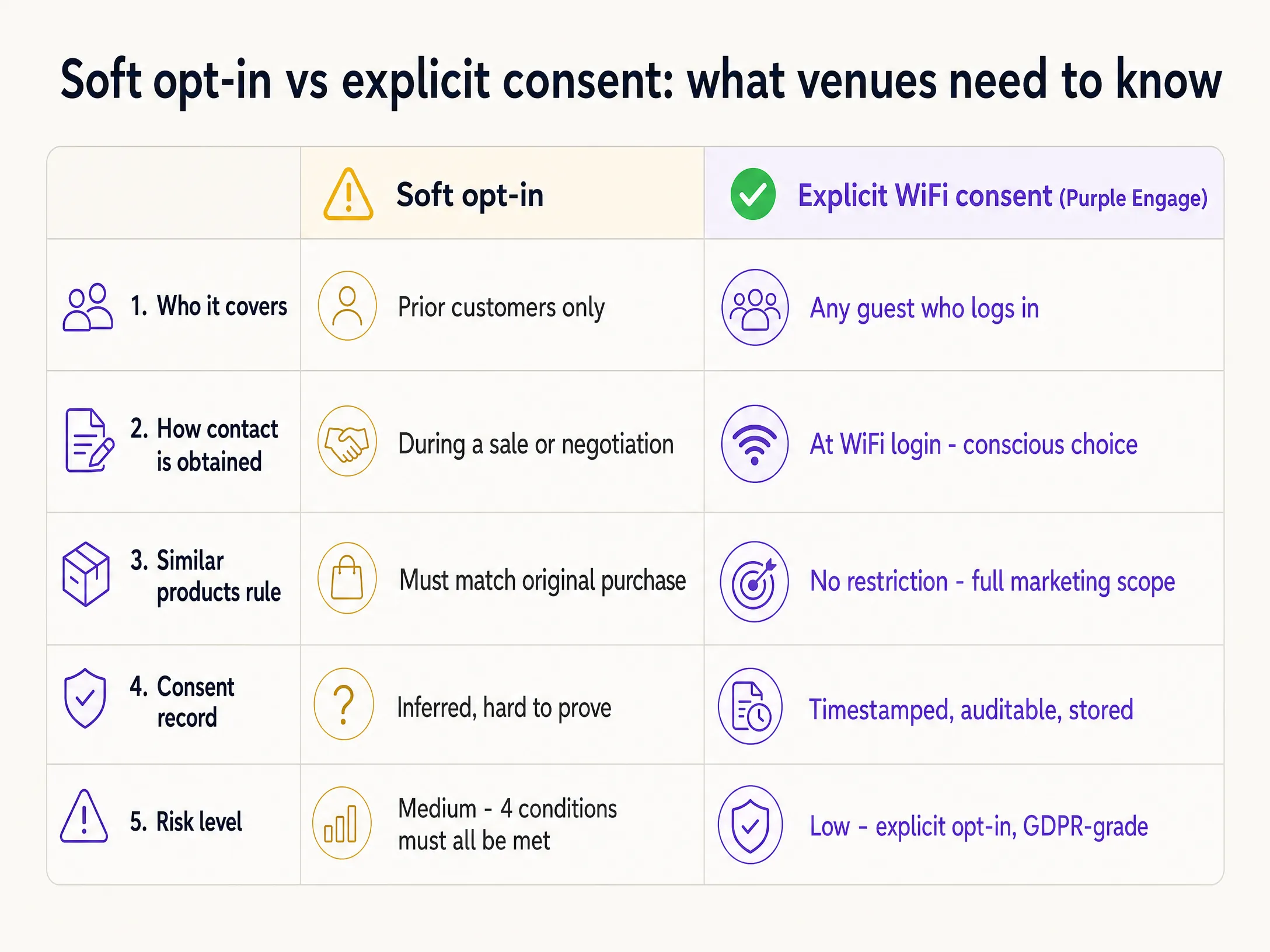
Explicit consent is the safer and more profitable option. According to CCPA/CPRA guidelines, consent must be freely given, specific, informed, and an unambiguous indication of the guest's wishes. By securing explicit consent, you eliminate the limitations of the soft opt-in entirely. You can market your full range of services to those who have opted in, regardless of whether they have made a purchase.
How to do this with your Guest WiFi
Your venue is already offering Guest WiFi. By integrating Purple Engage, you can convert a cost center into an automated list-building engine. When a guest connects to your network, they are presented with a Captive Portal - the web page required to interact with the guest before accessing the public WiFi network. This portal requires them to authenticate using a standard form or social login.
Crucially, the portal presents a clear, unchecked opt-in box for marketing communications. This is not bundled with the WiFi terms and conditions - bundled consent is unlawful under CCPA/CPRA guidelines. The guest makes an active, conscious decision to receive offers.
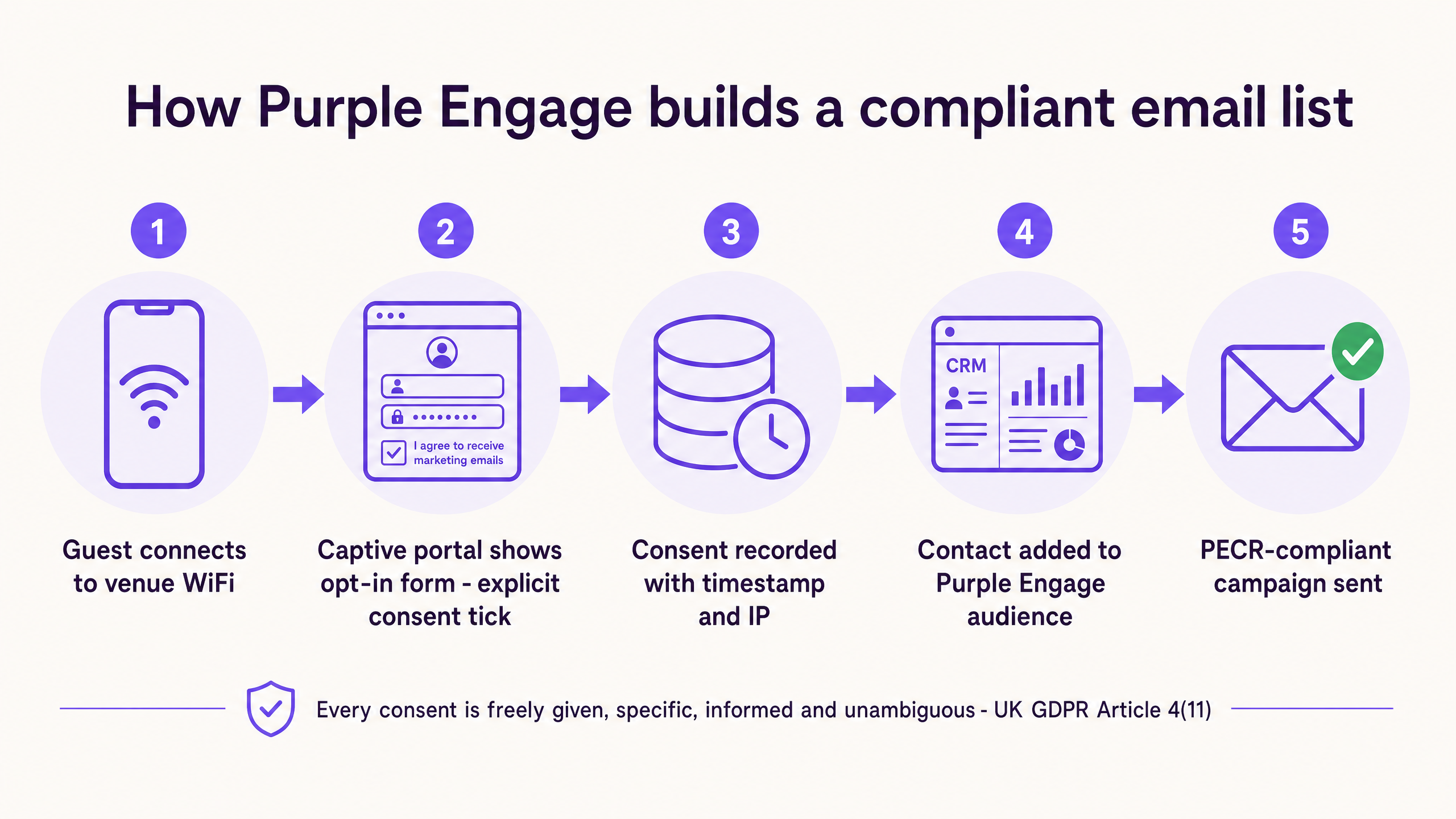
When the guest checks the box, Purple Engage records the exact timestamp, IP address, and the specific wording they agreed to. This creates an auditable consent record that meets the highest CCPA/CPRA and TCPA and CAN-SPAM standards. The data flows directly into your Purple Engage CRM, segmenting guests based on their demographics, visit frequency, and dwell time. Purple operates in over 80,000+ live venues and recorded 440 million logins in 2024 (Purple internal data, 2024), providing you with a proven, large-scale infrastructure for this approach.
What to send, and when
Once you have built a compliant list based on explicit consent, you can run targeted campaigns that drive foot traffic. Purple Engage allows you to automate these based on real-world behavior captured by the WiFi network.
Welcome campaigns: Send an automated email 24 hours after a guest's first visit. Thank them for coming and offer a small incentive to return - a free coffee or 10% off their next visit. This targets the critical window when a first-time visitor decides whether to become a regular.
Lapsed guest campaigns: Use WiFi presence data to identify guests who have not visited for 30 days. Automatically trigger a "we miss you" email with an enticing offer. Because you have explicit consent, you are not relying on a stale soft opt-in from a purchase made months ago.
Cross-sell campaigns: If a guest frequently visits your restaurant, email them about your upcoming ticketed events or private hire spaces. The soft opt-in might restrict this as a different product, but explicit WiFi consent gives you the freedom to promote your entire venue.
Measuring what works
Generic email metrics like open rates and click-through rates only tell half the story. The real measure of venue marketing is whether the email drove a physical visit and generated revenue.
Because Purple Engage links the email profile to the device's presence on the network, you can measure offline attribution. When you send a campaign to 10,000 opted-in guests, Purple tracks how many of those specific devices return to your venue within the next seven days.
Focus on these three metrics:
| Metric | What it tells you |
|---|---|
| Opt-in rate at WiFi login | The percentage of guests who actively check the consent box |
| Return visit rate | The percentage of email recipients who physically return to the venue |
| Revenue per send | The estimated spend generated by returning guests |
Where to start
To move away from the risks of the soft opt-in and build a compliant, high-performing email list, follow these steps in order:
- Audit your current list. Identify which contacts rely on the soft opt-in and whether you can prove all necessary compliance conditions for each.
- Deploy a Captive Portal. Set up Purple Guest WiFi with a branded login screen across your venues.
- Configure explicit consent. Ensure the marketing opt-in box is unchecked by default and clearly explains what the guest will receive.
- Automate welcome messages. Set up a Purple Engage automation to email new opt-ins within 24 hours to secure that second visit.
- Track offline returns. Monitor the dashboard to see how many emails are converting into physical footfall.
For a detailed walkthrough of the capture mechanics, see Guest WiFi email capture: how it works and what to expect.
References
[1] Federal Trade Commission, "CAN-SPAM Act: A Compliance Guide for Business," Guide to Truth in Advertising and Commercial Emails. https://www.ftc.gov/business-guidance/resources/can-spam-act-compliance-guide-business
[2] Federal Trade Commission, "How to Comply with the CAN-SPAM Act," Guidance on direct marketing using commercial emails. https://www.ftc.gov/business-guidance/resources/can-spam-act-compliance-guide-business
[3] California Department of Justice, "California Consumer Privacy Act (CCPA) Compliance Explained: What Every Email Marketer Needs to Know," May 2025. https://oag.ca.gov/privacy/ccpa
[4] US Privacy Group, "US Email Marketing: Compliance Guide (2026)," May 2026. https://usprivacygroup.com/blog/us-email-marketing-guide
[5] Purple internal data, 2024. 80,000+ live venues, 440 million logins in 2024.