
Proving marketing ROI to venue owners with WiFi data
Why this matters for your venue
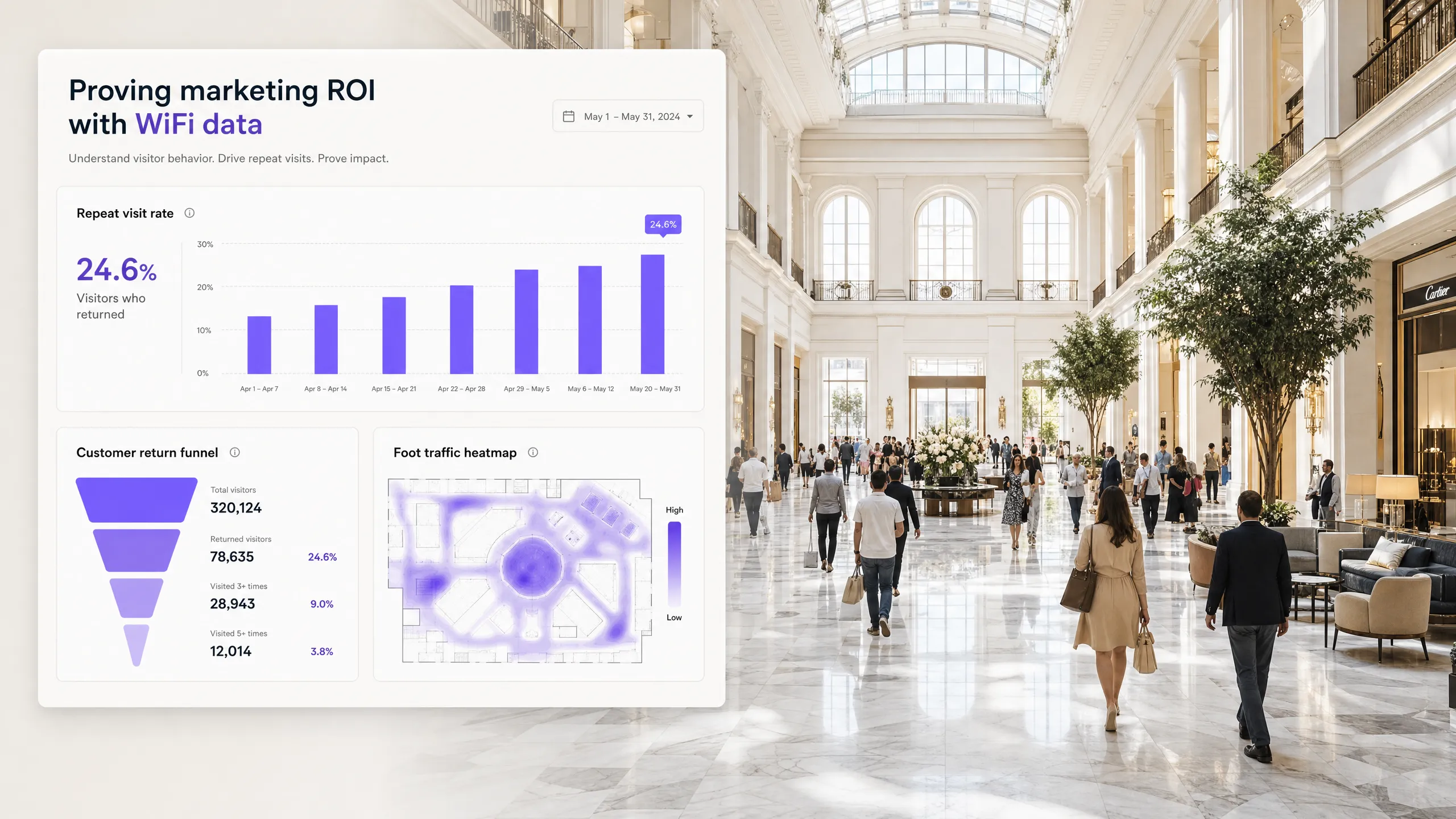
For any marketing director in hospitality or retail, the hardest question to answer is a simple one: "Did that email campaign actually bring customers through the door?" When you use a generic email tool such as Mailchimp, Klaviyo or HubSpot, you cannot answer that question with certainty. You can report open rates and click-through rates, but those are vanity metrics. What owners need to see is repeat visits and revenue.
If you cannot prove that your marketing spend directly influenced footfall, your budget is at risk at any moment. The solution is not writing better email copy, and it is not offering more aggressive discounts. The solution is changing how you collect data and measure results. By combining your venue's existing WiFi infrastructure with Purple Engage, you can turn an IT cost centre into a proven revenue generator.
When a customer logs in to your WiFi, you capture a verified, self-selected opt-in. When they visit again, their device connects automatically, giving you physical proof that they genuinely returned. This closes the loop between digital marketing and the physical world, allowing you to build an ROI case that owners will believe.
How to execute
To prove marketing ROI, you must move from hypothetical attribution to verified physical visits. This requires three fundamental shifts in your marketing strategy.
First, you must build your database organically, on site. Buying lists or running generic social media competitions only brings in low-intent contacts. As we explore in our guide Why bought email lists fail venues, high-quality first-party data comes from the people who are in your venue right here, right now.
Second, you must automate audience segmentation based on physical behaviour. Sending a generic newsletter to your entire database ignores the fact that a first-time visitor and a loyal regular need different messages, and that a lapsed customer needs a different incentive from someone who visited yesterday.
Third, you must measure results in physical return visits. If you send an offer to 10,000 people, the only metric that matters is how many of those specific people actually walked back into your venue during the campaign window.
How to achieve it with your guest WiFi
The technical implementation relies on your existing hardware. Purple is hardware-agnostic and runs as a cloud overlay on top of enterprise-grade wireless access points (APs) from vendors including Cisco Meraki, HPE Aruba, Ruckus, Juniper Mist, Ubiquiti UniFi, Cambium, Extreme and Fortinet.
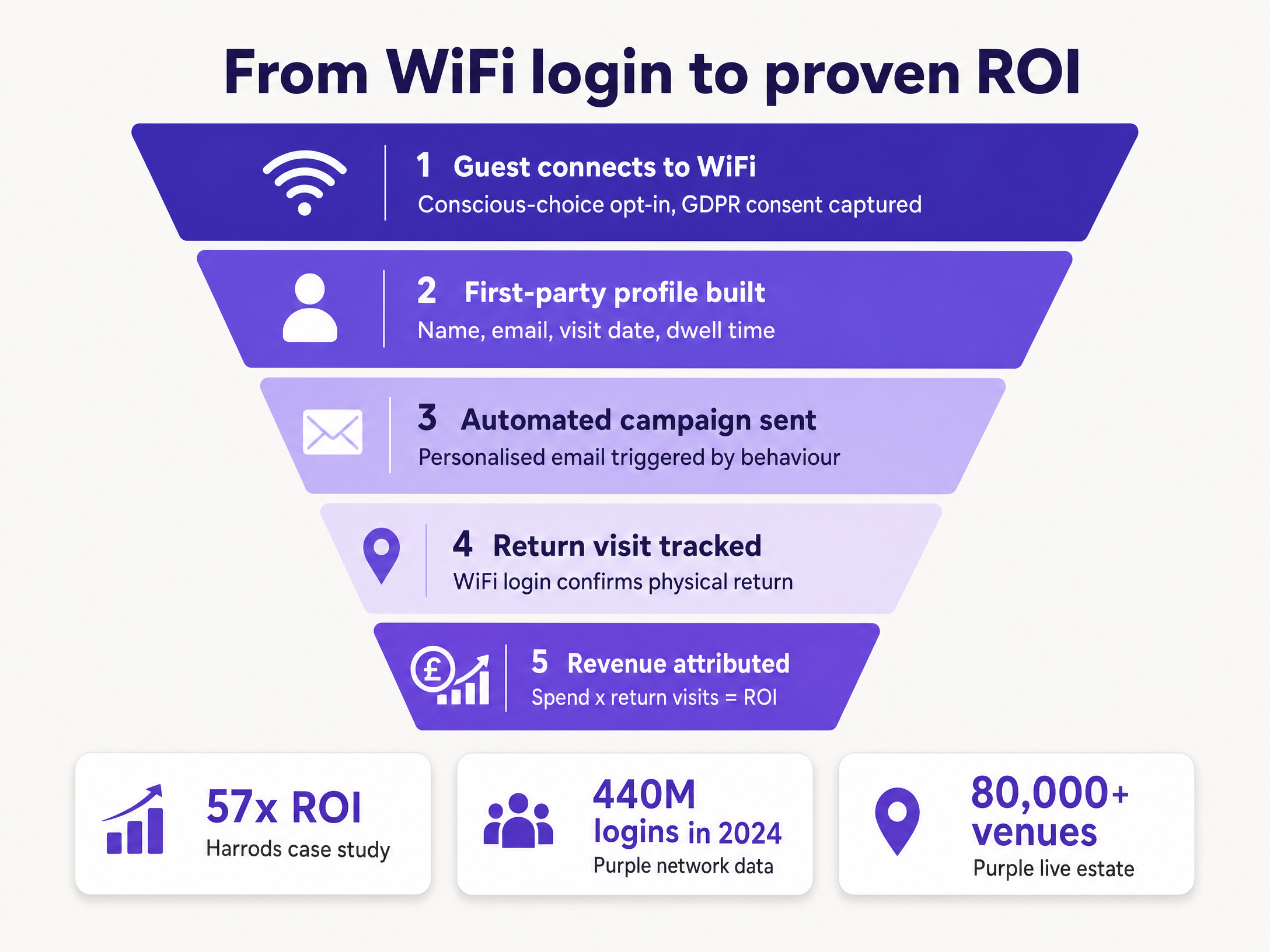
Step 1: Collect first-party data securely
When a customer attempts to access the internet, they are presented with a captive portal (a branded login page). To gain access, they authenticate by logging in with a social account or completing a form. This is where you collect their name, email address and demographic details.
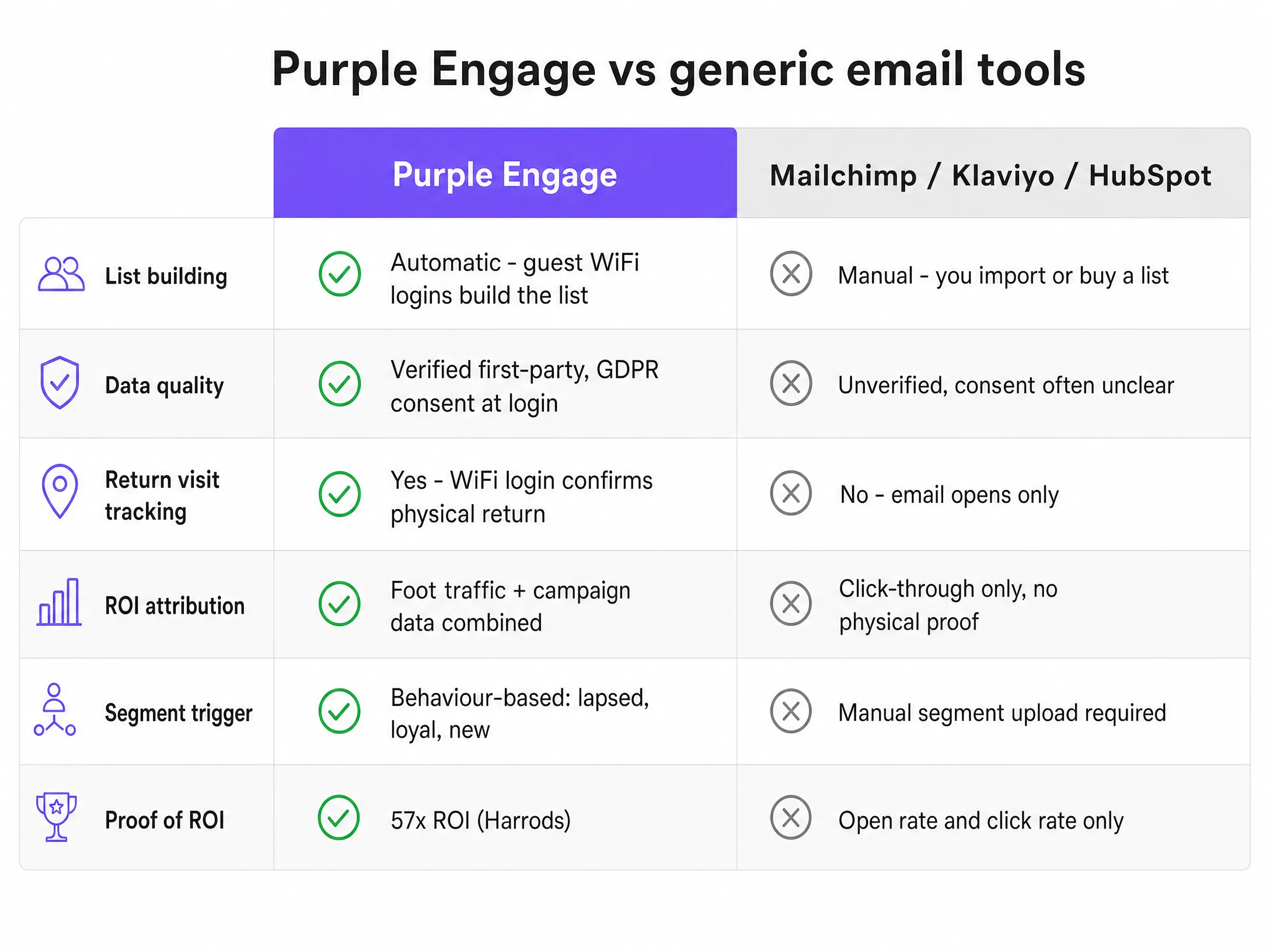
This is a self-selected opt-in. The customer explicitly agrees to your terms and conditions and to marketing communications, ensuring you are fully compliant with GDPR and CCPA. Unlike generic email tools that require you to import lists manually, Purple Engage builds your database automatically, 24/7, every time someone connects. Purple recorded 440 million logins across its network in 2024 (Purple internal data, 2024), demonstrating the scale at which this list-building mechanism operates.
Step 2: Build behavioural profiles
Once a customer has authenticated, Purple tracks their physical behaviour. This allows Purple to record how often they visit, how long they stay, and the specific locations they visit within your venue. Over time, this builds a rich first-party data profile. You will know exactly who your most loyal customers are, who only visits at weekends, and who has stopped coming altogether.
Step 3: Trigger automated campaigns
With Purple Engage, the marketing automation engine is built directly on top of physical data. You can set rules based on customer behaviour. For example, you can create a rule that says: "If a customer has visited three times but has not been seen for 30 days, send them an email with a 20% discount code." The system handles this automatically, targeting the right audience precisely at the most appropriate moment.
What to send and when
The most effective campaigns are triggered by specific physical behaviours. The table below outlines the four core automations every venue should deploy from day one.
| Segment | Trigger | Timing | Goal |
|---|---|---|---|
| First-time visitors | First WiFi login | 24 hours after the visit | Convert to a repeat visit |
| Loyal regulars | 5th cumulative visit within a single month | Same day via the portal, or the next day via email | Increase lifetime value |
| Lapsed customers | No visit within 45 days | Day 46 | Re-engage before they are lost for good |
| Birthday customers | Date of birth collected at login | 7 days before the birthday | Drive group bookings and high-value spend |
The lapsed segment typically delivers the highest and most measurable ROI, because the counterfactual is so clear: without the campaign, those customers were unlikely to come back. When you can show an owner that 340 specific customers returned after receiving a win-back email - people who had not visited in six weeks - that is a number they will believe.
Measuring results
This is where you prove ROI to the owner. Because Purple Engage controls both the sending of the email and the physical network, attribution is seamless.
When you send a campaign to 5,000 lapsed customers, Purple tracks precisely how many of those specific people returned to the venue within the following 14 days. To calculate ROI, you can use a simple formula:
(Return visits from campaign recipients) x (average spend per visit) = revenue attributed to the campaign
Take Harrods as an example. By using Purple to collect Guest WiFi data and trigger targeted campaigns, they achieved a 57x ROI (Purple customer case study, Harrods). They did not need to guess whether the emails worked; they had the physical network data to prove that the people who received the emails genuinely walked back into the store.
This level of attribution changes the conversation with owners. Marketing stops being seen as a cost centre that only produces open rates; it becomes a revenue engine driving verifiable footfall.
{{asset:proving_marketing_roi_to_venue_owners_with_WiFi_data_podcast.mp3}}
How to get started
To implement this strategy and start proving your ROI, follow this checklist:
- Audit your hardware: Confirm that your existing access points (Cisco Meraki, HPE Aruba, Ruckus, Juniper Mist, Ubiquiti UniFi, Cambium, Extreme or Fortinet) are compatible with Purple's cloud overlay system.
- Design the captive portal: Build a branded login experience that explicitly requests GDPR-compliant marketing consent. Pre-ticked boxes do not meet the standard - the opt-in must be an active action.
- Define your segments: Define what "loyal" and "lapsed" mean for your specific venue type and visit frequency.
- Build the automations: Set up the three core campaigns in Purple Engage: Welcome, Birthday and Lapsed.
- Establish a baseline: Let the system run for 30 days before switching campaigns on, so you can record your natural return rate.
- Report revenue outcomes: After the first campaign cycle, use the "return visits multiplied by average spend per visit" formula to present the results to the owner.
For a deeper look at why building your list organically outperforms every alternative, see our companion guide: Why bought email lists fail in physical venues.