
Why purchased email lists fail venues
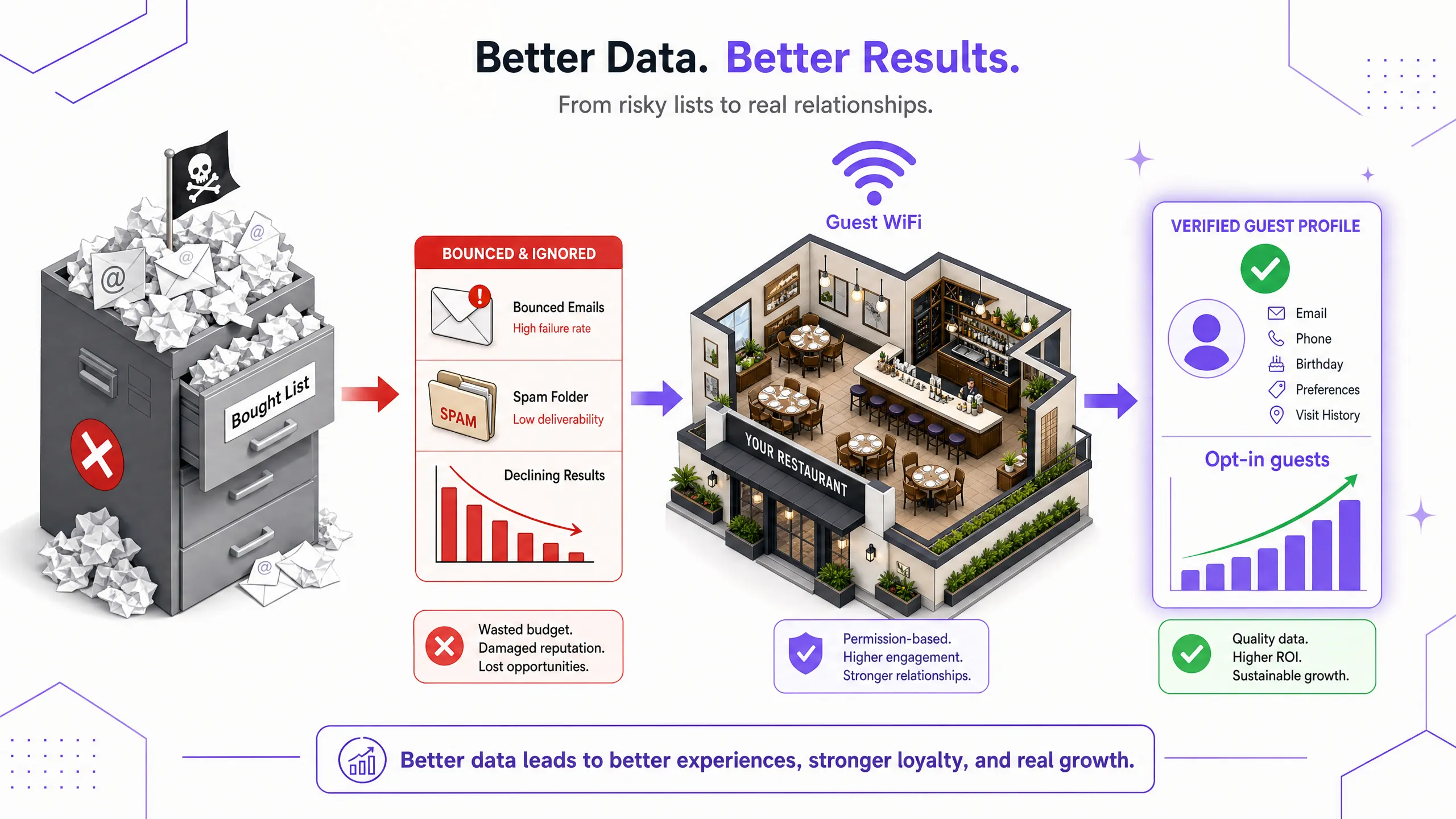
Buying email lists is one of the fastest ways to damage your sender reputation, violate GDPR, and waste marketing budgets. This guide explains the three reasons purchased lists fail physical venues - deliverability, legal compliance, and ROI - and shows how Purple Engage builds a verified, first-party database automatically from your guest WiFi logins, so you never need to buy a contact again.
Why this matters for your venue
Every physical venue has the same core marketing problem. Guests walk through the door, spend money, and leave. You have no way to follow up, no way to bring them back, and no idea who most of them are. So when a list vendor offers ten thousand email addresses of people in your area, it sounds like a shortcut.
It isn't. Buying email lists is one of the fastest ways to destroy your marketing programme. The damage is often invisible at first. Your campaigns still go out. The numbers look plausible. But underneath, your domain reputation is eroding, your emails are landing in spam folders, and your ability to reach the guests who genuinely want to hear from you is being quietly dismantled.
The cost of getting this wrong is not just a wasted campaign budget. Under UK GDPR and the Privacy and Electronic Communications Regulations (PECR), fines for non-compliant email marketing can reach £17.5 million or 4% of global annual turnover, whichever is higher. The ICO enforces these rules, and it does not treat "we bought the list in good faith" as a defence.
This guide covers the three reasons purchased lists fail, and shows how Purple Engage builds a high-performing, first-party alternative directly from your venue's foot traffic.
The approach
1. The deliverability problem
When you send emails to a purchased list, you are sending to people who have never heard of you and never asked to hear from you. Many of those addresses are old, inactive, or invalid. Some are spam traps - email addresses deliberately maintained by internet service providers to identify senders who use scraped or purchased data.
Hitting a single spam trap damages your sender reputation. Hit enough of them, and your domain gets blocklisted. From that point, even your legitimate campaigns - the ones going to guests who have opted in and want to hear from you - start landing in junk folders.
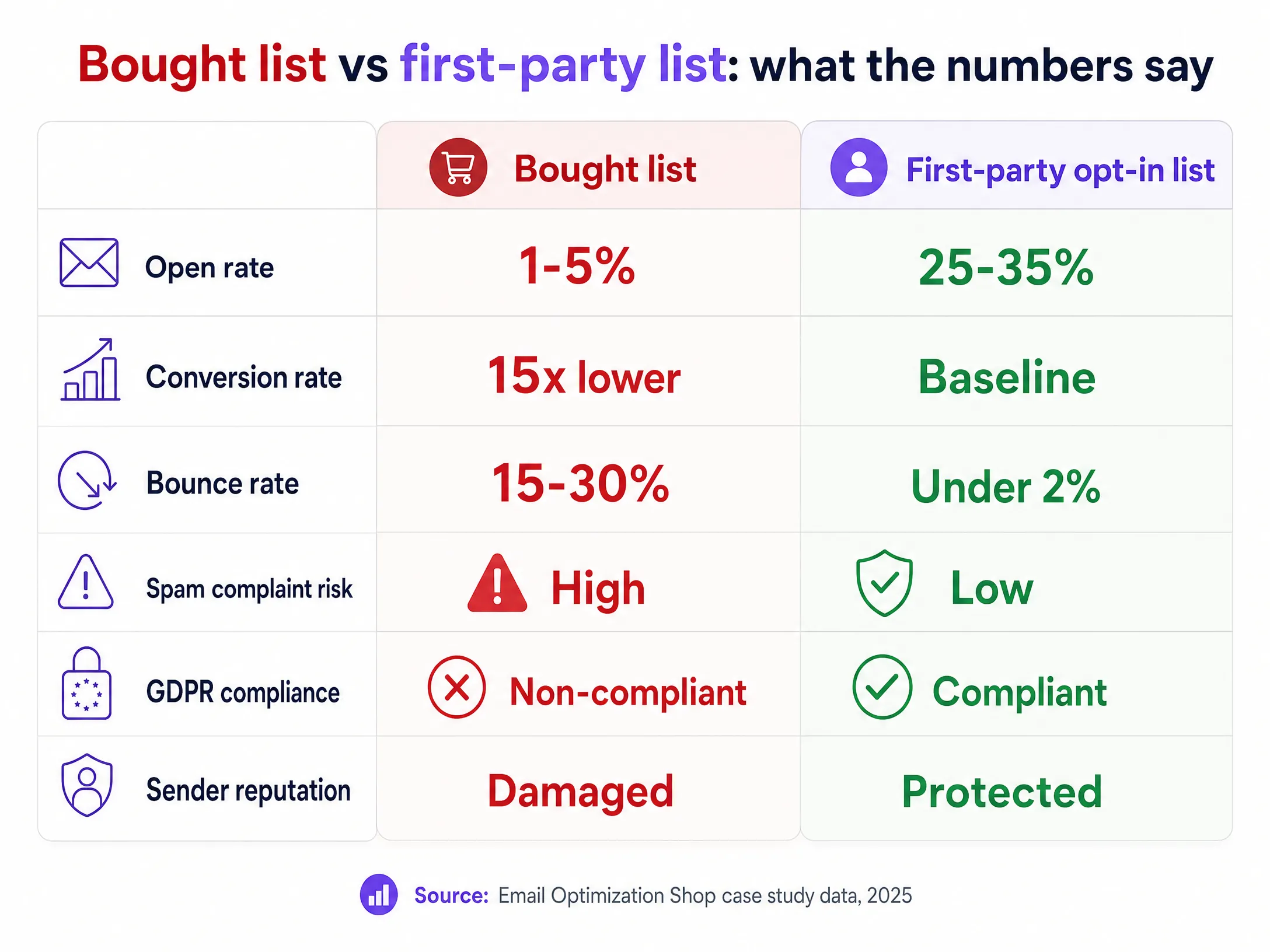
High bounce rates compound the problem. Bought lists typically produce bounce rates of 15-30%, compared to under 2% for a clean, first-party list. Most email providers will suspend your account if your bounce rate exceeds 5%. You have not just wasted the campaign budget. You have damaged your ability to run any future campaign.
The performance data is stark. Research from the Email Optimization Shop, based on a direct head-to-head comparison of opt-in versus non-opt-in segments sent identical campaigns, found that permission-based lists delivered conversion rates up to 15 times higher. Open rates were three times higher. Click-through rates were ten times stronger. This is not a marginal difference. It is the difference between a campaign that drives revenue and one that wastes it.
2. The legal problem
Under UK GDPR, consent to receive marketing emails must be freely given, specific, informed, and unambiguous. It must be given by the individual to your specific organisation. A list vendor cannot secure that consent on your behalf.
Even if a vendor claims their list is "opt-in", that consent was almost certainly given for something entirely different - a competition entry, a different brand's newsletter, or a generic data collection form. That consent does not transfer to your venue. Sending marketing emails on the basis of third-party consent is a violation of GDPR and PECR.
The ICO is explicit on this point. Consent must be "specific to your organisation". Most commercially available email lists fail this test entirely. The practical compliance requirement makes purchasing lists extremely inadvisable for any UK venue operator.
The financial exposure is real. Google was fined €50 million for breaching GDPR's consent requirements. For a venue group, the reputational damage of an ICO investigation can be as costly as the fine itself.
3. The ROI problem
Even setting aside deliverability and legal risk, bought lists simply do not perform. The people on them have no relationship with your venue. They have not visited. They do not know your brand. They have no reason to engage.
HubSpot's 2024 State of Marketing Report found that email marketing ROI dropped 15% for campaigns using third-party lists compared to those using opt-in or first-party data. Permission-based email marketing, by contrast, delivers an average ROI of £36-£44 for every £1 spent, according to research cited by LYFE Marketing.
The arithmetic is clear. A purchased list of 10,000 contacts might cost £500-£5,000. The same spend on building a first-party list through Purple Engage will generate contacts who have already visited your venue, who have actively opted in, and who are far more likely to return.
How to do it with your guest WiFi
The alternative to buying lists is to capture data from the guests already walking through your door. Your venue is your best acquisition channel. You just need a mechanism to collect consent at the right moment.
Purple Engage does this automatically. When a guest connects to your Guest WiFi, they see a branded captive portal - a login page before they access the internet. To connect, they provide their email address and actively tick a box to receive marketing communications from your venue. This is a conscious-choice opt-in. It is fully compliant with GDPR and PECR.
Because Purple integrates directly with enterprise hardware including Cisco Meraki, HPE Aruba, Ruckus, Juniper Mist, and Ubiquiti UniFi, you do not need to replace your existing network infrastructure. The data capture layer sits on top of your current setup.
Every guest who connects becomes a verified profile in Purple Engage. The profile includes their email address, visit history, dwell time, and any additional data they provided at login, such as date of birth or marketing preferences. This is the foundation of a database that builds itself, every day, from your existing foot traffic.
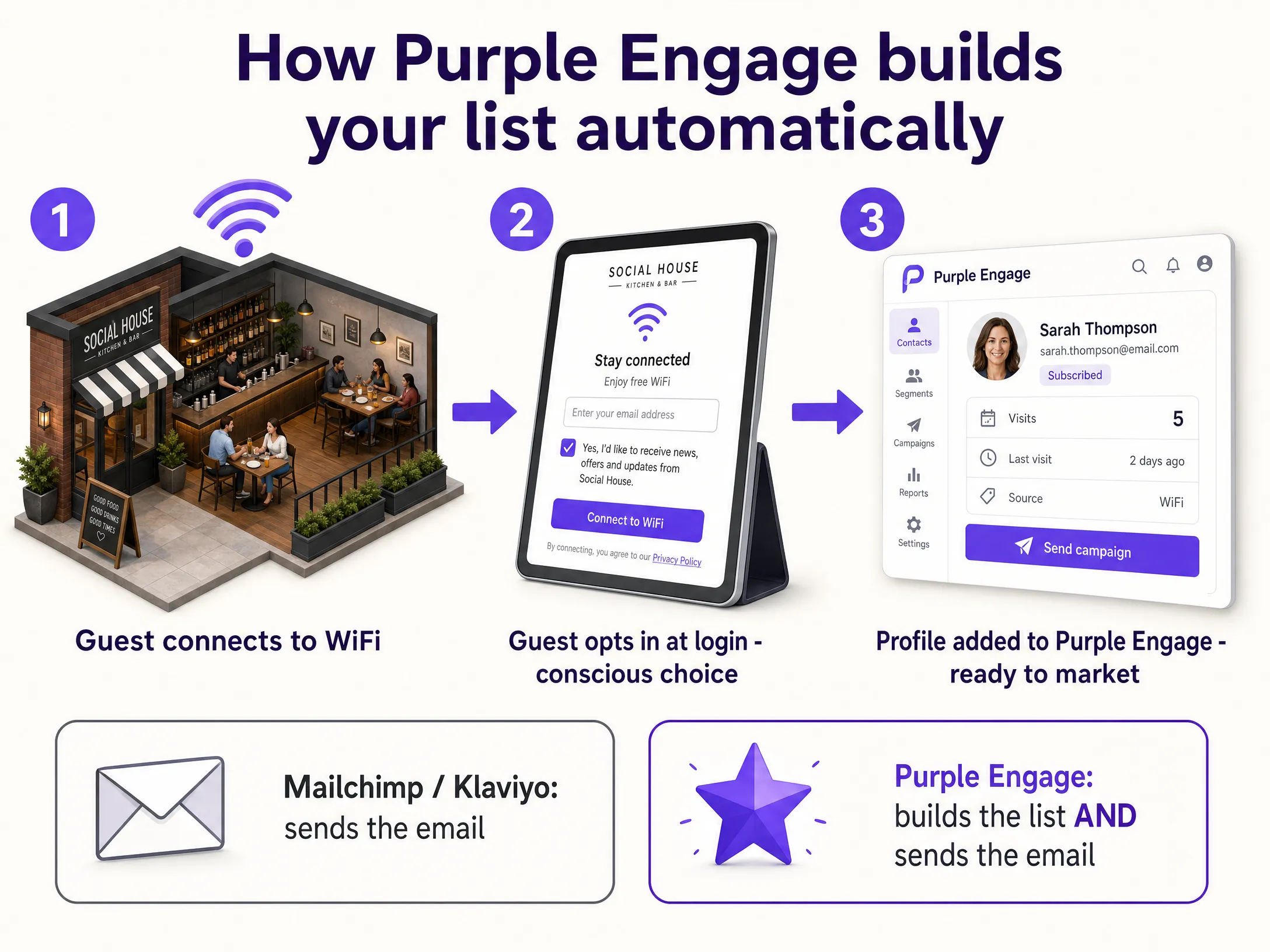
Generic email tools like Mailchimp, Klaviyo, and HubSpot are excellent at sending campaigns. But they rely on you to supply the data. If you supply bad data from a bought list, the platform cannot save you. Purple Engage solves the root problem by building the list before you ever send a campaign.
What to send, and when
Once you have a clean, first-party list, you can segment and automate campaigns based on real venue behaviour.
| Campaign type | Trigger | Audience | Goal |
|---|---|---|---|
| Welcome | 24 hours after first visit | New opt-in guests | Drive second visit |
| Birthday offer | 14 days before birthday | All guests with DOB captured | Increase visit frequency |
| Win-back | 90 days since last visit | Lapsed guests | Re-engage and recover revenue |
| Post-visit survey | 48 hours after visit | All recent guests | Gather feedback and reinforce loyalty |
| Seasonal promotion | Manual or scheduled | Segmented by visit frequency | Drive visits during quiet periods |
For deeper segmentation using visit frequency and dwell time data, see our guide on Using dwell time and visit data to segment venue guests.
Measuring what works
Stop measuring campaign success by open rates alone. Apple Mail Privacy Protection artificially inflates open counts, making them an unreliable metric. What matters for a physical venue is footfall and revenue.
Purple Engage links email campaign data to physical visit data. When you send a campaign to 5,000 guests, the platform tracks how many of those guests return to the venue within a defined attribution window - typically 14 or 30 days. You get a direct read on the revenue generated by each campaign, not just the digital engagement.
This is the fundamental difference between a generic email tool and a platform built for physical venues. Mailchimp tells you who opened the email. Purple Engage tells you who came back.
Where to start
- Stop buying lists. Remove any purchased contacts from your active campaigns immediately. The longer you send to them, the more damage accumulates to your sender reputation.
- Clean your existing database. Suppress anyone who has not engaged with your emails in the last six months. A smaller, engaged list outperforms a large, stale one every time.
- Enable Purple Engage on your WiFi. Configure your captive portal to capture email addresses with a clear, explicit marketing opt-in at login.
- Set up your first three automations. Welcome, birthday, and win-back campaigns cover the majority of repeat-visit revenue opportunity.
- Measure by footfall. Set up attribution windows in Purple Engage to track physical return visits from each campaign send.
Ready to build a list that works? See the Purple Engage product overview or read our guide on Using dwell time and visit data to segment venue guests.