
Customer lifetime value for restaurants and hotels
A practical guide for hospitality marketers on calculating and increasing customer lifetime value (CLV) using verified visit data. Learn how to move from estimated segment averages to individual-level tracking by capturing first-party data through guest WiFi.
Why it matters for your venue
Most hospitality venues spend the lion's share of their marketing budget on acquiring new guests, and spend almost nothing on retaining those they already have. This approach is expensive and inefficient. Research consistently shows that increasing guest retention by just 5% can increase profits by 25% to 95%.
For a restaurant or hotel, customer lifetime value (CLV) is the single metric that makes this argument real. It tells you exactly how much a guest is worth to you overall, for as long as they keep returning to your venue. When you know this number, every marketing decision changes. You stop treating every guest the same. You start investing more in those who are worth more.
How it works
To calculate customer lifetime value, you need three numbers: average visit value, visit frequency, and guest lifespan.
CLV = average visit value × visit frequency × guest lifespan
Average visit value is the average amount of money a guest spends each time they visit. Visit frequency is how many times a guest visits per year. Guest lifespan is how long a guest keeps returning before they stop coming.
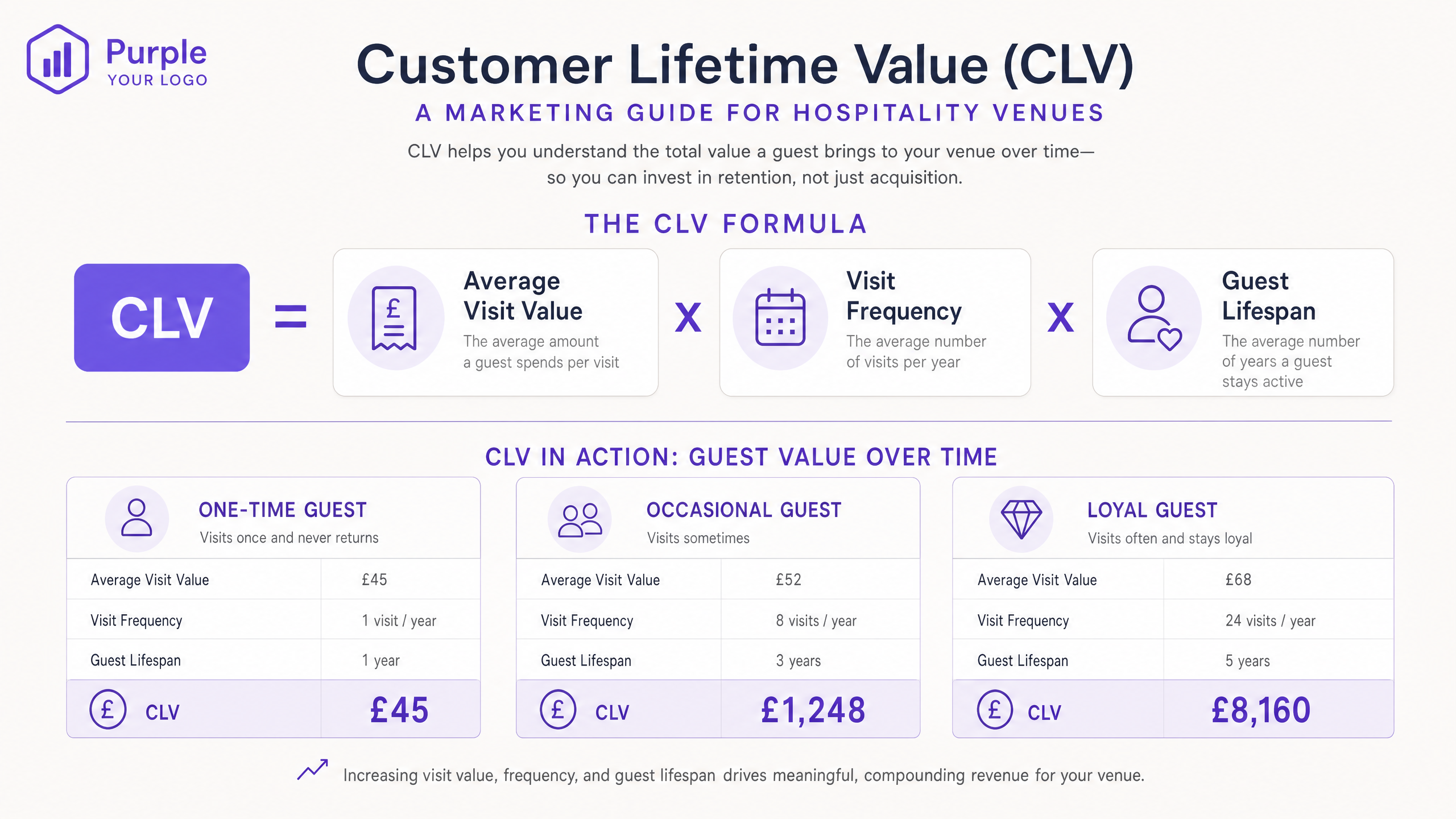
Take a casual dining restaurant, for example. A one-off guest spends £45, visits once, and never returns. Their CLV is £45. A loyal regular guest spends £68 per visit, comes twice a month, and remains active for 5 years. Their CLV is £8,160. That loyal regular guest is worth 180 times more than the one-off guest. Yet most venues market to both in exactly the same way.
The challenge is that most venues estimate CLV at a segment level because they cannot link individual guests to their visit history. POS systems record transactions, not people. Reservation systems record bookings, but miss walk-ins. To calculate CLV accurately, you need verified, individual-level visit data.
How to do this with your guest WiFi
This is exactly where guest WiFi becomes a strategic marketing tool. When a guest connects to your WiFi, they complete a login page. That login captures their name, email address, and consent to receive marketing communications under GDPR.
Purple uses active-choice opt-ins. The guest actively chooses to receive communications. This is a verified, deliberate decision, which means these opted-in guests engage at a significantly higher rate compared to contacts acquired through other means.
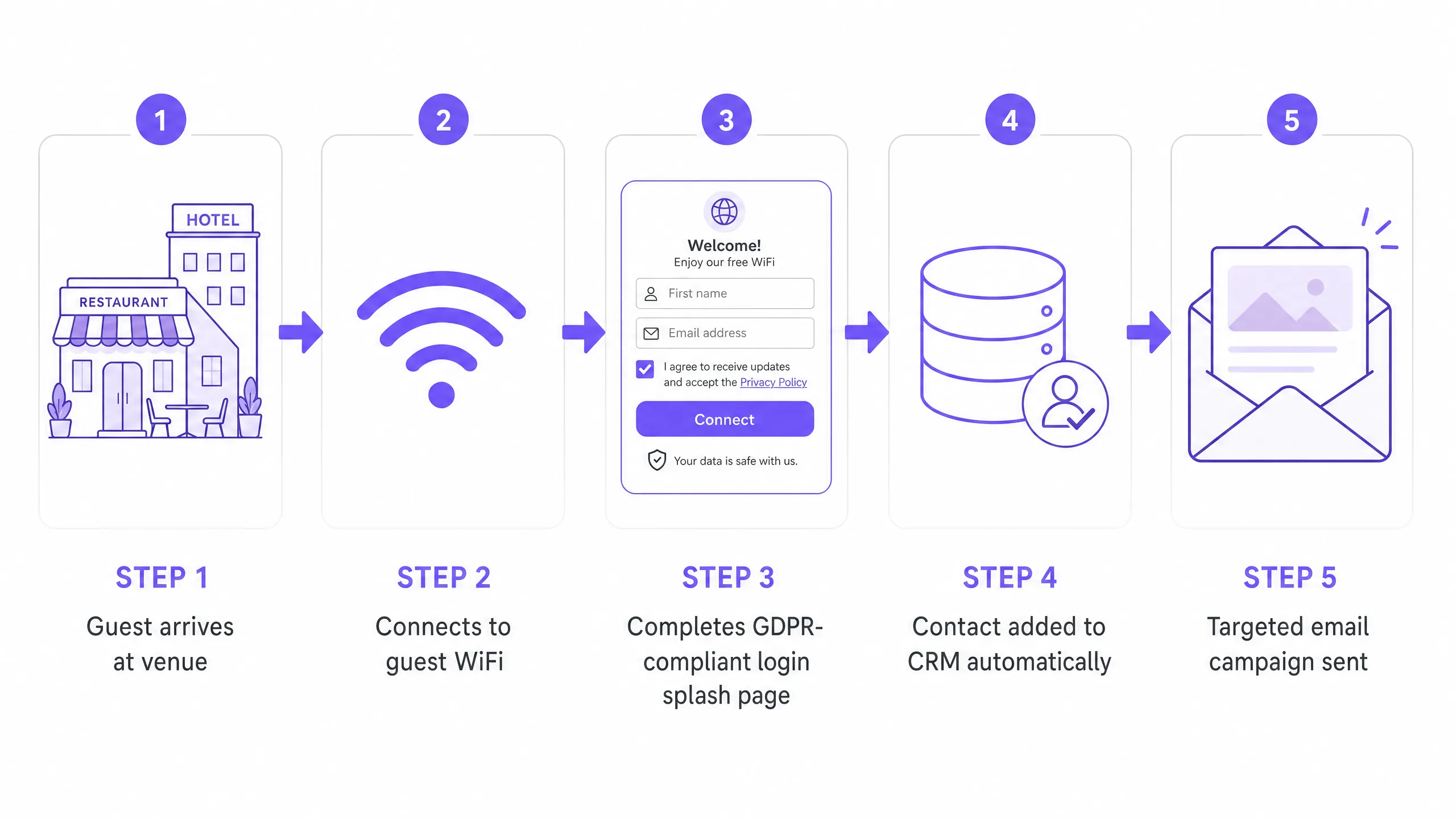
Most importantly, every time that same guest returns and reconnects to your WiFi, Purple links that new visit to their existing profile. You now have a verified record of how many times, on which dates, and at what times that specific individual has visited. This is visit frequency data, captured automatically at the individual guest level.
By pairing this with your POS or PMS data, you can calculate a real CLV for real people. Generic email tools like Mailchimp send campaigns, but they do not build lists or capture visit data. Purple Engage captures first-party data and links it directly to repeat visits.
To learn more about segmentation, read our guide on Using dwell time and visit data to segment venue guests.
What to send and when to send it
Once you have individual-level visit data, you can create segments based on actual behaviour rather than guesswork.
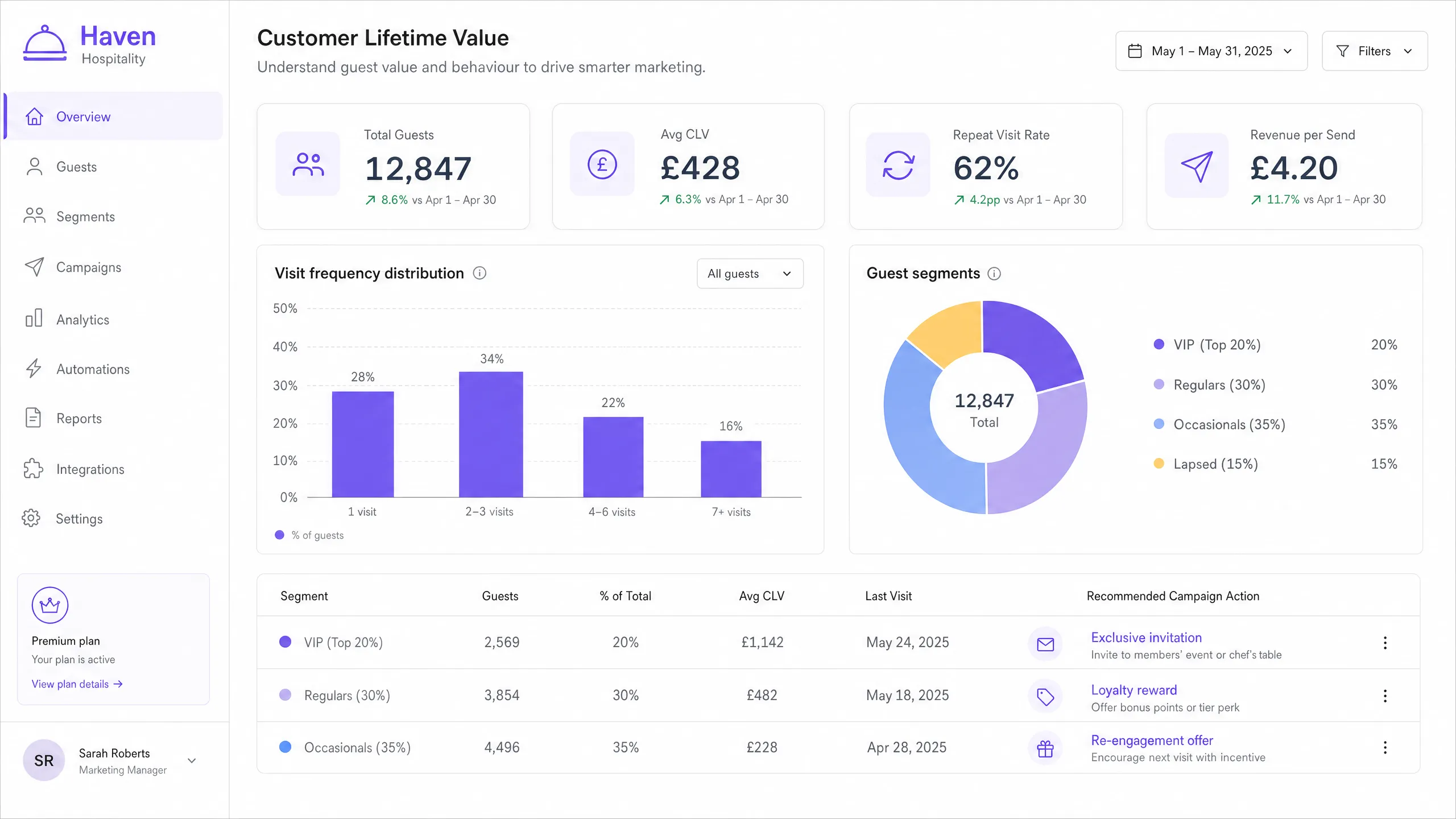
At a minimum, you should create four core segments:
- New guests: Visited once. Send a welcome email 24 hours after their visit.
- Occasional guests: Visited 2-5 times. Send targeted offers to increase their visit frequency.
- Regular guests: Visited 6+ times. Give exclusive rewards or early access to events. Do not offer discounts; they already love your venue.
- Lapsed guests: No visits in 90 days. Send a strong re-engagement offer. Winning back a guest who stopped coming after six visits is far more valuable than acquiring a new guest you have never seen before.
Measuring what works
Do not measure the success of your campaigns by open rates or click-through rates. Measure them by return visits and revenue generated per send.
Because Purple Engage tracks physical visits via WiFi login, you can see exactly how many people received an email on Tuesday and actually walked through your door on Friday. This attribution closes the loop, helping you see which campaigns actually drive footfall and increase CLV.
Where to start
- Audit your WiFi: Ensure you have a captive portal that captures first-party data with GDPR-compliant consent.
- Connect your CRM: Ensure captured data flows automatically into your CRM or marketing platform. See the Purple Engage product overview to learn how this works seamlessly.
- Segment your audience: Group your guests by visit frequency.
- Automate the basics: Set up a welcome campaign for new guests and a re-engagement campaign for lapsed guests.
- Track physical returns: Measure success by actual venue visits, not just email open rates.