
RFM segmentation for restaurants and hospitality
Why this is important for your venue
Sending the same email to every guest on your list is a waste of money and attention. When you send generic offers to your entire database, you teach your best guests to ignore you and give away margin to people who would have come anyway.
The business results of getting segmentation right are measurable: segmented email campaigns generate 760% more revenue than non-segmented broadcasts [1]. For restaurants, the stakes are even higher. An analysis of over 100 million guest records showed that 60% of restaurant revenue comes from repeat guests [2]. If you cannot identify your repeat guests, you cannot protect that revenue.
This is where the RFM segmentation model changes everything. RFM stands for Recency, Frequency, and Monetary value. It is an analytical method that scores your guests based on when they last visited, how often they visit, and how much they spend.
Unlike generic email tools like Mailchimp or Klaviyo that rely on you manually importing lists, Purple Engage builds the list for you. When a guest logs into your Guest WiFi, they authenticate through a Captive Portal. This creates a verified, opt-in, first-party data record. Purple links that collected email directly to the recency and frequency of their visits - exactly the input required for RFM to work.
Methodology
RFM segmentation evaluates three specific aspects of guest behaviour.
Recency is the number of days since a guest last visited your venue. A guest who visited yesterday is far more likely to respond to a message than one who visited six months ago. Recency is the most powerful single indicator of future behaviour.
Frequency is how many times a guest has visited within a specific timeframe, typically the last 12 months. This separates your regulars from transient customers. A guest who visits 15 times a year is a completely different marketing target than one who visits twice.
Monetary value is the total or average spend associated with a guest's profile. This is where you identify those guests who generate a disproportionately high amount of revenue. Studies consistently show that roughly 20% of guests contribute 80% of total revenue [3]. Knowing who those guests are changes how you allocate your marketing budget.
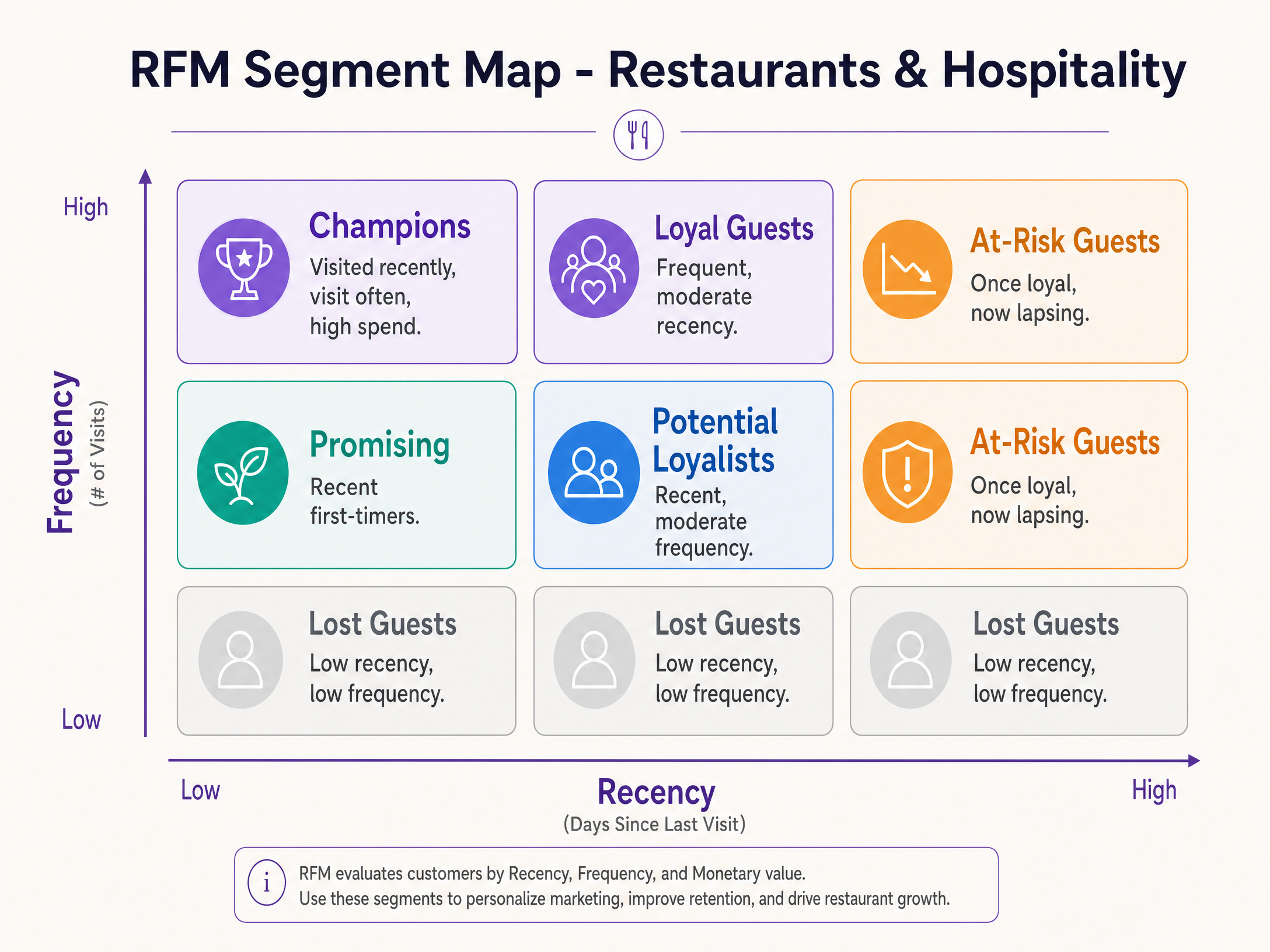
By scoring guests from 1 to 5 on each of these metrics, you create distinct, actionable segments. A guest with high recency, high frequency, and high spend is a Champion. A guest with low recency but historically high frequency is an At-Risk regular, who requires a win-back campaign before they churn completely.
| Segment | Recency | Frequency | Monetary | Action |
|---|---|---|---|---|
| Champions | High | High | High | Exclusive access, VIP recognition |
| Loyal Guests | Medium | High | Medium-high | Reward and retain |
| Potential Loyalists | High | Medium | Medium | Time-limited incentives to build habits |
| At-Risk Regulars | Low | High | High | Strong win-back offer |
| Promising | High | Low | Low | Welcome series, second-visit incentive |
| Lost Guests | Low | Low | Low | Low-cost reactivation attempt |
How to do this with your Guest WiFi
The fundamental flaw in most hospitality CRM strategies is data collection. If you ask staff to request email addresses at the till, or rely on physical comment cards, your data will be sparse and inaccurate. If you rely solely on reservation data, you are capturing only a fraction of the actual footfall.
Purple Engage automates this process using your existing network hardware. We integrate directly with Cisco Meraki, HPE Aruba, Ruckus, Juniper Mist, Ubiquiti UniFi, Cambium, Extreme, and Fortinet. The data capture layer works regardless of the hardware you use.
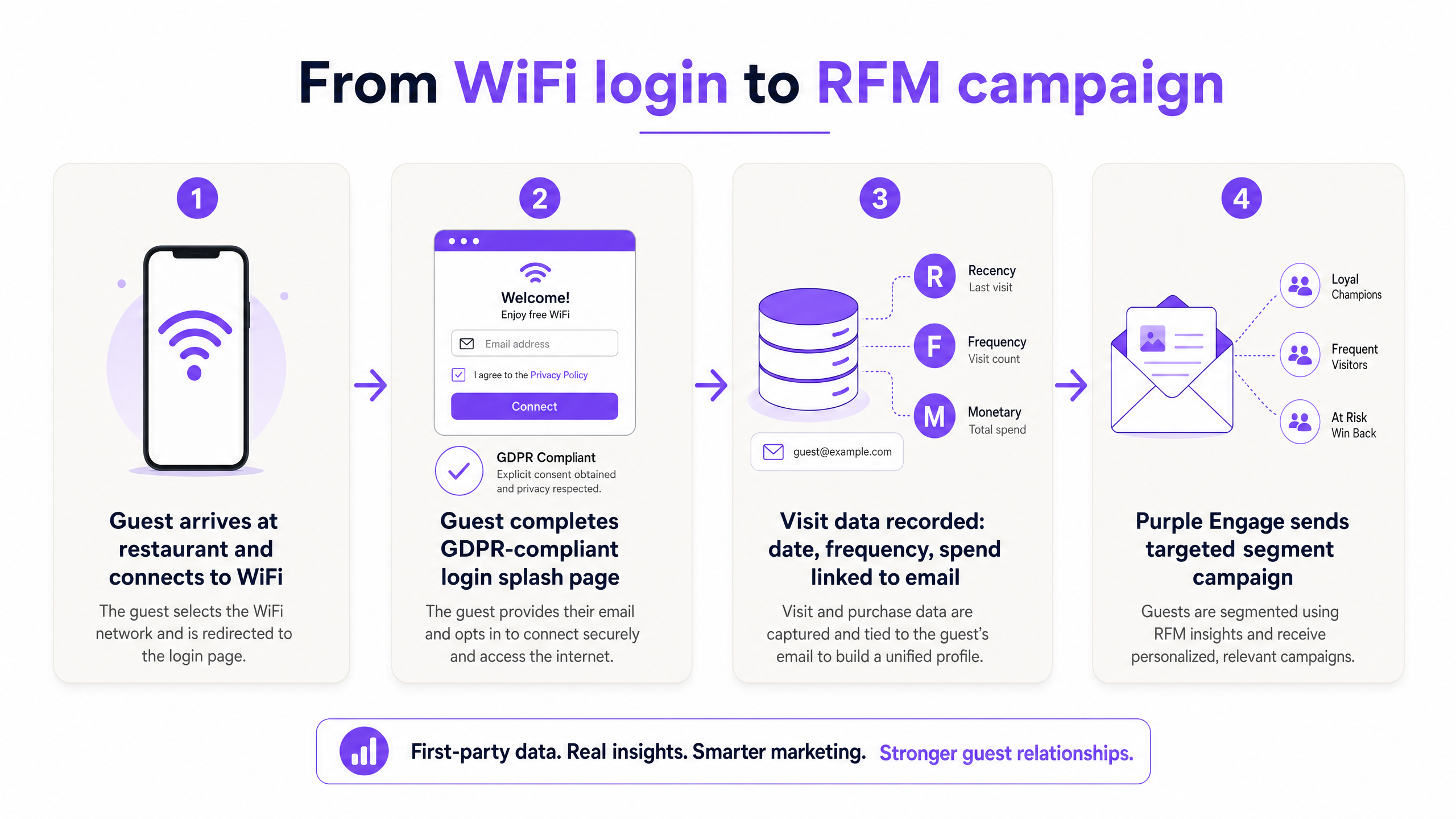
Here is the data capture flow. A guest enters your restaurant and connects to the Guest WiFi. They are presented with a branded Captive Portal and authenticate using their email address. They explicitly consent to marketing, ensuring full GDPR compliance. Purple records the visit, instantly updating their Recency and Frequency scores.
This means your customer list builds itself. You no longer have to guess how often someone visits; the network confirms it. Every return visit automatically updates the guest's profile, creating a rich behavioural record without any manual data entry.
The key differentiator is that tools like Mailchimp or HubSpot can send campaigns, but they do not build lists. You have to import contacts manually. Purple builds lists from real physical visits, with verified consent attached to every record.
What to send and when
Once Purple Engage categorises your guests, you will set up specific automations for each segment. The tone and offer must align with the segment's relationship with your venue.
Champions (High R, High F, High M) are your best guests. Do not send them discounts; they already value your offering at full price. Sending a 20% discount voucher teaches them to wait for the next voucher. Instead, send exclusive access. Invite them to a menu-tasting evening. Offer priority booking for peak dates. Give them a complimentary off-menu item on arrival. The goal is recognition, not acquisition.
Potential Loyalists (High R, Medium F, Medium M) have visited recently and a few times before. They are building a habit. A well-timed nudge converts a casual visitor into a regular. Send a time-limited incentive to return within 14 days - for example, a complimentary starter on their next visit. You are not discounting the experience; you are accelerating the habit.
At-Risk Regulars (Low R, High F, High M) used to visit often and spend well, but have not been seen for 60 days. Use your strongest financial incentives here. A significant offer - such as 25% off their next bill, or a complimentary bottle of wine with dinner - is justified because the cost of that discount is far lower than the cost of acquiring a brand-new high-value guest.
For a detailed comparison of platforms that can run these campaigns, read Best email marketing software for restaurants compared.
Measuring what works
Do not measure success by open rates alone. A 32% open rate is the industry average [4], but open rates do not pay the rent.
You must measure return visits and incremental revenue. Because Purple Engage tracks physical presence via the Guest WiFi network, you can measure exactly how many people received an email and then physically returned to your venue. This closes the attribution loop in a way that standard email tools cannot.
Track segment conversion rates - the percentage of guests within a specific RFM segment who physically return after receiving a campaign. A well-run RFM campaign targeting high-value segments should achieve an 8-12% conversion rate for return visits [5]. If your At-Risk campaign wins back 10% of lapsed regulars, you can calculate exactly how much revenue was saved based on their historical Monetary score.
Loyalty programme members spend 38% more per visit than walk-ins [6]. Guests enrolled in loyalty programmes generate 12-18% more incremental revenue annually compared to non-members [7]. RFM segmentation is the process that makes these numbers achievable at scale.
For the full capabilities of the platform, see the Purple Engage product overview.
Where to start
Implementing RFM segmentation does not require a data science team. Follow these steps.
- Audit your network: Ensure your hardware (Cisco Meraki, HPE Aruba, Ruckus, or equivalent) is configured to route guest traffic through Purple.
- Configure the portal: Create a clean, GDPR-compliant login splash page with a clear marketing opt-in checkbox and a visible privacy policy link.
- Let the data build: Allow Purple to collect visit data for 30 days to establish baseline Recency and Frequency scores.
- Create your first segment: Isolate At-Risk guests who have not visited for 45 days but had a Frequency score of three or more visits in the preceding 12 months.
- Launch a win-back campaign: Send a single automated email with a strong financial incentive. Keep the messaging direct and personal.
- Measure physical return: Track how many of those guests log back into the WiFi within 14 days of receiving the email. That number is your campaign's conversion rate.
References
[1] Digital Applied, "Email Marketing Statistics 2026: 200+ Essential Data," 2026. [2] GoFoodservice, "Restaurant Loyalty Programs | Build Repeat Business," Feb. 2026. [3] Putler, "RFM Analysis," 2025. [4] Mailmend, "30 Open Rate Statistics for Email Marketing," Feb. 2026. [5] Zigpoll, "RFM Analysis Implementation Metrics That Matter for Hotels," 2026. [6] Paytronix, "7 Stats Showing the Effectiveness of Loyalty Programs," Nov. 2025. [7] Deliverect, "Loyalty Programs for Restaurants: Stats and Trends 2024," Aug. 2024.