
The best email marketing software for restaurants, compared
This guide compares send-only email tools like Mailchimp and Klaviyo against build-and-send platforms like Purple Engage. It explains how restaurant operators can automatically build high-quality, GDPR-compliant email lists from Guest WiFi logins and track actual return visits to prove marketing ROI.
Listen to the audio briefing:
Why this matters for your venue
Most restaurants invest time and money in email marketing, but they fail to ask the most critical question: where does the list actually come from? You can sign up for Mailchimp, Klaviyo, or HubSpot, design a beautiful template, and configure an automation sequence. But if your list contains 300 people who signed up on your website two years ago - half of whom have never actually visited your restaurant - your return on investment collapses. The tool is ready, but the list isn't.
According to industry data, restaurant email marketing returns approximately $42 for every dollar spent [1]. That makes it one of the highest-ROI channels in hospitality marketing. However, that figure assumes you are sending campaigns to people who know your brand, have visited your venue, and have a reason to come back. If your list is thin, stale, or full of people who have never set foot in your restaurant, that ROI evaporates. The core problem is that most venues evaluate tools based on features like drag-and-drop builders or A/B testing, but they never address the upstream challenge of building a list of verified guests.
So the question isn't just "which email tool should I use?" but "which tool helps me build the list as well as send to it?"
The solution
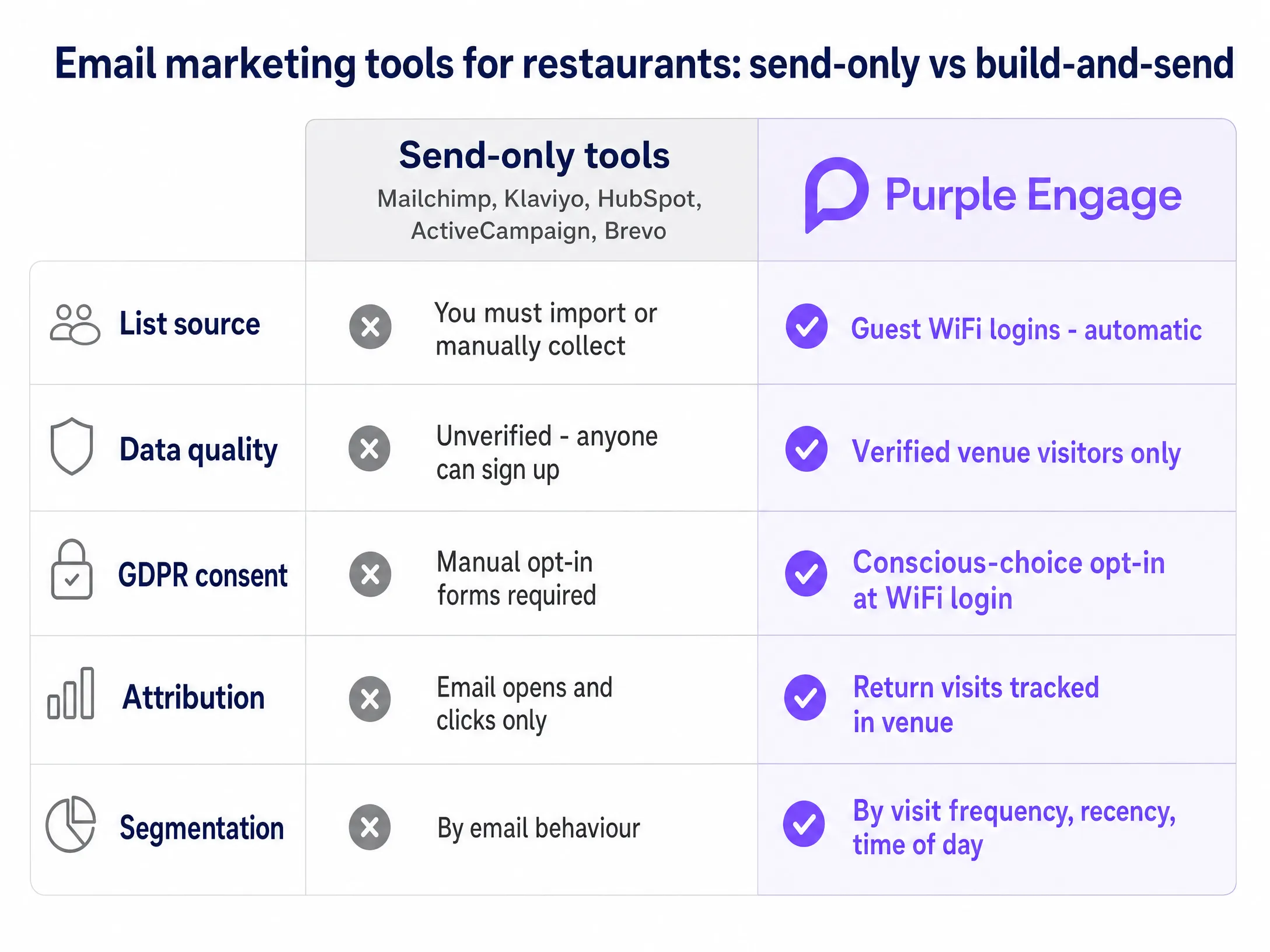
There are two distinct types of email marketing tool for restaurants: send-only tools and build-and-send tools.
Send-only tools - such as Mailchimp, Klaviyo, HubSpot, ActiveCampaign, and Brevo - make up the vast majority of the market. These platforms are excellent at sending campaigns. They offer sophisticated automation, strong deliverability, and detailed analytics. However, they won't build your list for you. You have to import contacts manually, or rely on website popups and till-side sign-ups. If you already have a large, high-quality list of verified guests, these tools perform well. But if you are starting from zero, or your list is small, a send-only tool gives you a powerful engine with no fuel.
Build-and-send tools capture guest data at the moment guests arrive at your venue - typically via a Guest WiFi login - and feed those contacts directly into a CRM and email automation system. The list builds itself automatically, every day, from every guest who connects to your WiFi. Purple Engage falls into this category. It combines Guest WiFi data capture with email marketing automation built specifically for physical venues.
How to achieve this with your Guest WiFi
The mechanics of list building matter. A guest arrives at your restaurant and connects to the WiFi. They see a branded splash page carrying your logo and colours. On that splash page is a clear, simple opt-in. The guest enters their email address and ticks a box confirming they are happy to receive marketing emails from you. This is a conscious-choice opt-in. They actively choose to receive your messages, which fully satisfies GDPR's requirement for freely given, specific, informed, and unambiguous consent.
Once they connect, their profile is created in Purple Engage. The platform records when they visited, how long they stayed, whether they have been before, and what time of day they tend to visit. This context lays the foundation for effective personalisation.
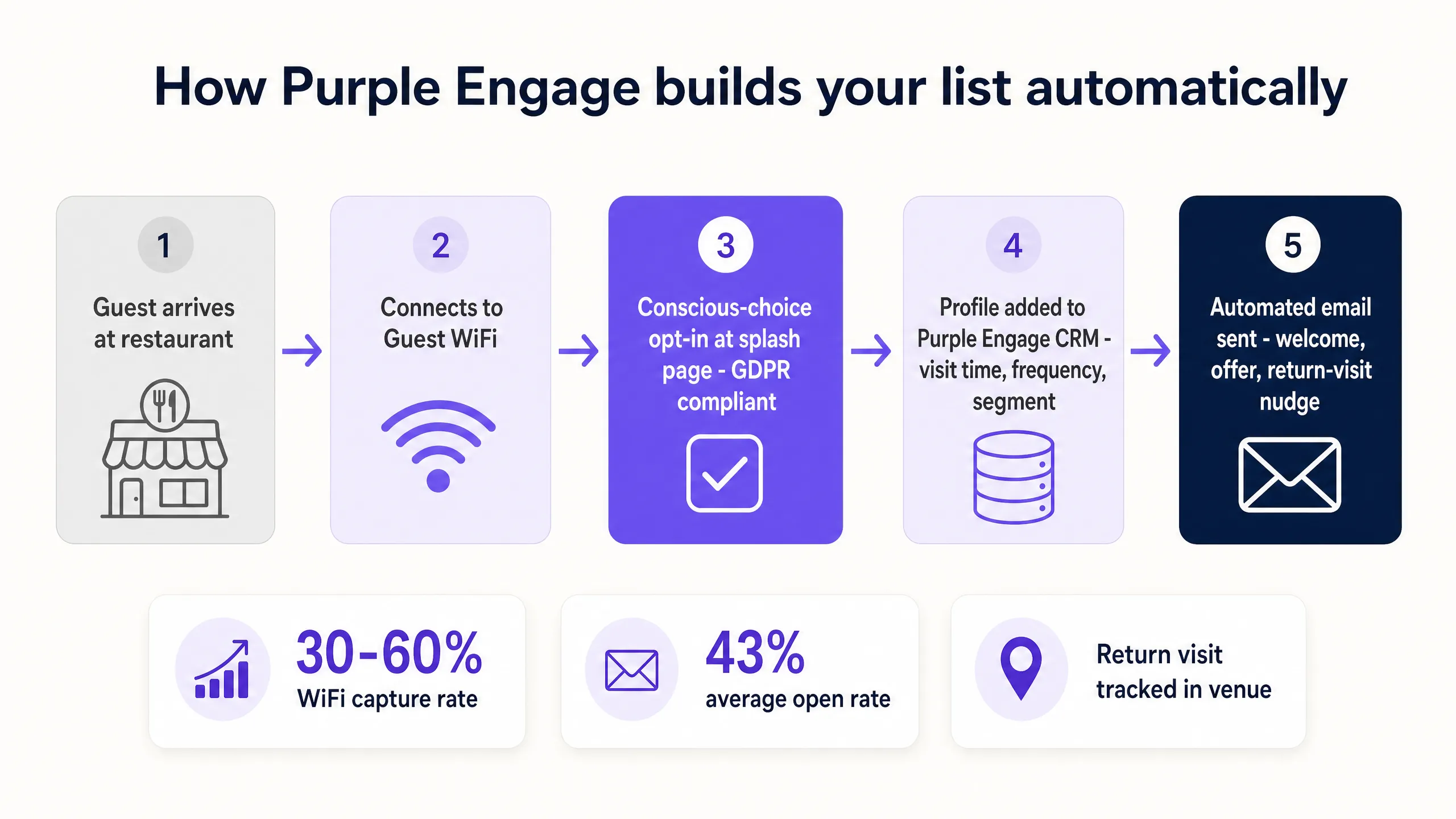
A venue with 200 visitors a day and a 50% WiFi capture rate builds a list of 36,500 opted-in guest contacts in a single year. Real-world capture rates typically range between 30% and 60%. If you operate five sites, you will capture more than 180,000 verified visitor contacts per year. By comparison, website popups convert just 1% to 3% of visitors, and the people they capture may never have visited your venue. WiFi capture rates are 10 to 100 times higher than any other method, and the quality of the contacts is fundamentally different, because they are verified, in-venue guests.
What to send, and when
Once a guest profile is created, automated sequences drive engagement without any manual effort. Within minutes of connecting, an automated welcome email goes out. Within 24 hours, the system sends a review request. On day 21, it sends a return-visit nudge, typically including an offer. The sequence runs automatically for every guest who opts in.
Beyond automated sequences, segmentation is essential. Don't treat email marketing as a broadcast channel. Sending the same message to everyone on your list, regardless of their visit history, depresses engagement. A guest who visited once six months ago needs a very different message from a guest who visits every week. You can segment your list by visit frequency, recency, and time of day. Morning visitors receive a coffee offer, for example, while evening visitors receive a dinner special. The data to make these distinctions is captured automatically in your WiFi logs.
Measuring what works
The most common trap in restaurant email marketing is measuring success by open rates and click rates alone. Open rates tell you how effective your subject lines are. Click rates tell you how relevant your content is. But neither metric tells you whether the guest actually came back to your restaurant.
Return-visit rate and incremental revenue per send are the metrics that truly matter. Purple Engage tracks return visits by detecting when a guest reconnects to your WiFi after receiving a campaign. This delivers closed-loop attribution, something send-only tools simply cannot do. You can see exactly how many guests returned to your venue as a direct result of an email campaign.
To see how this compares with generic tools, read our related guides: Mailchimp for hotels: where it falls short for venues and Mailchimp for hotels: where it falls short for venues (Spanish).
How to get started
- Audit your current list. Establish how many contacts you have, when they last visited, and what proportion have opened an email in the past 90 days.
- Choose your approach. Decide whether you need a send-only tool for an existing high-quality list, or a build-and-send tool to grow a list of verified guests.
- Configure your splash page. Make sure your Guest WiFi opt-in is clear, separate from the WiFi access terms, and fully GDPR-compliant via a conscious-choice checkbox.
- Deploy the automation. Set up the three-email sequence: a welcome email, a review request after 24 hours, and a return-visit nudge after 21 days.
- Segment from day one. Tag first-time visitors and regulars differently, track visit frequency, and identify your VIP guests so you can send targeted, highly relevant campaigns.
References
[1] Stripo. "Restaurant email marketing statistics: how emails drive reservations, loyalty, and revenue." https://stripo.email/blog/restaurant-email-marketing-statistics-how-emails-drive-reservations-loyalty-and-revenue/