Engage
Comparisons

Purple Engage vs Mailchimp: what venue marketers need to know

This guide compares Purple Engage with Mailchimp for marketing directors and owner-operators at physical venues. It explains why a purpose-built venue CRM that captures first-party contacts from Guest WiFi logins outperforms a generic email tool that can only send campaigns. The core argument: Mailchimp sends the campaign, but Purple Engage builds the list first.

6 min read1,318 words

Why this matters for your venue

Physical venues face a marketing challenge that online businesses do not. Foot traffic does not automatically translate into digital contacts. If 1,000 people visit your restaurant, hotel, or retail store today, how many can you email tomorrow? For most venues, the honest answer is close to zero.

Generic email tools like Mailchimp are built to send campaigns. They assume you already have a list. They do not help you build one from the guests physically standing in your venue right now. This forces venue marketers to rely on manual sign-ups, paper forms, or online booking integrations that capture only a fraction of actual visitors.

Purple Engage solves the list-building problem first. It turns your existing hardware into a first-party data capture engine. When a guest connects to your WiFi, they authenticate via a captive portal, providing a verified email address and GDPR-compliant consent. The list builds itself. You capture the contact, the location, the visit frequency, and the dwell time, then trigger automated campaigns based on that real-world behaviour.

The business outcome is measurable. Venues using Purple capture contacts at an average cost of £0.28 per lead, compared to £6-12 on paid social (Purple internal data, 80,000+ venues). More importantly, they build a database of verified, conscious-choice visitors who actually walked through the door.

The approach

The core difference between Purple Engage and Mailchimp is the source of the data.

Mailchimp is a broadcast mechanism. You upload a CSV, connect an ecommerce integration, build a template, and hit send. It is highly effective at delivering the message, but it knows nothing about the physical world. It cannot tell you if the recipient visited your venue three days after receiving the email, or if the campaign drove a single return visit.

Purple Engage is an Identity-Based Network. It links the physical visit to the digital identity. The approach runs in three steps.

Step 1 - Capture at the source. The captive portal captures the email address and GDPR-compliant consent before granting network access. The guest makes a deliberate, conscious choice to opt in.

Step 2 - Verify the identity. Purple verifies the email address in real time. Without verification, expect roughly 17% of captured addresses to be invalid. With Purple's Verify add-on, database accuracy improves by 83% (Purple internal data).

Step 3 - Trigger the action. The system sends automated, visit-based campaigns: a welcome email 30 minutes after a first login, a loyalty enrolment prompt after a third visit, or a win-back offer after 60 days of absence.

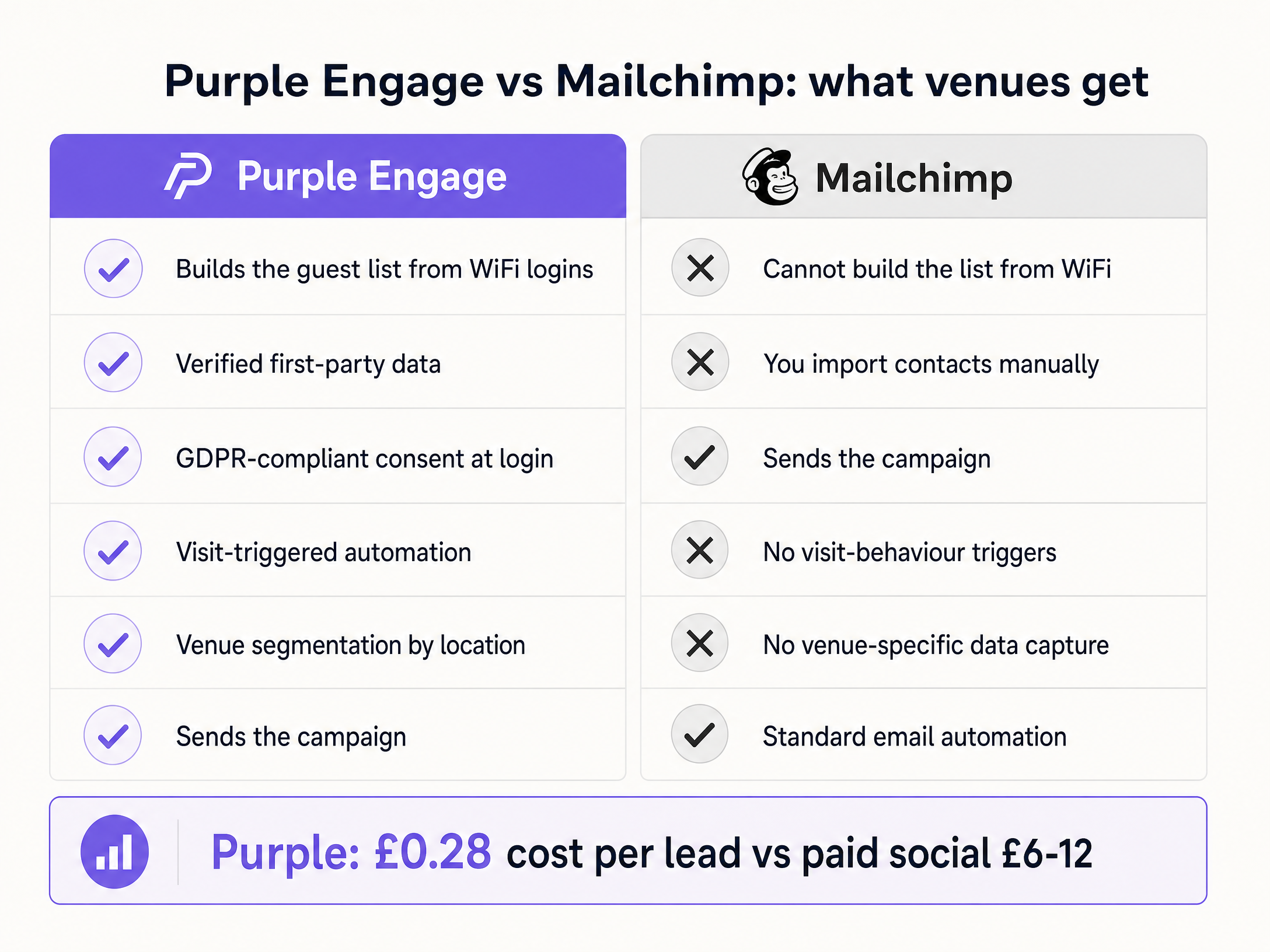
Comparison chart

The table below summarises where each tool operates.

Capability Purple Engage Mailchimp
Builds the guest list from WiFi logins Yes No
Verified first-party data Yes Depends on your import
GDPR-compliant consent at login Yes, built in Your responsibility
Visit-triggered automation Yes No
Venue segmentation by location Yes No
Sends the campaign Yes Yes
Standard email automation Yes Yes
CRM integration Yes, 400+ connectors Yes

How to do it with your guest WiFi

To build the list from your WiFi, you do not need new hardware. Purple is a hardware-agnostic cloud overlay. It integrates with Cisco Meraki, HPE Aruba, Ruckus, Juniper Mist, Ubiquiti UniFi, Cambium, Extreme, and Fortinet.

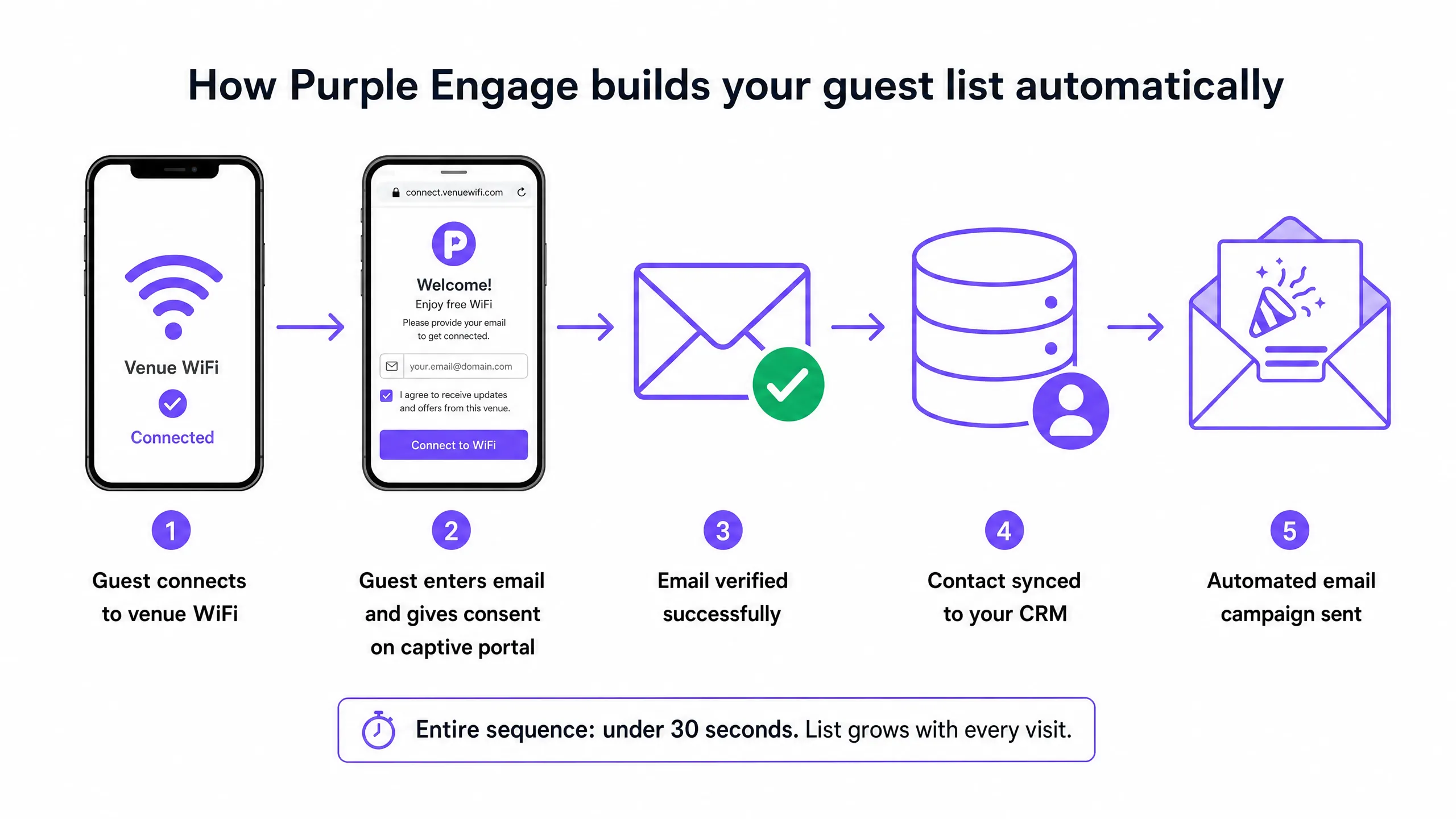
When a guest selects your network, the captive portal appears. This is the value exchange: you offer secure, fast internet access; the guest provides their email address and actively checks the marketing consent box. The consent is recorded with a timestamp, IP address, and version of the consent statement - exactly what GDPR requires.

Because this happens at the network level, the data is clean. The device identifier ties to the email address. When that device returns to any venue in your estate, Purple recognises it automatically. You do not need to ask for their email again. The system logs the repeat visit and updates the customer profile.

Wifi login flow

This is how Pizza Express captured 3.7 million guests into their CRM in two years. It is how Harrods drove over 4,400 sign-ups through Guest WiFi alone, achieving a 57x return on investment. The list does not require a campaign to grow. It grows with every visit.

For a deeper look at the mechanics, see our guide on how to build an email list from your WiFi (without buying one).

What to send, and when

With Mailchimp, you segment by open rates or click rates. With Purple Engage, you segment by physical behaviour. This enables highly specific, automated campaigns that respond to what guests actually do.

The welcome campaign. Trigger an email 30 minutes after a guest connects for the first time. Thank them for visiting. If they are in a hotel, include the digital compendium. If they are in a retail store, offer a 10% discount valid for the next 24 hours. If they are in a restaurant, invite them to join the loyalty programme.

The win-back campaign. Identify guests who visited three times in a month but have not returned in 60 days. Send an automated offer. Because Purple tracks physical presence, you know exactly when they return, allowing you to measure the precise ROI of the campaign.

The cross-venue campaign. If you operate multiple locations, identify guests who frequently visit one venue but have never visited another. When they connect at the new location for the first time, trigger a message acknowledging their loyalty across the estate.

The loyalty enrolment trigger. After a guest's third visit, send an automated email inviting them to join your loyalty programme. Guests who have visited three times are significantly more likely to enrol than first-time visitors.

For sector-specific campaign ideas, see our guide on email marketing for restaurants: a practical guide.

Measuring what works

Mailchimp measures success in opens and clicks. Purple Engage measures success in return visits and revenue.

When you send an email through Purple, the system tracks who received it. Because Purple also monitors the physical network, it knows if the recipient walked into your venue three days later. This closes the attribution loop. You are no longer estimating whether your email marketing works; you can see the foot traffic it generates.

Avanti West Coast used Purple to promote upsells throughout the WiFi journey, achieving 3,744 purchases and a 463% ROI. They tracked the exact path from WiFi connection to purchase because the data existed at both ends of the journey.

The metrics to track are:

Metric What it measures
Opt-in rate Percentage of WiFi connections that become verified contacts
Cost per lead Total platform cost divided by new contacts captured
Return visit rate Percentage of contacts who physically return within 30 days of a campaign
Revenue per send Total incremental revenue attributed to a campaign send
Lifetime value uplift Difference in spend between guests in the CRM vs anonymous visitors

Where to start

  1. Audit your hardware. Confirm your access points are on the compatible hardware list. Purple works with Cisco Meraki, HPE Aruba, Ruckus, Juniper Mist, Ubiquiti UniFi, Cambium, Extreme, and Fortinet.
  2. Design the portal. Create a branded captive portal. Keep the form simple: name, email, and a clear GDPR-compliant consent checkbox. Simpler forms achieve higher opt-in rates.
  3. Set the welcome trigger. Build one automated email that fires when a new guest connects. This single automation will outperform any batch newsletter sent to an unverified list.
  4. Monitor the capture rate. Track how many daily visitors convert into verified contacts. A well-configured portal typically achieves a 40-65% opt-in rate (Purple internal data, 80,000+ venues).
  5. Expand the automations. Once the list is building automatically, add win-back and loyalty campaigns.