
Digital Marketing for Hotels: An Action Plan That Works
Digital marketing for hotels explained through channels, segmentation, journeys and holdout measurement so you can prove what actually drives bookings.
Hotel digital marketing looks like a channel problem, but the problem is measurement. In hotel groups, the same reservation can mean new acquisition, OTA-to-direct migration, repeat retention, or demand pulled forward, and those are not the same commercial outcome. When direct bookings and OTA bookings each represented 21% of total bookings in a 2025 survey of more than 21,000 properties, 700 brands, and 310 cities, attribution stopped being a side issue and became the strategy itself, because moving an existing guest from one channel to another isn't the same as creating new demand (survey summary).
That's why the useful starting point isn't SEO, email, or paid media. It's a measurement model that separates revenue you would have captured anyway from revenue that marketing genuinely created. If you want a practical channel checklist after that, Carlos Alba Media's hospitality playbook is a useful reference point, but the better question is whether your current campaigns can prove incrementality before they scale.
Table of Contents
- Why Hotel Digital Marketing Needs a Different Starting Point
- Building a Single Guest Record You Can Segment
- Choosing Between Email, SMS and WhatsApp for Each Job
- Designing Journeys Around Intent Not Blast Size
- Coordinating Paid Search, Metasearch and Social Ads
- Proving Incrementality With Holdouts and Control Groups
- A 90-Day Rollout Plan and Governance Checklist
Why Hotel Digital Marketing Needs a Different Starting Point
Most hotel marketing teams still inherit a familiar pattern. They buy traffic, send campaigns, publish content, and then judge success by clicks, opens, and last-click bookings. That feels productive, but it hides the central commercial question, how many of those bookings would have happened without the campaign?
The attribution gap is large because hotel demand is split across direct and third-party channels. Direct bookings represented 32% of hotels' online revenue in 2023, up 7 percentage points from 2019, and hotel websites generated 29% of online revenue on average according to D-EDGE's 2024 Hotel Distribution Report (report). That mix means a booking isn't automatically a win for one channel or another, it can be a shift in route to purchase rather than a gain in total demand.
The four outcomes that matter
The cleanest way to read hotel digital marketing is through four outcomes:
- New-to-brand acquisition, a guest who hasn't booked before and arrives through digital discovery.
- OTA-to-direct migration, a guest who would have booked, but does so on the brand site instead.
- Repeat retention, a returning guest who books again because your messaging stayed relevant.
- Demand pulled forward, a stay that would have happened later but gets booked earlier.
Those outcomes lead to different budget decisions. A campaign that moves a repeat booker to the direct site may still reduce commission, but it doesn't create the same value as a campaign that brings in a new guest who hadn't considered the property. A senior revenue analyst has to care about both, but not confuse them.
The strongest working rule is simple. Measurement comes before channel selection, not after it. If you can't tell which of the four outcomes a campaign influenced, you're managing activity, not revenue.
Building a Single Guest Record You Can Segment
The first step is to stop treating guest data as separate piles. WiFi sign-ins, booking confirmations, stays, POS receipts, and survey answers only become useful when they sit inside one guest record matched on email or another stable identifier. Without that structure, each department sees a fragment, and every campaign rebuilds the same audience logic from scratch.
A useful guest record updates fast enough to support lifecycle decisions. Consent, spend, stay history, and behavioral tags should refresh continuously, so a guest who checks out today can enter a post-stay or review journey tomorrow without manual cleanup. That is the difference between a database and a marketing system.
One segment rule can expose the gap quickly. If a guest's eligibility depends on five spreadsheets, the segment is not ready.
What belongs in the record
A durable record usually needs four layers:
- Identity, email, name, and any verified opt-in source.
- Behavior, recent visits, stays, bookings, cancellations, and purchases.
- Value, spend tier, room type, ancillary revenue, and loyalty status.
- Signals, survey answers, channel preferences, and campaign tags.
That structure lets teams build segments without rebuilding lists for every send. A condition like no stay in the last 45 days is far more useful than a static “newsletter list,” because it changes automatically as the guest's status changes. The segment can also be narrowed further, for example, no stay in 45 days plus opted in through WiFi, which keeps the audience relevant and consented.
Purple Engage is one platform that combines WiFi sign-ins, bookings, stays, and other guest data into a single record, then uses that record for segmentation and journeys. The data model should support journeys, not just storage.
For teams that already use CRM or POS software, the key test is whether the record can be joined across systems without losing consent history. If it cannot, the audience will stay smaller, dirtier, and slower than it should be. A useful rule of thumb is to design the guest record so marketing can read it, compliance can audit it, and revenue teams can trust it.
Choosing Between Email, SMS and WhatsApp for Each Job
Channel choice should follow the job, because each channel carries a different cost, cadence, and consent standard. If a hotel pushes the same message through email, SMS, and WhatsApp, the problem is usually the campaign design, not the channel mix.
Email works best for richer content, booking context, and lifecycle nurture that needs room to explain itself. Use it for room details, upgrade prompts, arrival guidance, local recommendations, and review requests. SMS is better for short, time-sensitive notices where speed matters more than depth. WhatsApp fits cases where a guest expects two-way conversation and has clearly opted in.
A practical split is easier to manage than a broad checklist.
- Email, pre-arrival notes, post-stay follow-up, lapsed-guest nurturing, and promotional storytelling.
- SMS, booking confirmations, same-day reminders, check-in timing, and urgent operational alerts.
- WhatsApp, concierge-style questions, re-engagement with a conversational tone, and service updates that need quick reply loops.
Consent matters as much as message content. Promotional and transactional communication should stay separate, because guests tolerate utility far more readily than noise. If a confirmation email starts acting like a sales blast, unsubscribe rates and complaint risk rise even if open rates stay healthy.
Consent is the channel strategy, not a compliance afterthought.
WhatsApp and SMS also require clear template approval and a traceable opt-in source. The channel can work well, but only if the guest understands why the message is arriving. Email remains the broadest lifecycle channel for most properties, while SMS and WhatsApp are better reserved for messages where immediacy or conversation changes the guest experience.
The decision rule is straightforward. Use email when the message needs detail, SMS when it needs speed, and WhatsApp when it needs a reply. If a campaign does not fit one of those jobs cleanly, it probably does not belong in a guest journey yet.
Designing Journeys Around Intent Not Blast Size
Audience size is often the wrong starting point. A smaller, better-timed send can reveal commercial intent more clearly than a broad blast, especially after a booking action, a stay, a purchase, or a consented WiFi opt-in. The key question is whether the guest has reached a moment where the next message serves a clear purpose.
A large hospitality benchmark covering about 226 million hotel emails found that segmented campaigns sent to 5,000 or fewer recipients achieved significantly better opens, clicks, and conversions than campaigns sent to more than 50,000 recipients, and it also reported 72.11% open rate and 25.75% click-through rate for automated booking-modification and confirmation messages (benchmark report). Small sends win because intent and relevance beat scale.
Journeys should follow the guest's signal
Pre-arrival, in-stay, post-stay, cancellation, lapsed guest, and OTA win-back flows each have different economics, so they need different logic and different success metrics. A pre-arrival email can support upgrade revenue, while a cancellation recovery flow may try to recover demand before it goes back to an OTA. The point is to match the journey to the behavior that triggered it.
Transactional and booking-modification messages deserve special attention because they already draw exceptional engagement. The benchmark above shows that operational emails can still carry revenue opportunities when the content stays relevant and the timing is tight. That makes them useful for more than service reassurance.
A working journey design usually passes three checks before any send:
- Consent check, confirm the guest can be contacted on that channel.
- Eligibility check, confirm the guest belongs in the segment now.
- Timing check, confirm the send fits the guest's current trip stage.
Journey mapping should also be explicit, not implied. A clearer structure for that work is laid out in Purple's customer journey map guide, and the same logic aligns with a broader digital marketing customer journey framework when teams want to connect intent, timing, and measurement.
Good journey design asks a narrower question than most campaign briefs do. What intent has this guest just shown, and what is the smallest relevant audience that can respond to it? That shift usually improves reporting before it increases volume.
Coordinating Paid Search, Metasearch and Social Ads
Paid channels underperform when teams manage them as separate kingdoms. Search, metasearch, and social all draw from the same direct-revenue pool, so the reporting has to join impression, website visit, booking-engine start, and completed reservation. If each vendor reports success on its own, the hotel can end up paying three times for one guest's intent.
Mobile behaviour makes that integration even more important. The distribution report cited earlier shows that mobile traffic accounted for 70% to 80% of hotel website traffic, while metasearch advertising generated 39.2% of ad-driven direct revenue for D-EDGE clients in 2023, up 69% from 2019. Fast landing pages, short booking paths, and clear room details are revenue mechanics, not design preferences.
Search demand also needs to be split by intent before anyone judges efficiency. Branded search captures guests already looking for the property. Non-branded search reaches guests comparing destinations or stay types. Metasearch captures guests comparing price and timing. Social and retargeting usually work later in the journey, after initial discovery.
That separation stops teams from mistaking harvested demand for new demand. Branded search can look efficient while mostly collecting bookings that would have happened anyway. Retargeting has the same problem, and recent bookers should usually be suppressed from prospecting so platforms do not keep serving ads to people who already converted.
If the attribution window changes every quarter, the ROAS conversation is not stable enough to trust.
Use the same attribution windows across platforms, keep branded and non-branded campaigns separate, and compare cost per incremental booking rather than click-based vanity metrics. For hotel groups running multiple properties or markets, the comparison should happen at property level and portfolio level. A strong site can hide a weak booking engine somewhere else.
For audience building and data flow across paid channels, Purple's meta custom audiences guide is a useful reference. The bigger point is simpler. Paid media should reinforce qualified demand, not compete with the booking engine for credit after the fact.
Proving Incrementality With Holdouts and Control Groups
Open rates, click rates, and last-click bookings are useful diagnostics, but they do not prove lift. They can flatter a campaign by rewarding harvested intent, especially when a guest was already planning to book. Incrementality belongs above attribution in the reporting stack because budgets should answer a harder question, whether the booking would have happened anyway.
D-EDGE reported that hotels running ad-driven campaigns generated, on average, 7 percentage points more bookings than hotels that didn't run such campaigns (analysis). That is useful context, but it is still an association. Better-positioned properties may also be better priced, better known, or easier to convert.
What a defensible test looks like
A holdout design needs four elements. First, establish the baseline direct-booking share before any campaign starts. Second, map the funnel from impression to visit, booking-engine start, and completed reservation. Third, create a control using holdouts, matched audiences, or geo comparisons. Fourth, report incremental bookings, cancellation-adjusted revenue, and contribution margin.
The distinction that matters is simple. Attributed bookings tell you who touched the reservation. Incremental bookings tell you whether the campaign changed the total. A brand-search ad may capture a guest who would have booked anyway, while a holdout test shows whether the booking count moved. For a step-by-step walkthrough of holdout design, see this guide on proving marketing ROI for venue owners.
AI discovery adds another layer, but it does not justify giving up booking authority. Recent hospitality commentary says traditional search use for trip planning fell from 51% in late 2024 to 36% in the second half of 2025, while AI-platform use more than doubled, yet only 2% reportedly permit autonomous booking (commentary). The practical reading is straightforward. Hotels need to stay visible in AI-assisted research and still keep human approval and measured booking paths in place.
The right test is not whether AI or search “wins.” It is whether the hotel can stay credible in discovery and prove that the next booking was incremental, not merely reattributed. If reporting cannot separate harvested intent from new demand, it should not decide budget.
A 90-Day Rollout Plan and Governance Checklist
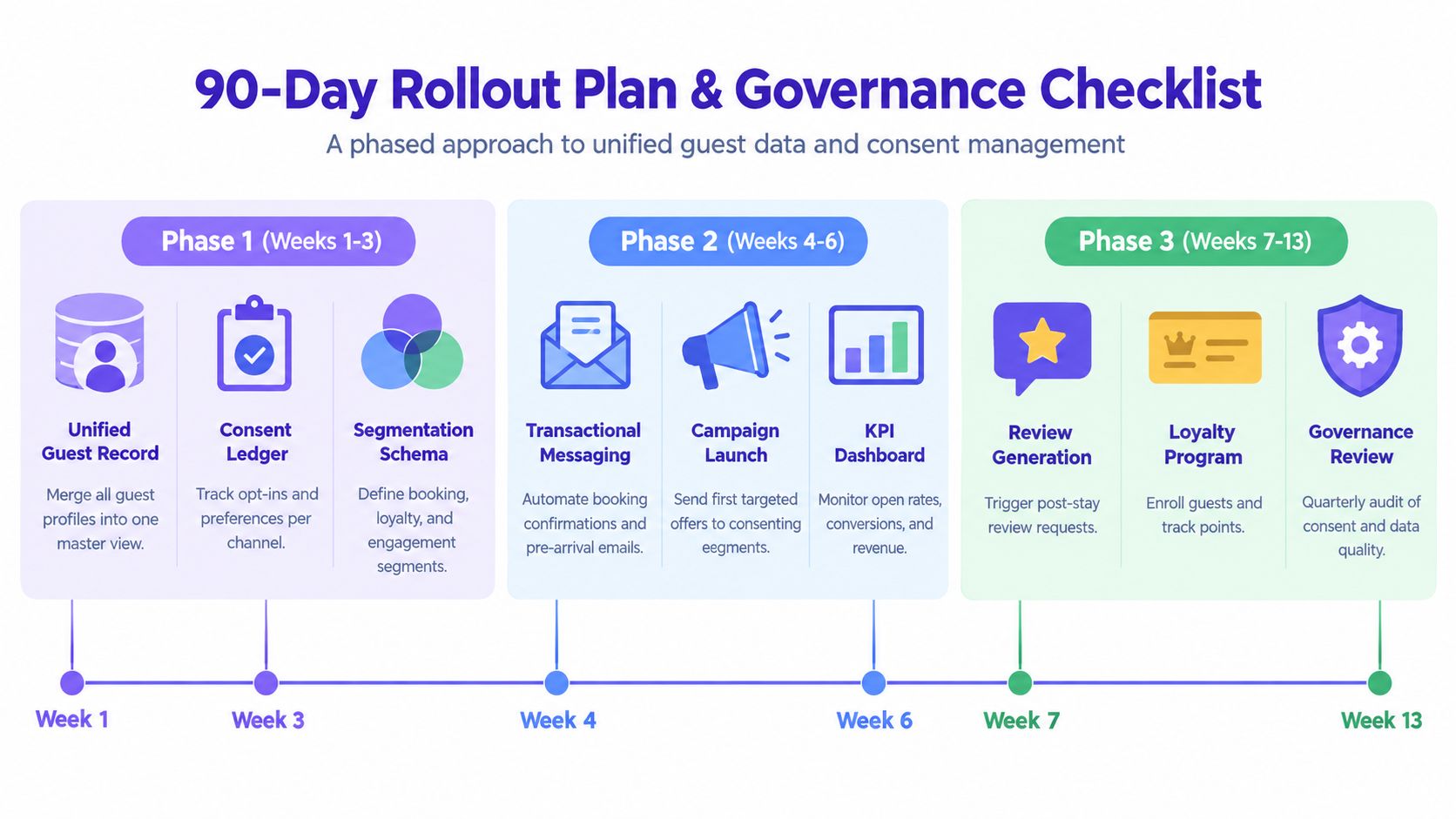
A hotel team can move from concept to control in one quarter if the sequence is disciplined. The first month should be about the data foundation, the second about lifecycle execution, and the third about proof. That order matters because campaign performance is only as strong as the guest record underneath it.
The 90-day sequence
Weeks 1 to 3 should focus on the unified guest record, the consent ledger, and the segmentation schema. If the property can't reconcile WiFi, bookings, stays, and purchases into one view, nothing else will hold together for long.
Weeks 4 to 6 should launch transactional and lifecycle journeys. Booking confirmations, pre-arrival messages, post-stay prompts, and a simple lapsed-guest flow are enough to prove the plumbing works.
Weeks 7 to 13 should layer in paid activation and the first holdout test. That's where the team learns whether direct demand is increasing, or whether the campaigns are mostly redistributing existing intent.
A governance checklist keeps the rollout safe:
- Single consent ledger, one source of truth for opt-ins and opt-outs.
- Human approval before send, no AI-drafted campaign goes live without sign-off.
- Venue time zones, sends should respect local property timing.
- Append-only audit trail, every action should be reviewable later.
- Monthly executive report, organize performance around the four outcomes, not channel impressions.
The most important discipline is reporting. Executives don't need another dashboard stuffed with opens and reach, they need a clean view of new acquisition, OTA-to-direct migration, repeat retention, and pulled-forward demand. Once the team can read the business that way, channel decisions become much easier to defend.
If you want a hotel marketing stack that ties guest data, consent, journeys, and holdout measurement together, explore Purple Engage and see how it can support direct-booking campaigns without losing sight of incremental revenue. It's built for teams that need one guest record, one approval flow, and one reporting model they can trust when the numbers are on the line.