
How to Ask Customers for Reviews the Right Way
Learn how to ask customers for reviews at venues with timing, templates, channel tips, and FTC-compliant workflows that actually convert.
The most popular advice about how to ask customers for reviews is also the advice I'd reject first: find a happy customer, ask immediately, and copy a friendly template. That approach confuses collecting flattering feedback with building a reliable review program.
For a venue group, the important decisions happen before anyone writes the message. You need a defensible audience rule, a completed-experience trigger, permission to use the chosen channel, and a plan for criticism. Get those decisions right, and a short request is enough. Get them wrong, and polished copy won't fix the workflow.
Table of Contents
- Why Most Venues Collect Fewer Reviews Than They Should
- The Business Case for a Systematic Review Workflow
- Channel Choices That Match How Guests Actually Respond
- Timing the Request Around the Real Customer Experience
- Designing Requests That Don't Gate or Bias the Results
- Templates, Measurement, and a 30-Day Rollout Plan
Why Most Venues Collect Fewer Reviews Than They Should
Sending everyone the same message at the same time isn't a strategy. Neither is waiting for staff to spot delighted guests and remember to ask them. My recommendation is to standardize eligibility, then adapt delivery to the experience.
The distinction matters. A restaurant diner, a hotel guest, and a retail shopper can all receive an equally fair invitation without receiving it through the same channel or at the same journey stage.
Willingness isn't the same as action
In BrightLocal's 2025 Local Consumer Review Survey, based on 1,026 U.S. adults, 96% were open to writing a review, but only 29% said they'd written a business review during the previous year; 40% selected email as a method that would make them likely to leave one, compared with 32% in 2024.
Those are U.S. survey findings, not global response-rate benchmarks. They nevertheless challenge the assumption that a quiet review profile means customers don't want to participate.
The operational question is whether you gave customers a recognizable invitation after an actual experience. A newsletter asking everyone to support the business doesn't provide the same context as a message identifying the restaurant they visited or the hotel they just left.
Diagnose the workflow before rewriting the email
Ask your team to show you the path from completed visit to review invitation. Don't accept a screenshot of the template as proof that the program works.
- Audience: Which recorded customers qualify, and who gets excluded?
- Timing: What event starts the journey, and has the experience ended?
- Message: Can the customer recognize the venue and reach the correct review destination?
- Feedback handling: Who owns criticism, and does a complaint affect access to the public-review opportunity?
A useful diagnostic is to trace a restaurant visit, hotel departure, and retail purchase through the system. Look for missing contact details, ambiguous completion events, incorrect venue mappings, and journeys that never activate.
Practical rule: Audit the customer's path before editing the subject line.
Low volume should prompt an operational investigation, not an assumption about customer motivation. Fix the missing invitation first, then test whether your copy needs improvement.
The Business Case for a Systematic Review Workflow
Reviews deserve an operating budget, not just attention when a manager dislikes the latest rating. Leadership should understand the commercial rationale, but it should also understand what the evidence does and doesn't establish.
A Harvard Business School study of Yelp and restaurant revenue associated a one-star increase with 5% to 9% higher revenue, with an estimate of 5.4% in a specification controlling for restaurant- and quarter-specific factors; the measured effect was concentrated among independent restaurants, rather than chain-affiliated restaurants.
That's a reason to take reviews seriously. It isn't a forecast for your hotel group, a conversion-rate estimate, or a promise that requesting more reviews will produce the same revenue change.
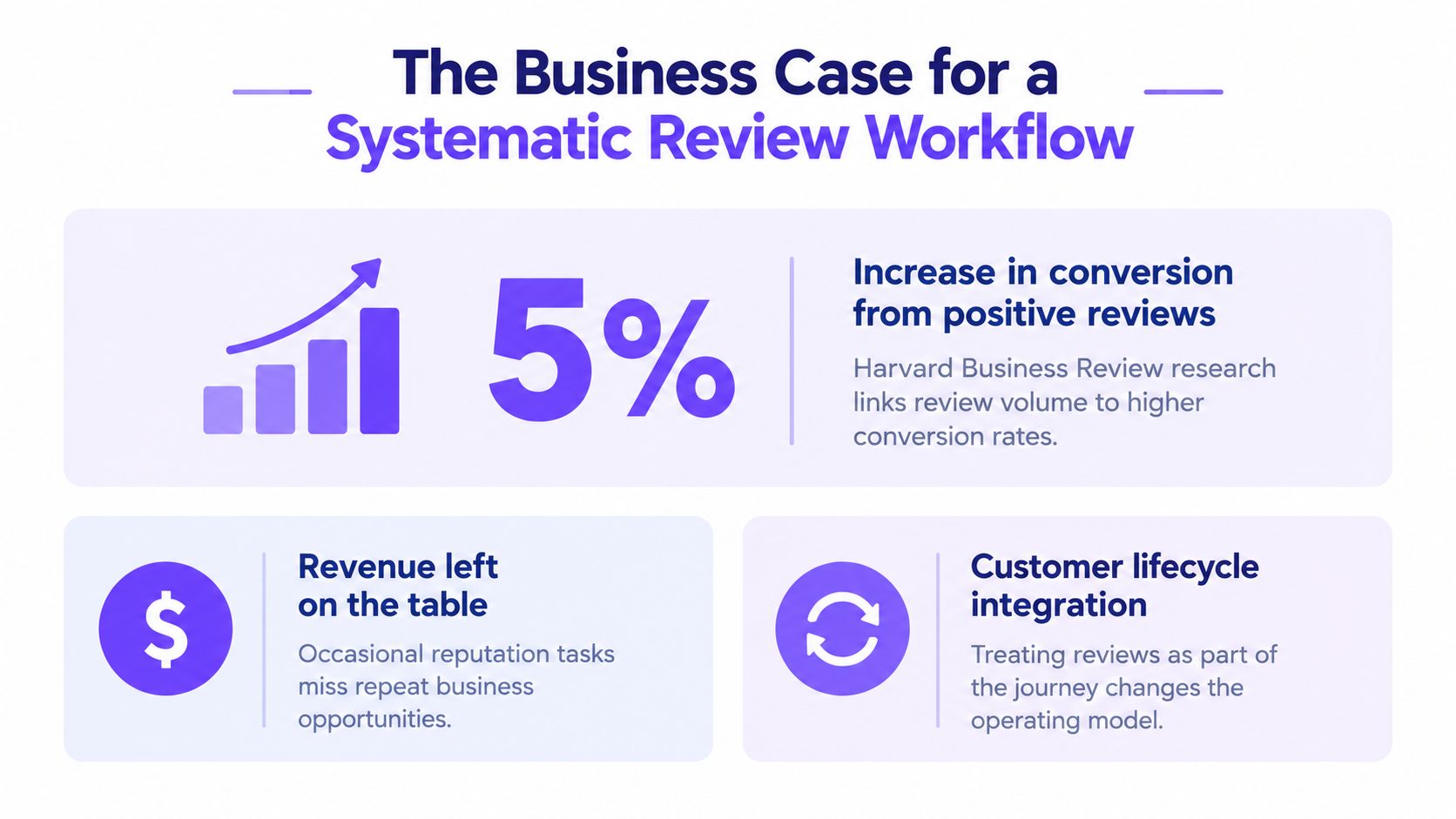
Treat the commercial evidence as a restaurant revenue association, not a review-volume or conversion benchmark. For other venue categories, build the investment case around your own measured outcomes rather than borrowing a restaurant estimate.
Fund infrastructure, not a ratings push
A review program requires coordination between marketing, operations, data, and compliance. Marketing owns the invitation, operations owns the underlying experience, and the data team makes sure the message refers to the right guest and site.
Map those responsibilities into the customer lifecycle. A customer journey map is useful for identifying the completed-experience event, the customer-facing touchpoint, and the team responsible when something fails.
| Operating requirement | What leadership should fund |
|---|---|
| Reliable visit records | Event mapping and guest matching |
| Correct local destination | Ownership of venue review profiles |
| Controlled messaging | Consent checks and approval processes |
| Useful reporting | Site-level analysis and experiment design |
| Actionable criticism | A named service-recovery owner |
Don't make average rating the sole performance target. That invites teams to chase flattering responses rather than improve the experience or collect useful feedback.
Instead, ask leadership to approve a recurring process with named owners and explicit boundaries. The program should keep running when a local manager changes, a new location opens, or the marketing calendar becomes crowded.
The investment case is straightforward: customers already complete visits, purchases, and stays. Your job is to turn those existing lifecycle events into a measurable, governed opportunity to hear from them, without claiming that every review produces revenue.
Channel Choices That Match How Guests Actually Respond
Start with email when you have appropriate permission and reliable addresses. Use SMS selectively, treat WhatsApp as its own channel, and keep QR invitations available for customers you can't legitimately message.
That's a practical starting order, not a universal performance ranking. Channel preference, contactability, and permission determine the usable audience before copy or timing enters the calculation.
Review Request Channels at a Glance
| Channel | Best for | Consent basis | Typical timing | Main risk |
|---|---|---|---|---|
| Post-stay and post-visit follow-up | Documented permission appropriate to the message and jurisdiction | After completion, with a tested delay | Using an address collected for another purpose | |
| SMS | Brief, mobile-first invitations | Applicable messaging permission and recorded opt-outs | After the service ends | Intrusion and repeated prompts |
| Guests already expecting venue communication there | Channel-appropriate permission | Within the established guest conversation | Assuming a phone number means permission | |
| QR receipt | Walk-in diners and retail shoppers | Customer chooses to scan, with permission assessed separately for later messaging | At payment or departure | Wrong destination or awkward placement |
| Staff verbal ask | A relaxed departure interaction | Optional invitation, not permission for future messages | After service is complete | Pressure or selective asking |
Pick channels by context, not convenience
For hotels, email gives you room to identify the property and stay without squeezing everything into a text. Test a post-departure send rather than adding the review request to an essential operational message just because that message already exists.
For restaurants, receipt QR codes offer a practical route for walk-ins whose contact details you don't have. Email or SMS can support follow-up for contactable guests, but the booking phone number shouldn't automatically become a marketing audience.
For retail, distinguish a review of the shop experience from a review of the purchased product. An invitation after payment may suit checkout feedback, while product feedback requires time to use the purchase.
WhatsApp should fit the guest's established communication habits. Use this comparison of WhatsApp and SMS for restaurant marketing to frame the channel decision, then check your own permissions and message expectations.
- QR placement: Keep the invitation readable and test the destination on a phone.
- Staff delivery: Make the ask optional and let the guest leave without explaining a refusal.
- Channel testing: Compare equivalent eligible audiences instead of crediting a channel that happened to reach more loyal customers.
Don't stack email, SMS, and WhatsApp because a guest hasn't clicked. An unanswered invitation isn't permission to pursue them everywhere.
Timing the Request Around the Real Customer Experience
A booking confirmation isn't a completed stay. A WiFi sign-in isn't a finished meal. Trigger from the end of the experience you're asking the customer to assess, not the earliest event your software can detect.
My starting framework is restaurant feedback after the bill is settled, hotel feedback after checkout, event feedback after the event ends, and retail service feedback after purchase. These are testable operating choices, not universal optimal send times.
Match the delay to the journey
A hotel guest may still be dealing with luggage or onward travel at checkout. A restaurant guest may be ready to comment at departure, but that doesn't mean an automated text should arrive while they're paying.
For teams thinking about the difference between checkout and the broader stay experience, Irie Tulum Boutique Hotel's a guide to intimate hotel experiences is a useful companion resource. Use the guest's actual journey to frame your timing test rather than treating the departure timestamp as the whole experience.
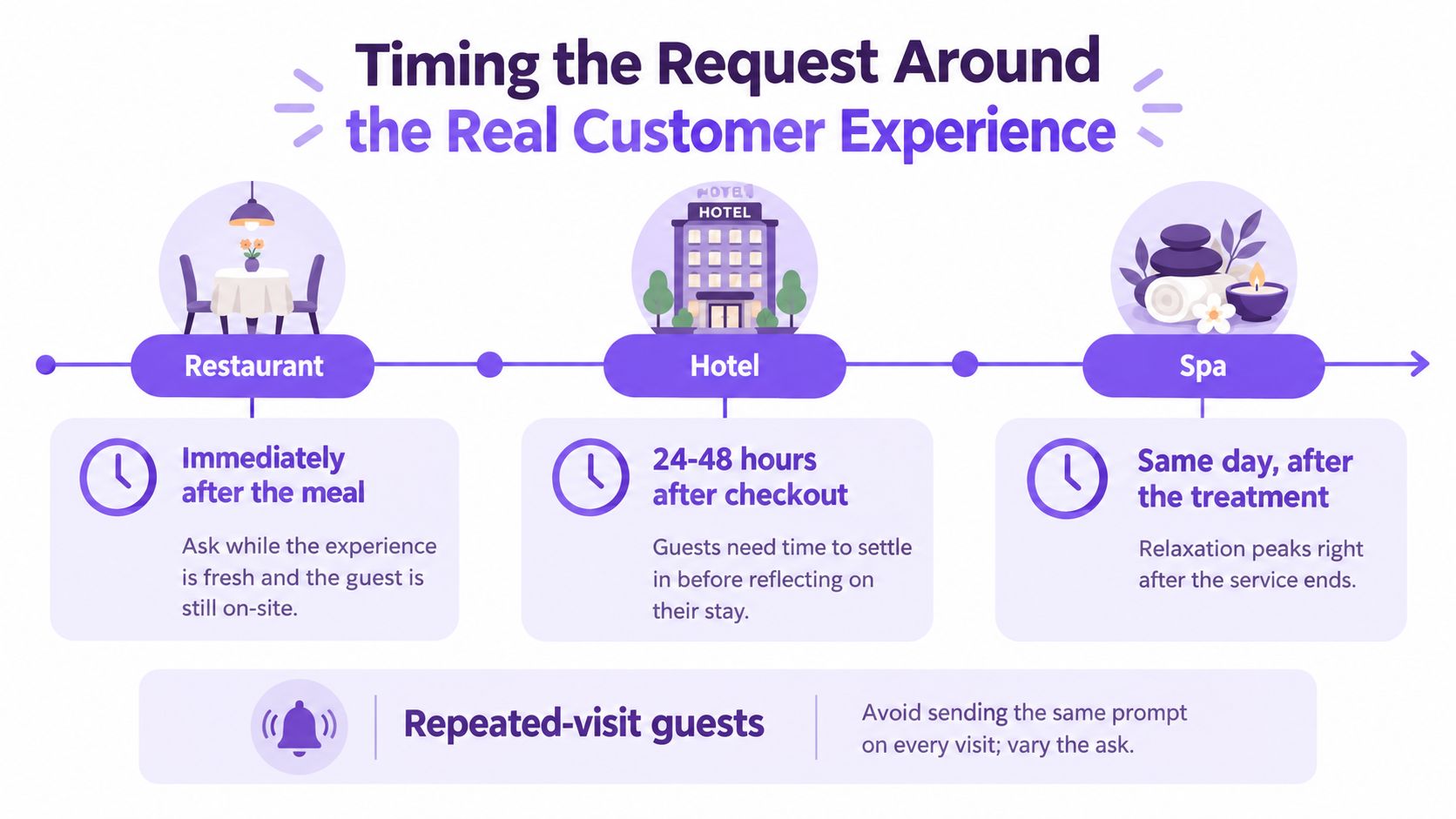
Treat venue-specific timing suggestions as starting hypotheses, not proven optima. Keep the completion event fixed while testing the delay.
A field test discussed in Near Media's review-request timing analysis reported a 6% review rate for next-day requests versus 12% without a prompt, with approximately 3% at day five, 3% at day nine, and 2% at day fourteen.
That result is a warning against assuming earlier always means better. It also shows why counting reviews after a send doesn't establish that the message caused them.
Build the trigger and suppression logic together
- Confirm completion: Match the finished visit, purchase, booking, or stay to the guest record.
- Check permission at send time: Don't rely only on the permission status captured when the journey began.
- Apply a cooling-off period: Share frequency limits across locations so regular guests don't receive overlapping invitations.
- Stop appropriately: Suppress after confirmed completion or opt-out. If completion can't be reliably observed, don't treat a click as proof of a review.
Allow at most a single reminder to non-responders, with its delay tested locally. Keep a randomized no-message group so you can assess incremental participation.
A guest's return visit should feel like recognition, not a fresh excuse to send the same request.
Designing Requests That Don't Gate or Bias the Results
A neutral message becomes a biased collection process when it goes only to apparently happy guests. Set the eligibility rule before writing the copy: every customer with a completed, eligible experience gets the same opportunity to leave a public review. A private satisfaction score must never determine who receives that invitation.
Separate public participation from service recovery
The FTC's guidance for platforms featuring customer reviews warns against practices that distort the review record, including suppressing negative feedback and selectively seeking positive reviews. The Consumer Reviews and Testimonials Rule took effect October 21, 2024.
Keep the operating standard clear: don't manipulate who gets heard. FTC guidance, the rule's specific prohibitions, and individual platform requirements are distinct, so check each one when setting your process.
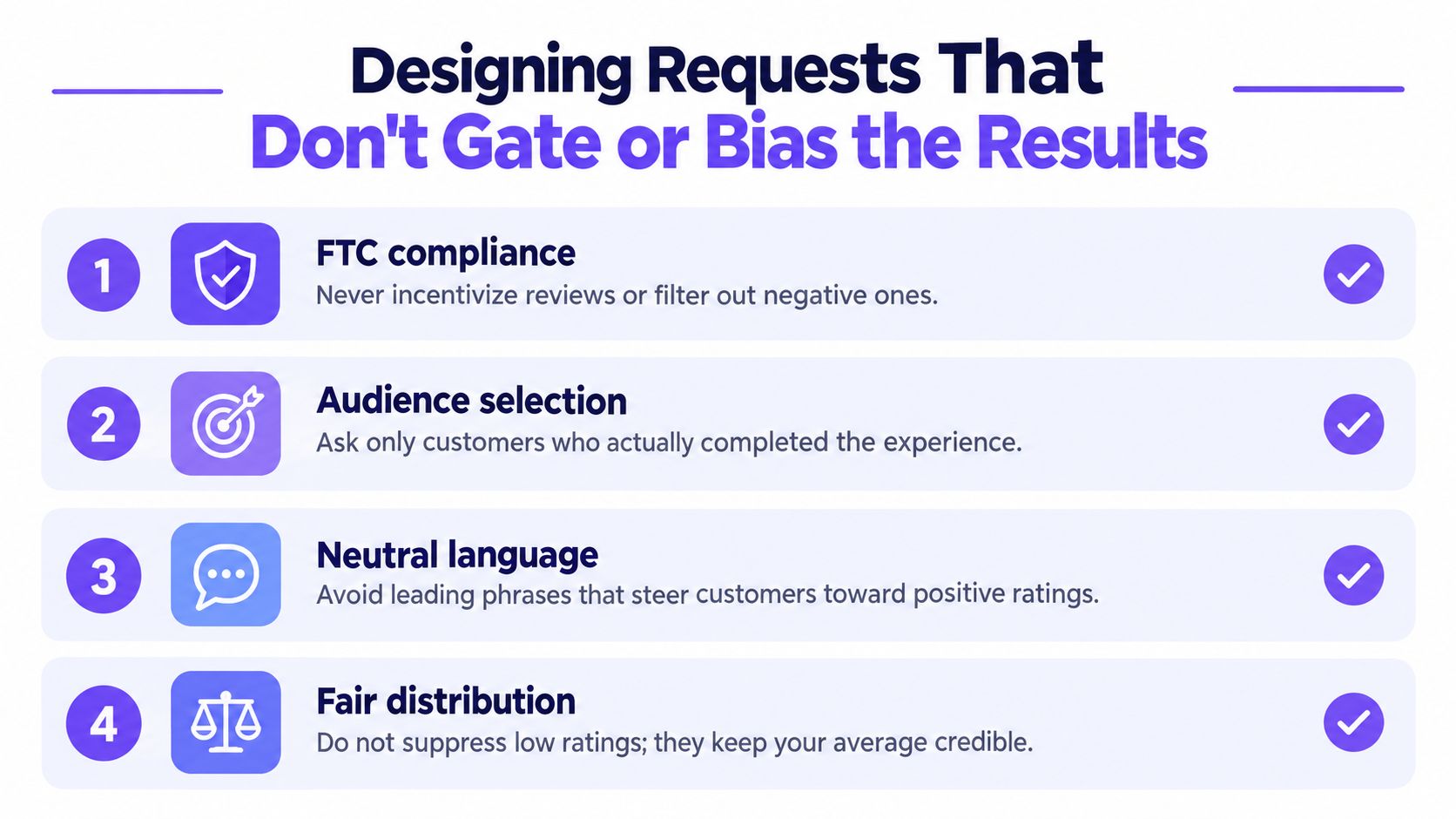
My recommendation is no review incentives. It gives your team a clean, consistent policy; it does not mean every incentive is categorically illegal.
The FTC's guide to soliciting and paying for online reviews says incentives must not depend explicitly or implicitly on positive sentiment and should be disclosed. Some review platforms prohibit incentivized reviews altogether, so check platform rules before launching any offer.
Give guests parallel routes
| Avoid this pattern | Use this instead |
|---|---|
| Show the public-review destination only after a favorable survey answer | Give every eligible guest the same public opportunity |
| Send dissatisfied guests exclusively to a private form | Offer private support while preserving public access |
| Ask for a favorable rating | Invite an honest account of the experience |
| Tie a reward or remedy to changing feedback | Resolve the service issue independently |
A post-visit feedback survey for hotels and restaurants can help staff investigate problems. Keep survey answers out of the public-review eligibility decision.
When criticism arrives, assign a venue owner to acknowledge the issue and investigate. Move personal booking or payment details into a private conversation. Never make assistance conditional on deleting or rewriting a review.
Governance check: Could an unhappy guest receive the same public-review invitation as a delighted guest?
Keep an auditable record of eligibility, consent, exclusions, message version, and destination. Compliance teams need to inspect the audience logic as well as approve the wording.
Templates, Measurement, and a 30-Day Rollout Plan
Templates should demonstrate the policy, not substitute for it. Keep the business name, actual experience, honest-feedback invitation, and review destination visible.
The examples below are suggested copy, not customer quotes. Replace the bracketed fields with real visit details and your verified venue-specific destination.
Short requests worth testing
Hotel email
Subject: Your stay at [Property name]
Thanks for staying with us, [First name]. Would you share an honest review of your recent stay? Details about the room or service can help future guests decide whether we're right for them.
Leave your review: [Venue review destination]
Restaurant SMS
Thanks for visiting [Restaurant name]. We'd welcome an honest review of your meal and service: [Venue review destination].
Retail WhatsApp
Hi [First name], thanks for shopping at [Store name]. If you'd like to share your experience, you can leave an honest review at [Venue review destination].
Receipt QR invitation
How was your visit? Scan to share an honest review of [Venue name].
Optional reminder
You recently visited [Venue name]. If you'd still like to share your experience, the review destination is [Venue review destination]. Thanks for your time.
Don't promise a completion time you haven't measured. Test the mobile path yourself, including the correct location, destination access, and any sign-in steps.
Use the first month to establish a credible baseline
| Rollout stage | Operator's task | Decision gate |
|---|---|---|
| First week | Wire the completion event, consent check, destination, and exclusions | Can the team trace a qualifying visit end to end? |
| Second week | Launch an approved variant with a randomized holdout | Are deliveries and suppression behaving correctly? |
| Third week | Inspect participation, opt-outs, and complaints | Is the guest experience acceptable, and is measurement usable? |
| Fourth week | Adjust timing or channel, then document cadence | Is there enough evidence to change the process? |
A month is a launch window, not a guarantee of statistical certainty. Low-volume sites may need a longer test before you can distinguish a useful effect from ordinary variation.
Track eligible guests, delivered messages, clicks, confirmed completed reviews, opt-outs, complaints, and rating distribution separately. Where platforms don't let you reliably match a review to a recipient, state that limitation rather than presenting estimated completions as observed facts.
Compare review outcomes against the holdout and report uncertainty with confidence intervals. Change a single test variable at a time, preserve the eligibility rule, and judge success by incremental reviews, not attractive click reports.
Purple Engage is one option for connecting WiFi, purchase, booking, and stay data into a shared guest record and triggering uniform review requests with consent and approval controls. Visit the platform to assess how your team could replace disconnected review campaigns with a recorded-visit journey, neutral eligibility, and deliberate holdout measurement.