
Restaurant CRM Software: Features and How to Choose
Restaurant CRM software joins WiFi, tills and bookings into one guest record. See the features, buying tests and how to measure real return visits.
The popular advice is to choose restaurant CRM software by comparing campaign builders, loyalty features, and email templates. That order is backwards. If the system can't match guests across your WiFi, tills, and bookings, or preserve their consent when records move between tools, more campaign features just help you send more messages to a fractured audience.
Start with a pilot, not a feature tour. Make the vendor prove that guest identities match, opt-outs survive imports, and a holdout group returns more often before you commit.
Table of Contents
- What Restaurant CRM Software Must Do
- Why One Diner Becomes Several Records
- Systems That Should Feed the Guest Record
- Tests to Run Before You Buy
- Offers That Create Visits Rather Than Subsidise Them
- Prove Incremental Visits Before You Commit
What Restaurant CRM Software Must Do
| Capability | What it handles | Why it matters |
|---|---|---|
| Guest identity | Matches WiFi, till, booking, and stay records on email | One regular isn't four contacts |
| Consent ledger | Records who agreed, when, on which channel, and with what wording | Imports mustn't reverse an opt-out |
| Segments | Uses visits, spend, tags, and survey answers | Finds lapses, such as no visit in 45 days |
| Journeys | Triggers on a WiFi join, purchase, booking, or checkout | The message follows a real visit |
| Offers | Applies caps, budgets, time windows, and one single-use code per guest | Stops unlimited discount costs |
| Measurement | Uses a holdout group and tracks incremental visits | Separates campaign effect from habit |
These are pass-or-fail jobs, not a menu of nice-to-have features. A generic email platform may store a name and address, but that alone won't connect a purchase to a booking or show whether a campaign brought someone back. If a product can't demonstrate guest identity and holdout measurement in a pilot, reject it before comparing templates.
Start with the guest record
A restaurant CRM should gather interactions across the dining journey, connect them to one person, and make the resulting timeline useful for messaging and measurement. Email can be a practical matching key when it's captured consistently, but it isn't magic: guests may use different addresses, share an address, or pay without identifying themselves. Test those edge cases using real, de-identified records from your venues, and agree which system owns each field.
Segments need to reflect restaurant behavior, not generic sales stages. For example, a “lapsed” segment can use a rule such as no recorded visit in 45 days, while other groups might be built from visit frequency, spending, tags, or survey answers. A segment that looks tidy in a demo but misses regulars because their booking and till records don't connect isn't useful.
Treat sends as controlled operations
A consent record needs more than a subscription checkbox. It should retain the channel and purpose a guest agreed to, the wording they saw, and when and where they gave permission. Suppression must still apply when records are imported or merged.
Likewise, an offer should have operating limits before it goes live. Set a budget and time window, cap redemptions, and use single-use codes when appropriate. Those controls help the team contain discount exposure instead of discovering its scale after the campaign has run.
Buyer's rule: Don't buy on the strength of a polished campaign demo. Buy only after the vendor proves it can build a dependable guest record and measure behavior against a control group.
Why One Diner Becomes Several Records
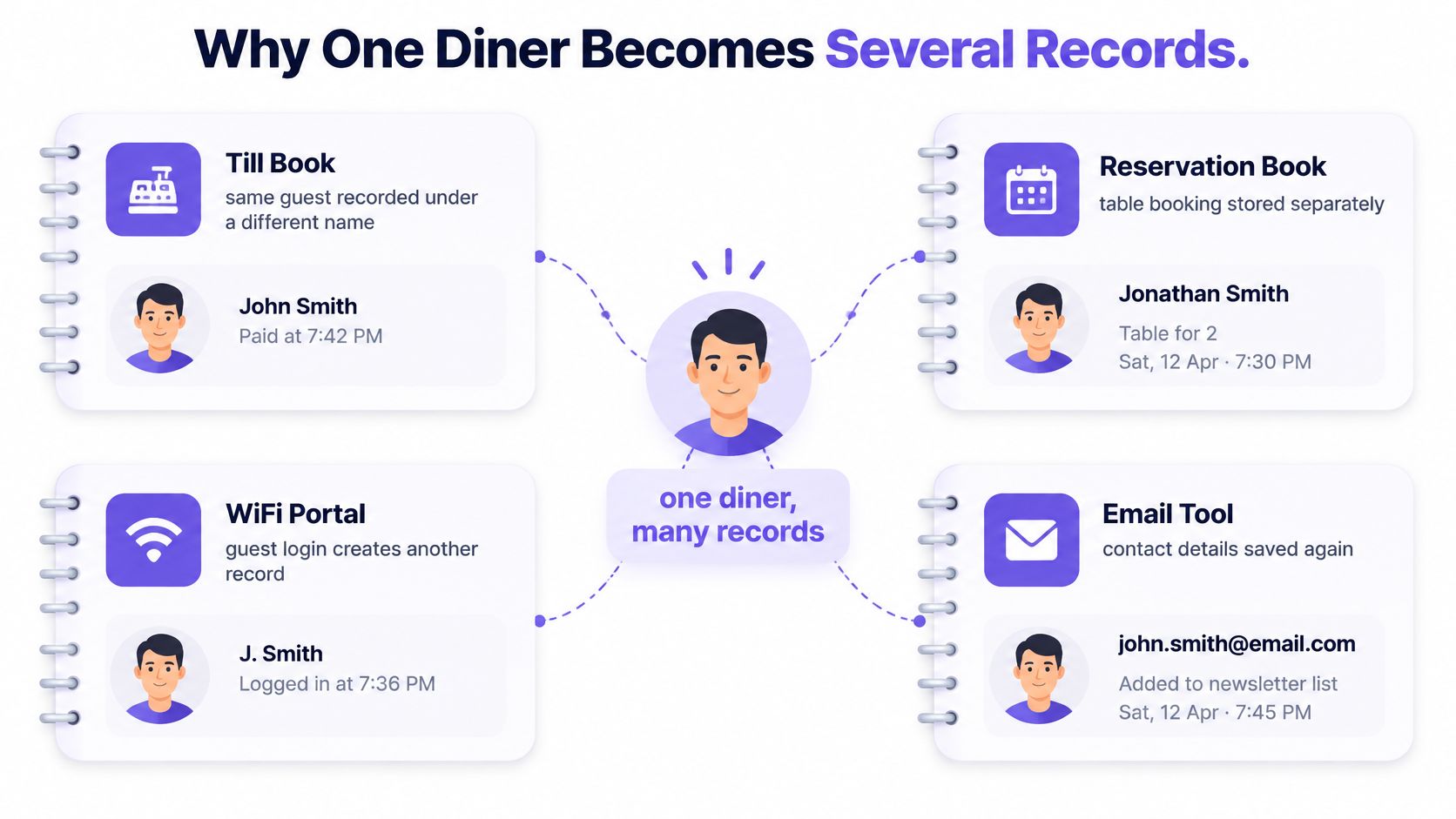
Before a restaurant connects its systems, each channel keeps its own notebook. The till has a transaction, the reservation book has a booking, the WiFi portal has a login, and the email tool has a contact. The same diner can appear in all four, recorded differently in each.
That fragmentation grew more consequential as ordering moved online. According to FinancesOnline's summary of restaurant software statistics, digital-ordering-platform sales increased 313% after the pandemic began and were 452% above pre-pandemic levels by December 2020, when digital orders represented 28% of all restaurant orders. Each additional ordering channel could create useful activity, but only if a restaurant could connect it to a guest identity and the permissions attached to that identity.
Follow one guest through the systems
Say a diner joins guest WiFi through a captive portal, enters an email, accepts the terms, and opts in to marketing. The WiFi record can include the email, visit date, dwell time, and preferred site. When the diner later books a table or makes a till purchase using the same email, those events can attach to the same guest timeline.
That timeline gives a venue more to work with than an address list. Purple Engage records more than 60 event types for each guest, including WiFi sign-ins, purchases, bookings, check-outs, form submissions, campaign activity, and survey responses. Its 36 automation triggers include joining WiFi, making a purchase, completing a booking, and checking out of a stay. The practical point isn't the size of the event catalogue. It's whether the relevant event arrives, attaches to the right person, and triggers an appropriate next step.
Measure the return, not just the send
A 40-site restaurant group already used Mailchimp and recorded a 35% open rate. After deploying Purple Engage on its Cisco Meraki network, the group ran a Birthday Month offer and a Lapsed Diner campaign and could report footfall attributed to each campaign. When the network recognises a guest's device on a return visit, the visit can be logged against the campaign without a QR code or voucher scan.
An open rate can indicate that an email was opened, but it can't tell the operator whether the diner came back because of that message. A connected timeline makes it possible to inspect the return visit alongside the booking, purchase, or other activity that followed. That's a more useful basis for deciding whether a campaign deserves another send.
Systems That Should Feed the Guest Record
Inventory your existing systems before adding another login. A restaurant CRM should read the tools that already handle guest interactions, rather than trying to replace the booking engine or payment system. For a broader look at the till side of the stack, choosing a POS for busy dinner services can help you think through what the payment system needs to do independently of the CRM.
| Source | Systems named | Status |
|---|---|---|
| Guest WiFi | Purple WiFi | Live |
| Guest WiFi | Cisco Meraki, Cisco Spaces | Pilot |
| Guest WiFi | Juniper Mist | Live |
| Tills | Square, Epos Now, Loyverse | Live |
| Tills | Lightspeed X-Series, Oracle Simphony | Pilot |
| Bookings | ResDiary | Pilot |
| Stays | Mews, apaleo | Pilot |
| Head-office CRM and email sync | HubSpot, Salesforce, Mailchimp | Live |
| Finance extracts and custom joins | Google Sheets, public API, signed webhooks | Available |
A “live” connection and a “pilot” connection aren't interchangeable. In Purple Engage's current integrations, data can be captured from Purple WiFi, Juniper Mist, Square, Epos Now, and Loyverse; Cisco Spaces, Cisco Meraki, Lightspeed X-Series, Oracle Simphony, ResDiary, Mews, and apaleo are in pilot. HubSpot, Salesforce, and Mailchimp can sync guest records in both directions. If you're planning custom reporting, learn what webhooks and APIs each do before deciding how finance extracts or bespoke joins will work.
Keep platform boundaries clear
This kind of platform isn't a booking engine, points scheme, payment provider, or cookie banner. It should work alongside your existing consent tool. It reads till data rather than writing sales back into the till, and redemption at the till remains a pilot on supported systems, so don't assume every offer code will scan at checkout on day one.
Build a simple stack inventory with one row per system that holds a guest email. Mark each connection live or pilot, name who owns the data, and note what happens when a sync fails. Drop any vendor that can't clearly distinguish a working connection from a pilot or can't explain which data moves in each direction.
Tests to Run Before You Buy
Many buying guides start with campaign features. The more urgent question is whether guest data can be activated reliably. In a 2025 Restaurant Business digital technology report, 36% of restaurant operators said they definitely or probably optimized the customer data they collect, down from 45% the previous year. Planned investment in integrations and APIs rose from 14% to 20%, while planned investment in data management and security increased from 17% to 26%. A new CRM can deepen fragmentation if it adds features without fixing identity, data ownership, and sync behavior.
Use a real pilot and score each test pass or fail. Don't compare template galleries until the core data paths work.
| Test | Pass looks like | Fail looks like |
|---|---|---|
| Identity match | Same email merges WiFi, till, and booking records across sites | Duplicate guests and missed regulars |
| Field ownership | One system is the source of truth for each field | Two tools overwrite each other |
| Consent survival | Opt-out stays suppressed after import and is rechecked at send | Import turns an opt-out back on |
| Refresh speed | Behavioral segments update within about a minute | Overnight batch only |
| Historical portability | Past visits and sales load onto the guest record | Only new sign-ups count |
| Failure recovery | Broken sync is visible and events aren't silently dropped | Data gaps with no alert |
| Incremental proof | Holdout shows extra visits or purchases | Opens and clicks only |
Test the failure cases, not just the happy path
Use the same test email across WiFi, till, and booking records at more than one site. Then deliberately introduce a duplicate, a conflicting field, a changed email, and a sync interruption. A capable platform should make the outcome visible instead of merging the wrong guest or dropping activity.
For consent, run the full path: record a guest's opt-out, import an older version of that contact, and attempt a send. The send must remain blocked. Consent should be recorded by purpose and channel, with a durable history of the guest's choice, rather than inferred from a single list-membership field. The ICO's guidance on recording and managing consent calls for records showing who consented, when, what information and wording they saw, and how consent was collected. The European Commission's consent guidance also makes clear that consent must be freely given, informed, specific, and limited to the purposes disclosed.
A green light in a dashboard isn't enough. Make the vendor show what the operator sees when a record is wrong, a sync breaks, or an opt-out meets an imported contact.
Offers That Create Visits Rather Than Subsidise Them
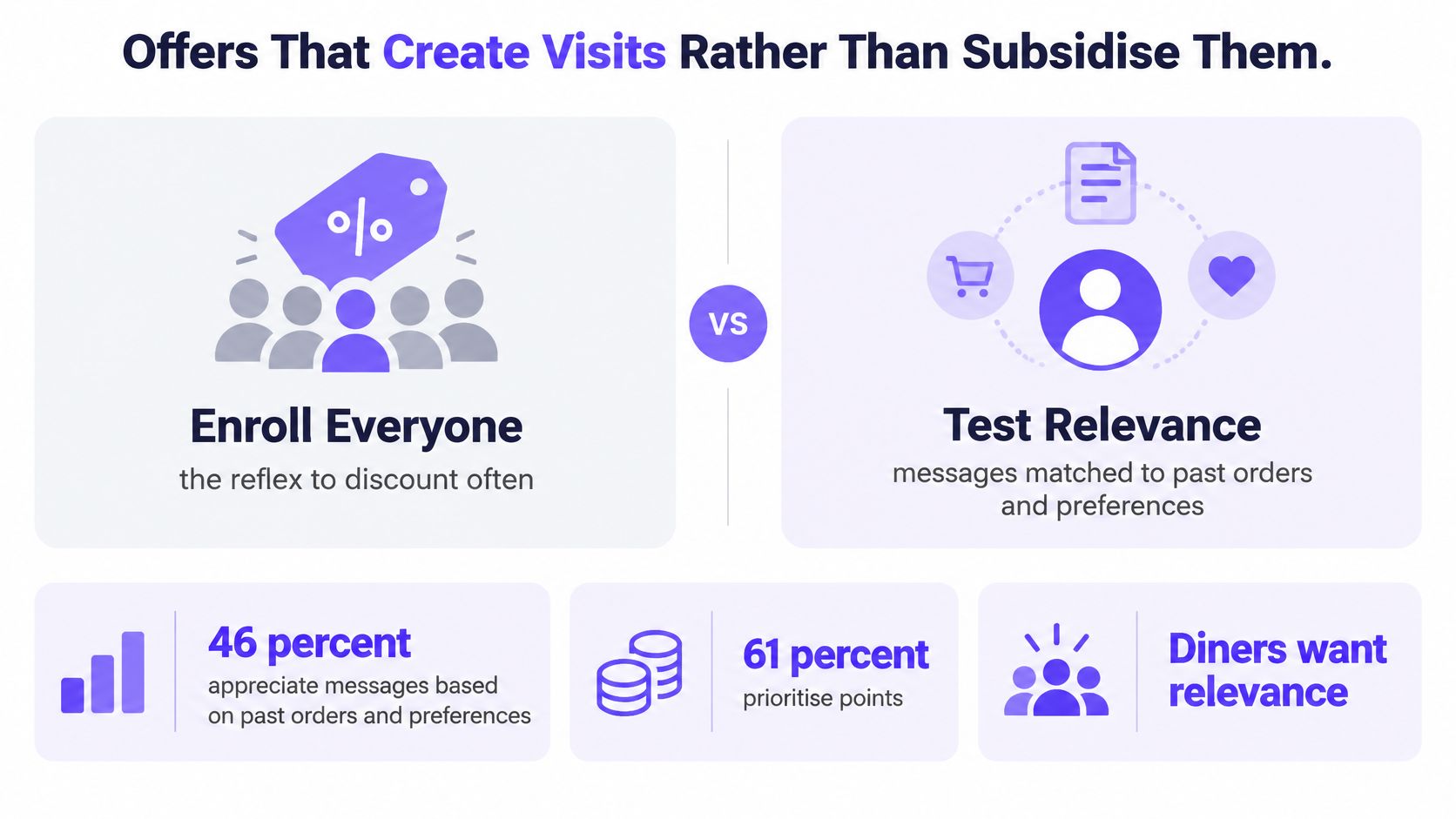
A redeemed offer does not prove it created a visit. Broad discounts can pay regulars to do what they would have done anyway, so judge a campaign by the additional behavior it produces and the margin left after its costs. Diners do value relevance: 46% appreciate messages based on past orders and preferences, and 61% prioritize points toward free food or drinks, according to the 2025 Restaurant Consumer Insights Report. Those preferences support testing targeted messages, not assuming personalization makes an offer profitable.
Compare a group receiving a campaign with a randomly assigned holdout that receives none. Set a clear inactivity rule, such as no visit in 45 days, then send a behavior-triggered win-back message to the treatment group. Compare visit rates and account for uncertainty. Random assignment helps distinguish campaign impact from guests' existing likelihood of returning.
Calculate what the offer added
Estimate incremental visits by subtracting the control group's visit rate from the treatment group's rate. Then estimate incremental gross profit, subtracting discounts, message costs, and campaign costs from the profit associated with attributable transactions. Retention benchmarks provide context, but cannot show that a specific promotion caused a return. DoorDash's restaurant customer-retention guidance reports that a 5% improvement in customer retention can increase profits by roughly 25% to 95%. Treat this as a benchmark, not a forecast for your campaign.
Purple Engage recommends starting with a 14-day attribution window for restaurants and adjusting it to the venue's natural visit frequency. Compare a generic discount, a behavior-based reward, non-monetary recognition, and no offer. Track margin and unsubscribes alongside redemptions. Strong redemption can still mean weak results if regulars use a code for visits they would have made anyway.
Test a personalized promotion against a non-monetary message, such as early access or recognition, rather than assuming every guest needs a discount. The guide to discounts versus added-value offers for restaurants can help frame that choice.
Operator-reported loyalty results, including restaurant-owner surveys, can indicate perceived benefits, but they are not proof from controlled testing. Judge your program by incremental behavior and margin, not enrollment totals or reward redemptions.
Prove Incremental Visits Before You Commit
Make the decision a stop-go sequence. A CRM shouldn't earn a long contract because a demo looked persuasive. It should earn one by proving the data path and showing that a campaign changed guest behavior.
Match the guest. Confirm that the same person connects across WiFi, till, and bookings using the identity rules your venues collect. If the join fails, stop and fix the data problem before buying campaign tools.
Protect the permission. Confirm that an opt-out stays in force after an import or merge and is checked again immediately before every send. If a later import can restore permission, don't proceed.
Test a real campaign. Run a lapsed-diner journey and a birthday or visit-triggered offer against a genuine holdout, using the chosen attribution window. For a useful primer on controlled measurement outside hospitality, measuring ad impact for DTC brands explains the logic of comparing exposed audiences with a control group. Restaurants should apply that discipline to visits and purchases, not treat clicks as the final result. For campaigns using Meta, Conversions API guidance for restaurants can help frame the separate question of how conversion events are shared.
Check the commercial model. Compare total cost per incremental visit, not just the headline plan price. Account for send and AI credits, overages, local taxes, and which plan includes the volume you need. Purple Engage has unlimited contacts on every plan, including its free plan; its 15,000-credit plan costs £27 per month or £293 paid annually, with a 10% annual saving. Listed prices include VAT where it applies, including 20% VAT in the UK.
Nothing drafted by AI should send or incur charges without a person approving it. Purple Engage can run this pilot on venues with guest WiFi and a connected till, reading venue data and reporting campaign footfall against the same scorecard you'd use for another vendor. If the pilot can't show incremental visits with a range, keep your current tools and fix the data joins first.
Purple Engage combines WiFi sign-ins, till receipts, bookings, and guest stays into a unified guest record, with consent controls, campaigns, and holdout-based measurement. If you're ready to test whether your data can prove real return visits, visit Purple Engage and assess it against your pilot scorecard.