
SMS vs email marketing: Which channel Fits your venue
Compare SMS vs email marketing for venues: costs, consent rules, measurement and the channel mix that drives repeat visits.
91% of consumers expected brands to communicate through their preferred channel in 2024, according to Twilio's Consumer Preferences Survey. That reframes SMS vs email marketing: the question isn't which channel gets more attention, but which message a guest wants, when they want it, and whether it produces a visit that wouldn't otherwise happen.
For a restaurant, hotel or retail venue, an interruption has a cost beyond the message charge. Treat SMS as a higher-risk permission asset, not a louder version of email. Use email to develop the offer, reserve texts for a clear reason to act, and judge both on incremental commercial outcomes.
Table of Contents
- SMS and Email Compared at a Glance
- What Guests Say They Prefer
- Matching Each Channel to a Venue Moment
- Consent and Frequency Rules by Channel
- What Each Channel Costs per Send
- Measuring Which Channel Actually Pays
- Setting Up Your Channel Mix This Quarter
SMS and email compared at a Glance
SMS vs email on the criteria venues compare
| Criterion | SMS | |
|---|---|---|
| Click rate benchmark | 2.09% click-through, 2025 benchmark | 5.76% average campaign click rate, not directly comparable |
| Delivery rate | Delivery benchmark available, discussed under venue journeys | Unknown, no comparable SMS delivery figure available |
| Content depth | Multi-block layouts with offers, surveys, video content and several links | One short prompt with one action and one link |
| Speed of attention | Asynchronous, competes with crowded inboxes | Immediate and interruptive, though attention isn't guaranteed |
| Consent basis | Email opt-in tracked on its own | Separate SMS permission required |
| Best role | Explanation, detailed offers and multi-step journeys | Time-sensitive prompts and reminders |
The click figures published in Sender's marketing statistics use different datasets, definitions, industries and attribution windows, so 2.09% for email and 5.76% for SMS indicate direction, not a winner.
The gap doesn't prove that replacing an email campaign with texts will generate more bookings. It doesn't establish comparable delivery, either. A message reaching an inbox or handset is different from a guest reading it, considering the offer and paying.
Choose for the job, not the headline metric
Email explains and sells; SMS prompts an immediate action. A hotel package needs room photography, inclusions, exclusions and booking information. A table becoming available tonight needs a brief invitation and a booking destination.
SMS also brings operational constraints that aren't visible in a click-rate chart. Encoding, carrier filtering, sender requirements, quiet hours and destination-country charges can change whether a campaign is practical. Email offers more room, but that isn't permission to pack every promotion into one message.
Purple Engage coordinates the channels through a shared consent ledger and guest timeline, without assuming that coordination alone guarantees better results.
Decision rule: Rank your venue's most important criteria before choosing the channel, such as urgency, explanation and cost per booking.
If explanation comes first, start with email. If an expiring opportunity comes first, consider SMS. If measurable profit comes first, keep enough eligible guests unmessaged to find out whether either channel earns its place.
What guests Say they prefer
For promotional messages in 2024, 75.4% of consumers preferred email and 19.2% preferred SMS, according to Sinch Mailgun's survey of more than 2,000 consumers in the United States, United Kingdom, France, Germany and Spain. For transactional updates, 75.1% preferred email and 43.4% preferred SMS, according to Sinch's 2024 Black Friday and Cyber Monday consumer survey.
These aren't venue-specific experiments, and the transactional results shouldn't be interpreted as mutually exclusive preferences. They're useful defaults, not a mandate to send every guest the same channel mix.
For a venue marketer, the practical distinction is between permission, preference and context. A guest may permit texts but prefer offers by email. That same guest may still appreciate a text about a booking change because the reason for the interruption is obvious.
Ask a question you can act on
Give guests a meaningful choice at sign-up rather than asking whether they want updates without explaining the channels.
- Promotional preference: Ask whether they prefer offers by email or text, while collecting the appropriate permissions separately.
- Useful interests: Let them identify relevant content, such as dining events, accommodation packages or store offers.
- Preference changes: Make it straightforward to change the selection without contacting reception or customer support.
Don't treat a channel preference as permanent. A conference organiser booking accommodation has different information needs from a local restaurant regular, even if both entered through the same sign-up form.
Store the answer on the guest record and use it when approving campaigns. The channel should follow the guest's stated choice and the message's purpose, not whichever tool the marketing team opened first.
Matching each channel to a venue moment
Ask whether the message needs several links or a picture to make sense. If it does, lead with email. Then ask whether the guest needs to respond within the hour. If so, consider SMS, provided the permission and operating conditions allow it.
Venue moment and the channel that leads
| Venue moment | Lead channel | Supporting channel | Why |
|---|---|---|---|
| Same-day table or room availability | SMS | Email for detail | The guest must act today |
| First visit follow-up | SMS reminder for a time-limited offer | Welcome content two hours after a first-time guest leaves | |
| Lapsed regular, no visit in 60 days | SMS reminder for guests who don't redeem | Context and a detailed offer, then a short nudge | |
| Birthday offer | SMS reminder for guests who haven't redeemed | Sent two weeks before the birth date | |
| Expiring offer ending tonight | SMS | Email earlier in the week | Time-sensitive action |
| Booking reminder | SMS | Email confirmation | Short prompt with one action |
Our automated triggers include a welcome email two hours after a first-time guest leaves, a win-back offer after a regular hasn't visited for 60 days, and a birthday promotion two weeks before their birth date. Those are starting configurations, not proof that every venue should use the same timing.
Build the journey around a recorded event
The DMA's 2025 email benchmarking report reports 98.0% delivery for 2024 activity and a 3.9x open-rate uplift for behaviour-based travel and hospitality email compared with generic broadcasts. Neither result proves incremental bookings, so optimise journeys on completed visits or revenue rather than open uplift.
An email can introduce a return-visit offer with its terms and booking route. Send a supporting text only when the opportunity is approaching expiry and the guest hasn't redeemed. Suppress anyone who has just booked or bought, rather than reminding them to do something they've already done.
Content depth matters particularly for group accommodation. Someone comparing locations may need to find New Mexico retreats with lodging through Taos Goji before discussing dates and suitability. That's an email resource, not material to squeeze into a text.
For a pub event, use our SMS and email event-marketing checklist to align the invitation, booking destination and reminder.
Start with a recorded first-visit follow-up if your departure signal is reliable. Otherwise, build the lapsed-guest journey using a visit or purchase event you can consistently recognise.
Consent and frequency rules by channel
An email opt-in doesn't establish SMS permission. Neither does a phone number on a booking, receipt or imported spreadsheet. Your team needs evidence of what the guest agreed to, not just a populated contact field.
ClickMinded's SMS benchmark guidance identifies consent source, country, proof of opt-in and consent age as useful segmentation dimensions. Audit WiFi sign-ins, tills, bookings, hotel stays, QR forms and imported lists separately because each collection route can contain different wording and purposes.
Maintain a consent lifecycle
- Capture channel-specific permission. Keep the wording shown to the guest alongside the recorded choice.
- Record purpose and jurisdiction. Identify the brand, intended communications and relevant country.
- Apply opt-outs immediately. Stop the affected marketing and honour the scope of the request across connected systems.
- Separate service from promotion. Don't assume a booking confirmation provides permission for subsequent offers.
- Review age and provenance before sending. A recent import date isn't evidence of recent permission.
For multi-site groups, centralise suppression. A group-wide opt-out must reach every relevant venue, while a channel-specific preference should retain its stated scope. Don't let another site's import restore a guest who has unsubscribed.
Cap contact across the guest relationship
In 2024, 56% of U.S. consumers said they would unsubscribe if the same company sent four or more texts or emails within 30 days, according to GetApp's Advertising Preferences Survey, which surveyed 5,996 respondents across 12 countries. That's a stated consumer reaction, not a universal safe sending threshold.
Set a combined marketing frequency cap, not separate allowances that email and SMS teams can exhaust independently. Count automated journeys alongside broadcasts, and prioritise relevant messages when campaigns collide.
A guest experiences messages from your business, not separate allowances from your channel managers.
Country-specific quiet hours and sender requirements need checking before activation. Our U.S. texting is in pilot, and WhatsApp marketing to U.S. numbers is off by default.
Use our restaurant SMS costs and consent guide when setting operating rules. Before sending anything new, audit an existing list for consent source, evidence and age.
What each channel costs per send
Cost unit and billing by channel
| Channel | Cost unit | Length or limit | Billing |
|---|---|---|---|
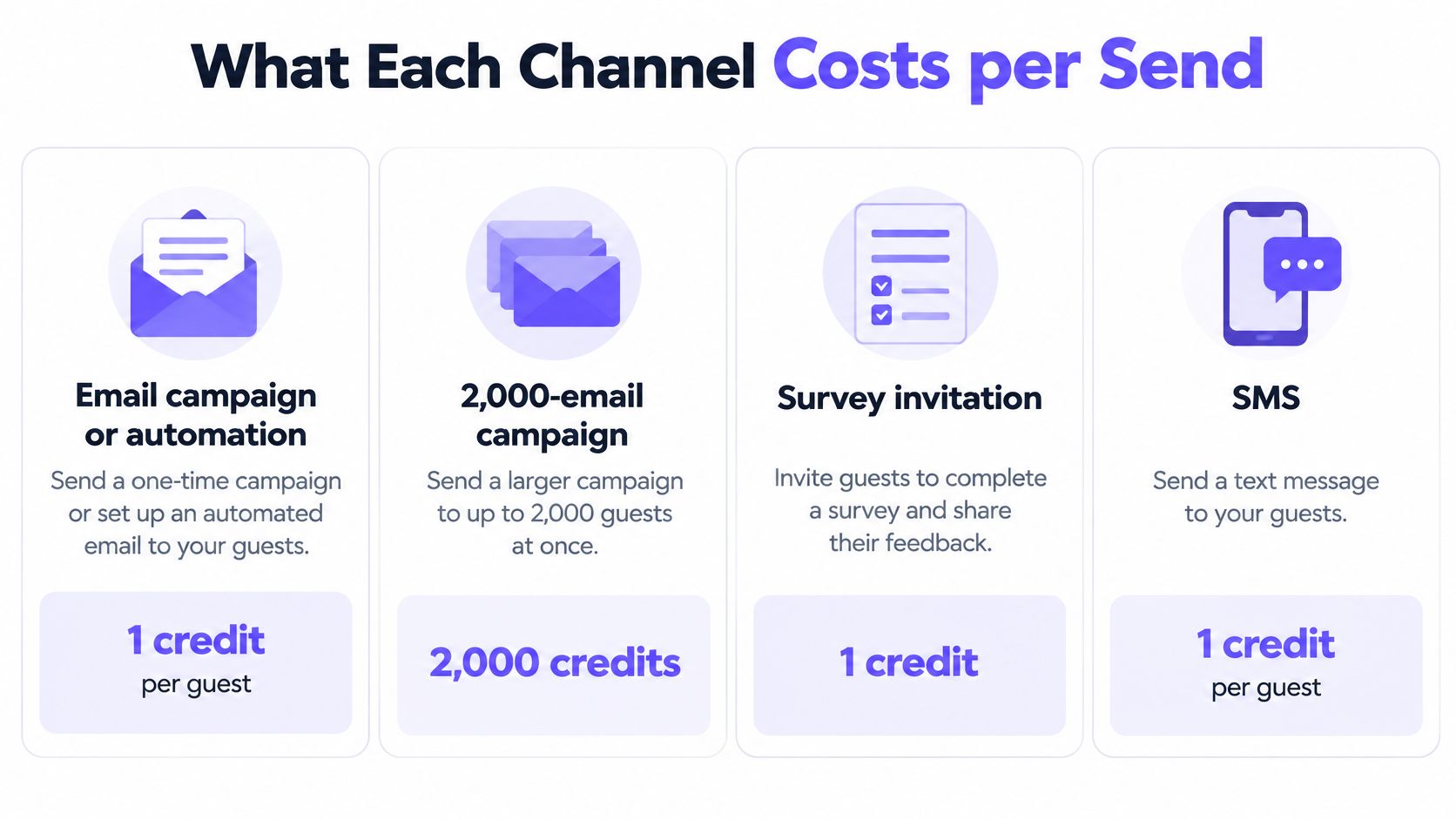
| Email in a campaign or automation | 1 credit per guest | Not counted by SMS-style character segments | Plan credits |
| Survey invitation | 1 credit per invitation | Invitation send, not individual survey questions | Plan credits |
| Text (SMS) | 1 credit per segment | About 160 characters, about 70 with emoji or other special characters | Plan credits plus Twilio price on your own account, no Purple markup |
| WhatsApp message | 1 credit per message | Subject to the approved template and messaging rules | Plan credits plus Twilio price on your own account, no Purple markup |
A campaign of 2,000 emails uses 2,000 credits. SMS requires closer inspection because you're counting segments rather than counting recipients.
Use the cost guide to check the unit before estimating monthly volume.
Separate credits from cash charges
An SMS uses 1 credit per segment. Emoji and other special characters can change encoding, so a text that looks short in the editor may require more segments than expected. Check the final rendered message, including the destination link and required opt-out wording.
Our SMS and WhatsApp messages use the same template and are sent through your own Twilio account at Twilio's price, without a Purple markup. Check the applicable destination-country rate in that account before approving a budget. There isn't a single global cash price to insert into every forecast.
Calculate revenue without calling it profit
As an illustrative example, not a benchmark, sending 10,000 emails that generate 500 return visits at an average spend of $20 produces $10,000 in revenue, or $1.00 revenue per send. That calculation describes attributed revenue; it doesn't prove all those visits were caused by the campaign.
Use a repeatable calculation:
- Count sends: Separate email recipients, SMS segments and WhatsApp messages.
- Record costs: Include credits, carrier charges and offer redemption costs.
- Estimate incremental revenue: Use the difference between the messaged audience and its holdout.
- Compare contribution: Account for the cost of serving the extra visits before deciding which channel pays.
A cheaper email can still lose to a more expensive text if the text creates profitable bookings that email doesn't. Conversely, a high-revenue text campaign can disappoint when many recipients would have visited anyway.
Keep credits, cash cost and incremental contribution per send beside one another in the reporting sheet. They answer different questions.
Measuring which channel Actually pays
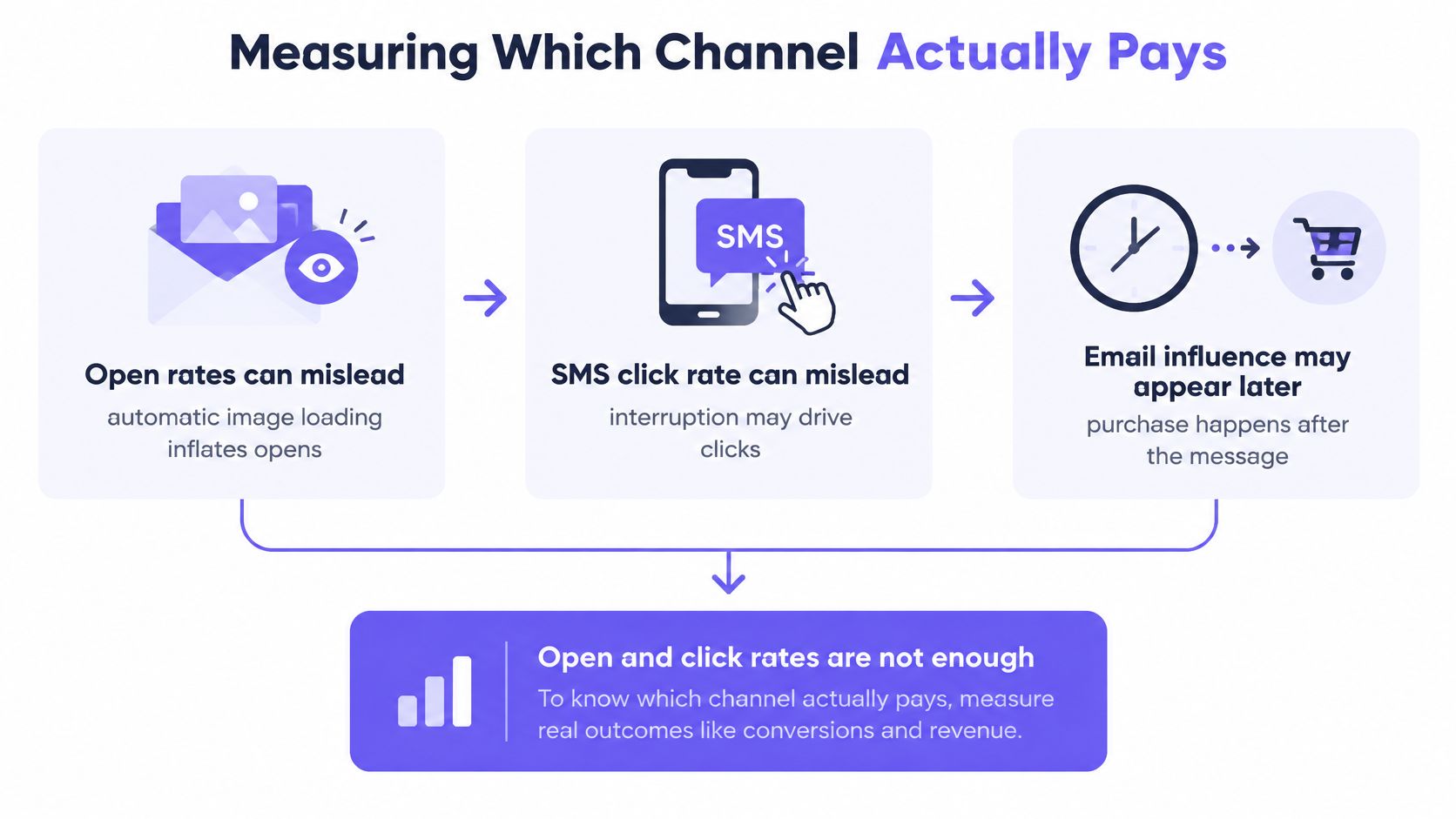
Attention isn't incrementality: a click doesn't tell you whether a guest would have booked without the message. Emarsys's omnichannel engagement benchmarks provide useful engagement context, but channel comparisons need downstream outcomes rather than a click-rate winner.
Automatic image loading can inflate recorded email opens. SMS clicks may reflect interruption, while email can influence a later booking without an immediate click.
Use this distinction when choosing what appears on the campaign dashboard.
Randomise before sending
Test arms for a fair channel comparison
| Test group | Purpose | Metric to read |
|---|---|---|
| Email only | Measures the email journey on its own | Incremental visits, bookings or spend against the holdout |
| SMS only | Measures the urgent prompt on its own | Redemptions and incremental visits against the holdout |
| Email plus SMS | Measures the coordinated pair | Lift over email only, after suppression rules |
| Holdout | Gives the baseline with no campaign messages | Visits and spend without the tested campaign |
Purple Engage combines WiFi sign-ins, till sales, bookings, forms, files, messages and survey answers into a guest record matched by email. For the full channel comparison, select guests with valid permission for both channels, then randomly assign them before launch.
Email matching excludes SMS-only guests without an email address. Don't force those records into the combined comparison. Maintain a separate, deduplicated SMS-only cohort using a stable identifier, randomise it between SMS and a no-campaign holdout, and report its result separately.
Choose a primary outcome and a four-week observation window. Treat that as the same test used for your quarterly channel decision, rather than starting a separate measurement exercise. Keep the holdout large enough for useful comparison; if bookings are sparse, acknowledge uncertainty rather than declaring a winner.
Exclude existing conversions before randomisation. Afterwards, stop reminders when a guest converts, but retain that guest in their assigned group for analysis. Prevent overlapping campaigns from contaminating the test and count each outcome consistently.
Read lift, then economics
Calculate incremental outcomes from the difference in outcome rates against the holdout, adjusted for group size. Divide campaign cost by those incremental outcomes. If the estimated lift is negligible or uncertain, don't manufacture a reassuring cost-per-booking figure.
Our guide to measuring email ROI at physical venues supports this outcome-led approach. For hotel events, The Merrill Hotel's resource can help you choose KPIs for hotel event performance before building the report.
Use the accompanying video alongside your test-planning discussion.
The highest-click channel may not produce the highest profitable lift. Launch the four-week holdout run within the next month, with the outcome and reporting owner agreed before sending.
Setting up your channel mix this Quarter
Most venues should lead with email and keep SMS selective. That's a starting recommendation, not a claim that every audience behaves alike. Increase texting only when your own results justify the cost and interruption.
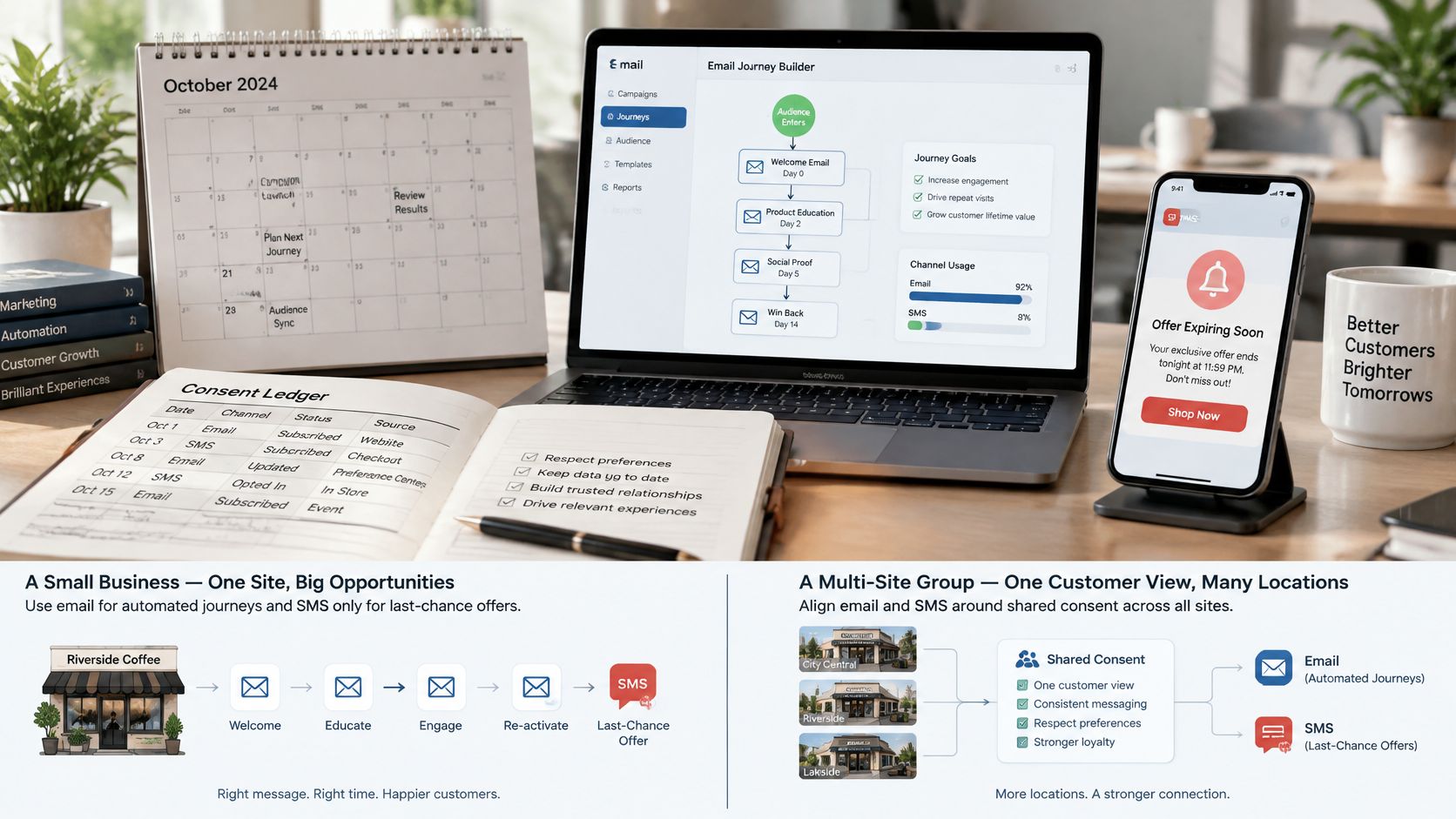
A single site with a small list should establish useful email journeys before adding texts for expiring opportunities. A multi-site group needs central consent controls, cross-venue journey coordination, and local SMS targeting, so an available table at one restaurant doesn't trigger irrelevant messages to the whole estate.
For a hotel or retail venue collecting guest WiFi details, connect the sign-up to a meaningful visit history before building win-back audiences. A contact appearing in a database isn't enough to establish that they've lapsed.
Keep the working setup focused on a shared calendar, audience definitions and accountable approvals.
Build a manageable operating plan
Audit the audience you already hold. Resolve ambiguous permissions, duplicate records and missing visit signals before expanding acquisition. Give someone responsibility for correcting the underlying collection forms, not just cleaning the export.
Build a lapsed-guest email journey. Choose an audience whose absence you can recognise reliably. Give the guest a relevant reason to return, a usable booking or redemption route, and terms staff can explain.
Add a selective expiry reminder. Use SMS only for eligible non-redeemers when there's a real deadline. Don't invent urgency to justify using the channel, and don't send a reminder after availability has disappeared.
Run the four-week comparison. Use the channel groups and holdout as a single operational run. Assign an owner to check delivery failures, redemption issues and conflicting promotions without changing the test conditions casually.
Budget the actual monthly workload. Count emails and WhatsApp messages, add a credit for each text segment, and choose a plan that meets the total. Include survey invitations and other planned credit usage rather than budgeting only for the headline campaign.
Scale the workflow, not just the send volume
Our plans include email, texts, WhatsApp, automations, offers, surveys, forms, segments, the guest record, the AI marketing team, integrations, API and webhooks. The practical choice is therefore the workload and controls you need, not a separate product purchase for each channel.
Keep the shared guest record, consent ledger and holdout measurement together, with SMS sent through your own Twilio account. For multi-site teams, nominate a campaign owner who can resolve audience overlaps before local managers approve competing promotions.
Before scaling: Require evidence of profitable additional visits, not simply a busier reporting dashboard.
If the coordinated journey doesn't improve contribution over email alone, remove the extra reminder. If SMS creates worthwhile lift for a narrow audience, retain that use case without rolling it out indiscriminately.
This week, choose the first journey you'll build and write down the outcome it must improve. A measured lapsed-guest campaign is a stronger starting point than a full calendar of messages nobody can evaluate.
Purple Engage brings email, SMS, guest records and consent controls into one venue-marketing workflow, with holdouts to estimate incremental visits, bookings or purchases. Visit Purple Engage to plan a lapsed-guest journey, add a selective SMS reminder and measure whether the extra contact earns its cost.