
What Is Customer Lifecycle Marketing? a Venue Guide
What is customer lifecycle marketing? Learn how venues map guest behavior to lifecycle stages, communications, offers, and measurable outcomes.
A restaurant guest joins the WiFi, orders dinner, books a table for a later date, and leaves a review after the visit. A hotel guest checks in, makes a purchase, and completes a survey. Later, the marketing team wants to invite each person back, but the details sit in separate systems, and the guest can be hard to recognize across them.
Customer lifecycle marketing helps a venue treat those actions as parts of one relationship. It uses a guest's history and current behavior to decide what communication may be useful next, then checks whether that communication made a difference. The focus is not just sending more automated messages. It's creating a connected, consent-aware way to build guest relationships and measure whether they lead to additional visits, bookings, or purchases.
Table of Contents
- Why Venue Guest Relationships Change Over Time
- Understanding the Core Concept
- Mapping the Main Lifecycle Stages
- Turning Guest Behavior Into Lifecycle Rules
- Hospitality Venue Lifecycle Examples
- Matching Communications to Customer Intent
- Measuring Incremental Lifecycle Value
- Build a Responsible Lifecycle Marketing Program
Why Venue Guest Relationships Change Over Time
A guest's relationship with a venue changes after each interaction. Someone who has only registered for WiFi may need a welcome, while a returning diner may be more interested in a new menu or an easy way to book again. A hotel guest who has just checked out has different needs from someone who hasn't stayed in a while.
Those interactions can also be scattered across WiFi, point-of-sale, booking, hotel, survey, and review systems. If each system holds a separate record, a team may see several isolated transactions instead of a developing relationship. Lifecycle marketing starts from the idea that the next decision should reflect what the venue already knows about the guest, not treat every contact as a brand-new campaign recipient.
The practice has roots in direct marketing and database marketing, which developed as businesses collected customer information and used behavioral histories to guide communication. Its modern form extends that relationship-based approach across digital and physical touchpoints, as discussed in this history of database marketing and its development.
For a venue team, the practical promise is straightforward. Map the moments that matter, decide which action is appropriate at each moment, and check whether the result was worthwhile. That means looking beyond whether a message was opened. A lifecycle program should help the team understand whether guests returned, booked, purchased, or gave feedback, and whether those outcomes justify the communication.
Understanding the Core Concept
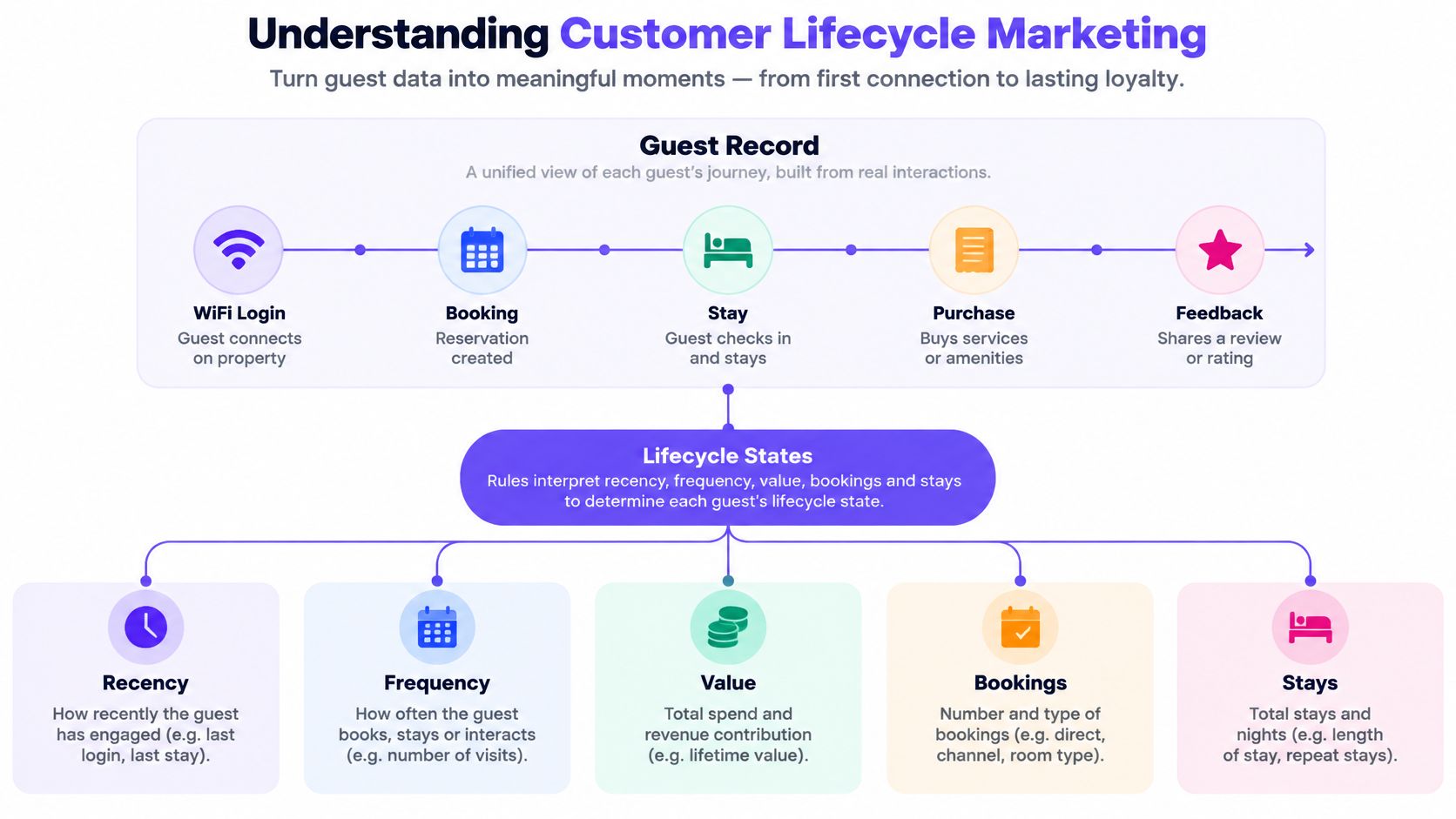
Start with a guest record that reads like a timeline: WiFi registration, booking, stay, purchase, feedback. Each entry adds context, but an event by itself doesn't explain the whole relationship. The team needs rules for interpreting what the guest has done and when.
Those rules create lifecycle states. A venue might use recency, visit frequency, spend, booking history, stay history, and survey answers to distinguish a new guest from a regular or someone whose visits have slowed. The state isn't a permanent label or a statement about a person's character. It's a useful, revisable description of the relationship based on observed activity.
From a list of sends to a feedback loop
A campaign-based approach often starts with a list and a message: select an audience, send an offer, then report opens and clicks. Customer-based marketing asks a different question: what has this guest done, what relationship context does that suggest, and what action is appropriate now?
The operating loop is identify, interpret, act, measure, refine. A guest makes a booking; the venue updates the record; eligibility rules determine whether a message is suitable; the team measures the outcome; and what happens next informs the next decision. The loop closes when measurement changes how the program behaves, instead of ending at the send.
This is why lifecycle marketing isn't a rigid funnel. A guest can become inactive, return, book without joining a loyalty program, or skip a typical stage entirely. The framework helps staff make consistent decisions, but the relationship can move in more than one direction.
Mapping the Main Lifecycle Stages
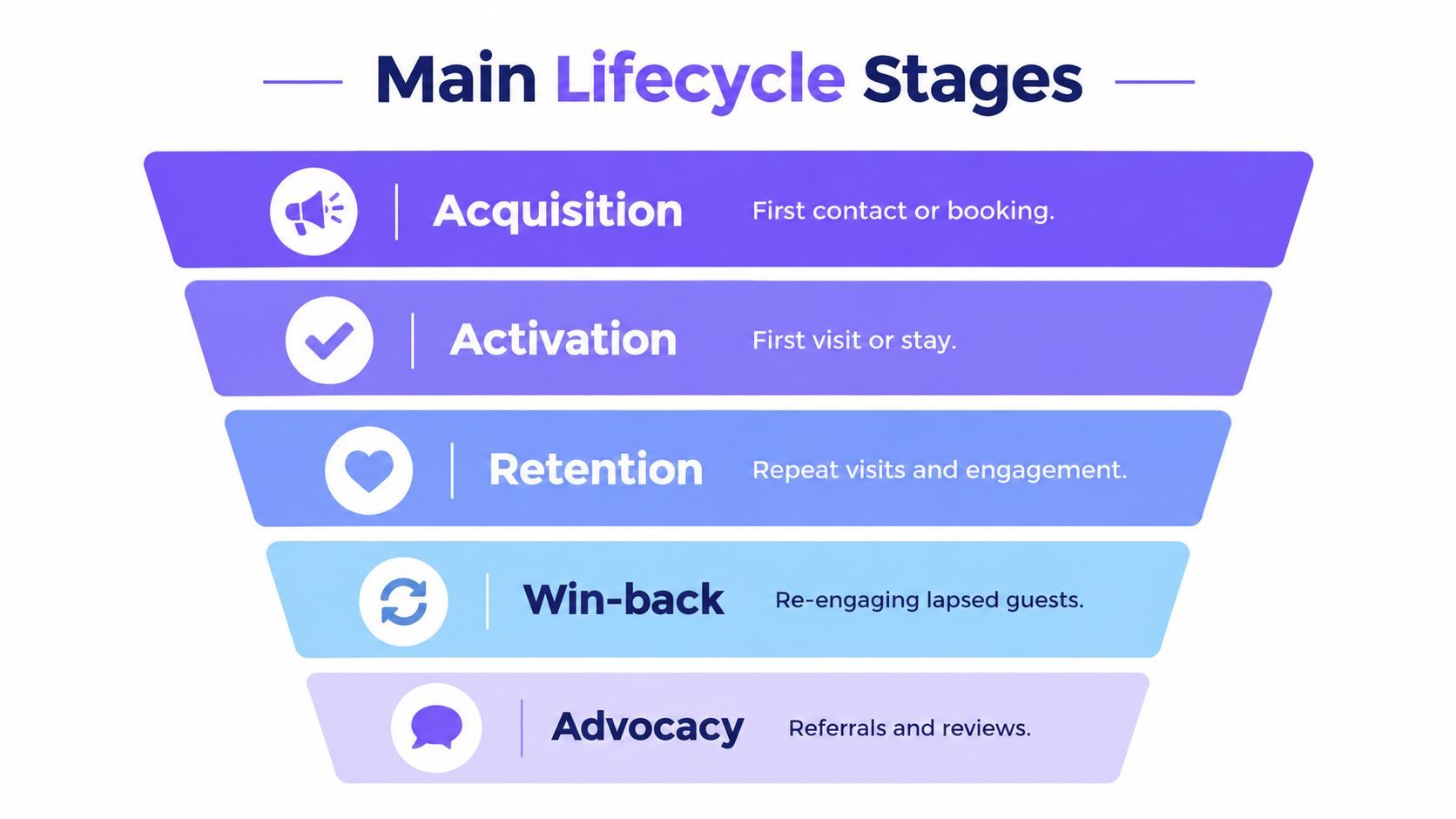
The stages give a venue a shared language for deciding what a guest may need. They're operating hypotheses, not a universal schedule: teams should adapt the signals to the way their guests visit, book, and return. A practical model can use recency, frequency, monetary value, booking history, and survey attributes to guide actions after events such as a WiFi registration, purchase, booking, checkout, or period of inactivity, as outlined in McKinsey's discussion of personalization.
The stages in venue terms
- Acquisition: The signal may be a first WiFi registration, a website enquiry, or a first booking. The venue's job is to make the next step clear, perhaps by explaining what the guest can expect or how to book. Measure whether the contact leads to a meaningful next action, not merely whether the record was collected.
- Activation: A first visit, stay, or purchase shows that the guest has experienced the venue. A timely thank-you, practical follow-up, or feedback request can support the relationship. Look for a later interaction that indicates the guest found enough value to consider returning.
- Retention: Repeat visits or bookings suggest a developing habit. Recognize relevant preferences or introduce an experience the guest may value, without sending the same generic promotion each time. Track whether the relationship continues, not just whether the message received attention.
- Win-back: A guest whose visit pattern has changed may be a candidate for a gentle invitation to return. For example, a venue could test a “no visit in the last 45 days” audience, then compare return behavior with an appropriate control group. The right threshold depends on the venue's usual visit pattern.
- Advocacy: A completed visit followed by positive feedback may be a suitable moment to invite a review or referral, subject to the venue's policies and the guest's consent. The outcome is useful feedback or a genuine recommendation, not just another message sent.
These stages don't have to happen in order. A first-time diner might book again immediately, while a regular may become inactive before returning later. If you're mapping the touchpoints and handoffs, this guide to building a customer journey map can help clarify where the venue has a useful signal and where it has a gap.
For venues that host weddings and other private events, lifecycle thinking also applies to the work around each event, from enquiry to follow-up. This overview of wedding event manager duties offers context on the responsibilities that can shape those guest and organizer touchpoints.
Turning Guest Behavior Into Lifecycle Rules
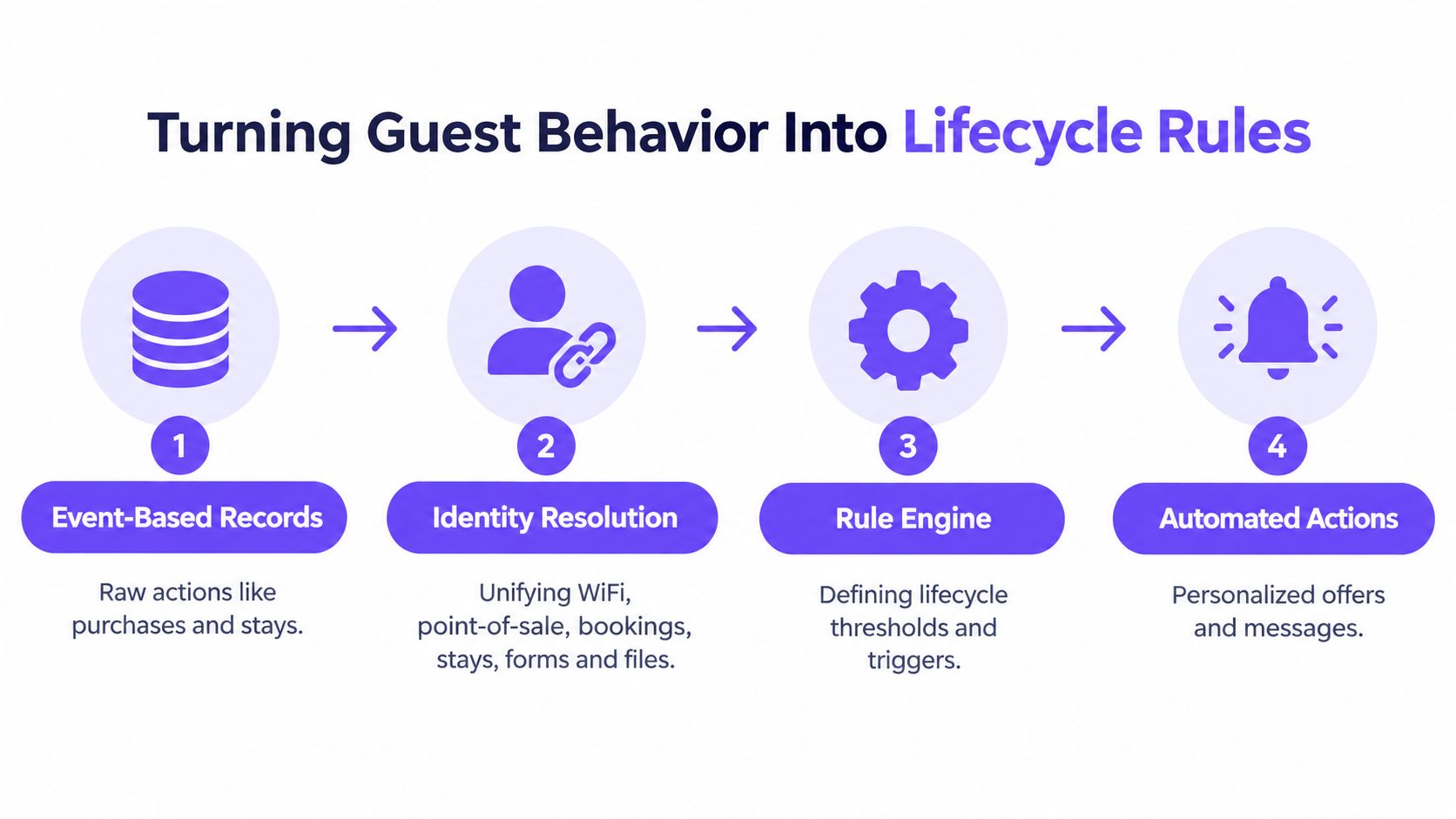
Good lifecycle decisions depend on reliable records, not just attractive campaign ideas. A WiFi login, till purchase, booking, hotel stay, form, and survey response can each add a timestamped event to a guest history. Identity resolution connects events that belong to the same person, while preserving the limits set by consent and the venue's own policies.
The next job is to define eligibility. A venue might describe a “lapsed regular” as someone whose current time since their last visit is longer than their usual interval, who has the right marketing consent, and who doesn't have an unresolved service issue or recent opt-out. A broad label such as “inactive” isn't enough to justify contacting someone.
Separate context, audience, and action
A lifecycle state describes the relationship context, such as new, returning, or potentially lapsed. A segment groups people who meet specific criteria, such as guests with a particular visit pattern and valid consent. A trigger is the event that starts an action, such as a purchase, booking, checkout, or crossing a defined inactivity threshold.
Keep communication eligibility visible in the rules. Coordinate email, SMS, WhatsApp, offers, surveys, review requests, and advertising so guests don't receive overlapping prompts because each channel has its own audience. Suppression rules should honor opt-outs and avoid unnecessary repeat contact.
Purple Engage can segment guests by visits, spend, tags, and survey answers, including conditions such as no visit in the last 45 days, with segments refreshed within about a minute. The practical point is to make rules usable and reviewable. Teams comparing guest-value approaches may also find this guide to RFM segmentation for restaurants and hospitality useful when deciding which behavior to include.
Hospitality Venue Lifecycle Examples
A café can begin with a WiFi registration. The guest receives a clear welcome that explains what they've signed up for, rather than an immediate string of promotions. After a recorded purchase, the café can send a brief thank-you or ask for feedback, if the guest has agreed to receive that kind of communication.

Suppose the team also wants to know whether a first-visit message encourages a return. It can compare the return behavior of eligible guests who receive the message with a similar group held back from it. If the message earns attention but doesn't lead to additional visits, the team has reason to reconsider its timing, content, or offer.
A restaurant group can use a booking as a signal to send practical information, then use a completed visit to decide whether a feedback request makes sense. A later decline in visit frequency may justify a separate win-back test. Each action has a different purpose: booking support, experience feedback, and a carefully timed invitation aren't interchangeable campaign steps.
A post-visit review request also shouldn't be used to filter who gets the chance to review. Purple Engage's stated capability is to request reviews uniformly after recorded visits, without gating or incentives. That distinction matters for teams that want feedback without steering only satisfied guests toward public review platforms.
A hotel needs context and restraint
For a hotel, a completed stay can support a relevant follow-up, but it doesn't mean every stay detail should be reused in marketing. A guest's preferences, consent, booking history, and future interactions can help a team choose a useful message. The message should fit what the guest would reasonably expect, not reveal sensitive or surprisingly specific details.
Accommodation marketers can also consider how their distribution and promotional activity fits the wider guest relationship. This overview of CS Outsource Airbnb marketing provides related context for short-term rental marketing. The lifecycle principle remains the same across venue types: use an appropriate signal, respect the permission attached to it, and measure the outcome rather than assuming that a personalized message worked.
A short explainer can help teams discuss how these journeys fit together:
Matching Communications to Customer Intent
A channel is a delivery choice, not a reason to contact someone. Start by asking what the guest may need at this point in the relationship, what the venue can responsibly offer, and whether the guest has given permission for the chosen channel. Then set one primary measure that reflects the purpose of the message.
| Lifecycle signal | Communication role | Venue example | Primary measure |
|---|---|---|---|
| New WiFi registration | Set expectations and welcome | Explain what the guest signed up for and how to book | Subsequent booking or visit |
| Upcoming booking | Provide useful, time-sensitive information | Send a booking-related reminder through an appropriate channel | Completed booking or visit |
| Recorded visit | Learn about the experience | Invite the guest to answer a survey | Survey completion and useful feedback |
| Completed visit | Encourage public feedback | Send a consistent review request where appropriate | Review activity |
| Declining visit pattern | Invite a return without assuming the cause | Test a relevant email or offer against a holdout | Incremental return visits |
Email can explain a new menu or event in more detail; an SMS may suit a time-sensitive, booking-related message when the guest has consented. A survey can help staff identify friction, while a review request can give guests a chance to share their experience. A paid audience can support discovery, but it shouldn't bypass consent or the venue's suppression rules.
Message fatigue is a real design concern. An Optimove report says 81% of surveyed consumers were more likely to open interest-tailored email, while 89% said they unsubscribe because of repetitive offers; the contrast supports relevance with restraint, not personalization at any cost (Optimove's consumer marketing fatigue report).
Practical rule: Coordinate frequency across channels as one guest experience. A person shouldn't receive several versions of the same promotion just because email, SMS, and advertising teams work from separate schedules.
Delivery problems can also interfere with a well-planned journey. If guests aren't receiving email as expected, teams can check whether their emails go to spam before concluding that the content itself is the problem.
Measuring Incremental Lifecycle Value
Opens and clicks can help diagnose whether a message reached someone or gave them a reason to interact. They don't show whether the campaign caused a visit. A guest may have planned to return anyway, and an attractive offer may produce a purchase while reducing the margin on that visit.
A holdout group helps answer the causal question. Randomly withhold an eligible group from the lifecycle action, then compare its behavior with the group that received the message. Track outcomes that matter to the venue, such as visits, bookings, purchases, spend, and the quality of reactivation. Where appropriate, include a confidence range so the team can describe uncertainty rather than treating one result as exact.
Customer value depends on more than message-attributed revenue. Future contribution, purchase frequency, margins, retention, servicing costs, and discounts all affect whether the relationship is worthwhile. A campaign that brings a guest back only with repeated discounts may look active in a dashboard while weakening profitability.
Measure the change, not just the response. A click tells you someone acted on the message. A holdout comparison helps you judge whether the message changed what they did.
When a journey underperforms, diagnose the stage before rewriting everything. Check whether records are connected, the audience rule fits actual visit patterns, consent is valid, the message suits the moment, and the selected measure matches the goal. Then test a change against a comparison group. For a deeper view of relationship value, see this guide to customer lifetime value in restaurants and hotels.
Build a Responsible Lifecycle Marketing Program
A venue team can use this checklist before activating a journey:
- Resolve identities: Check that WiFi, purchase, booking, stay, and feedback records are connected appropriately.
- Respect permission: Verify consent for each channel, keep opt-outs durable, and suppress guests who aren't eligible.
- Use real behavior: Set lifecycle rules from observed visit and booking patterns, not copied assumptions.
- Coordinate messages: Review contact frequency across channels, offers, surveys, reviews, and advertising.
- Set clear approvals: Make human review and accountability part of the process, especially for offers and sensitive personalization.
- Test outcomes: Use a holdout where possible and compare incremental activity, costs, and margin.
Three misconceptions are worth correcting. Lifecycle marketing isn't just a newsletter sequence. Personalization isn't permission to use every available signal. And a stage label doesn't prove that a guest is valuable or that a message will change behavior.
The strongest program is a continuously tested operating model. It connects guest history to appropriate communications, protects the guest's choices, and changes course when evidence shows a journey isn't helping.
Purple Engage brings WiFi sign-ins, point-of-sale receipts, bookings, and hotel stays into a shared guest record, with tools for segmentation, consent-aware campaigns, and holdout-based measurement. Explore Purple Engage to see how those capabilities could support a more connected, responsible lifecycle program for your venues.