
What is zero party data for venues
What is zero party data? How venues collect stated preferences, keep consent separate, and use answers beside visits and spend.

Zero-party data is what a guest intentionally tells you they want, rather than what you infer from visits, spend, WiFi or bookings. You're likely staring at a guest record right now that shows transactions, sign-ins and stays, yet it still can't tell you why that person came in or what they'd like next time. That gap is where a direct question helps. Ask clearly, store the answer properly, and you've got a stated preference you can act on without guessing.
Table of Contents
- What Zero-Party Data Means Beside Other Guest Data
- Why Guests Answer When the Benefit Is Obvious
- How to Collect Answers with Surveys and Forms
- Zero-Party Examples for Restaurants Hotels and Retail Venues
- Preferences Consent and What You Already Observed
- Test One Stated Preference Before You Scale
What Zero-Party Data Means Beside Other Guest Data
Say a restaurant guest orders a vegetarian dish on a busy Friday. Your till records the item, the time and the amount paid. It doesn't record whether vegetarian food is that guest's preference, a one-off choice, or an order picked for someone else at the table.
Only the guest can settle that. If a short survey asks about dietary requirements and they select vegetarian, that's a different kind of record. The purchase was observed. The preference was stated.
What counts as zero-party data
Zero-party data is information a customer intentionally and proactively shares directly with a brand. The peer-reviewed summary of the Forrester definition notes Forrester Research popularised the category in 2018, building on a definition attributed to Forrester analysts Khatibloo and colleagues in 2017, covering preference-centre information, purchase intentions, personal context, and how a customer wants a brand to recognise them.
That definition answers what zero party data is in plain terms. It's the guest telling you, in their own selection, rather than your team inferring it from browsing, purchasing, location or other behaviour.
- Dietary needs: A guest selects vegetarian, vegan, halal or an allergen note in a restaurant survey.
- Stay preferences: A hotel guest identifies a preferred room type before arrival.
- Communication choices: A guest picks email, SMS or WhatsApp, or says they want birthday offers.
- Visit context: A guest states an occasion, a trip purpose or an interest they'd like offers matched to.
Each example shares one feature. The guest knows they're giving you that information, and they can see the point of giving it.
The four types side by side
Think of the labels as a sorting exercise based on how the data was created, not how valuable it sounds in a sales deck. Zero comes first in directness, not because it's newer or better in every situation.
| Type | How it is created | Venue example | Main limit |
|---|---|---|---|
| Zero-party | Guest intentionally states it | Dietary preference, room type, channel choice, birthday offers, visit occasion | Explicit but can be biased or stale; not automatic marketing consent |
| First-party | Observed in your own interactions | WiFi sign-in, till purchase, booking, hotel stay | Behaviour needs interpretation and is not the same as stated intent |
| Second-party | Another organisation shares its first-party data | A partner venue or brand passes a consented guest list | You inherit their collection quality and their consent scope |
| Third-party | Aggregators compile it, often via cookies and tracking | Bought audience segments | Weakening as cookies decline; least transparent value exchange |
First-party data comes from your own systems. A WiFi sign-in, a till item, a booking and a completed stay all happened with you, so you can see what occurred. You still have to interpret what it means.
Second-party data is another organisation's first-party data shared with you. A partner venue might pass a consented list for a joint event. You didn't collect it, so you're relying on how carefully they asked, recorded and consented those guests.
Third-party data sits furthest from the guest. Aggregators compile segments using cookies and other tracking, then sell audiences such as likely diners or frequent travellers. The guest rarely has a clear moment where they understood that exchange.
A purchase tells you what happened. A stated preference tells you what the guest says they want next.
What the label does not promise
Zero-party describes the source and manner of collection. It doesn't guarantee the answer is accurate, complete or lawful to use for every purpose you can think of later.
You still need a clear purpose for asking, appropriate consent where it's required, secure storage, and a way for the guest to correct or withdraw what they shared. A guest who states a dietary requirement for tonight's service hasn't handed you a permanent, unlimited profile field.
That caveat isn't a reason to avoid asking. It's a reason to ask fewer, better questions, and to treat each answer as a guest's statement you hold on trust. Done well, survey answers, stated interests and purchase intentions add explicit context to a guest record, with a clearer value exchange than quiet tracking provides.
Why Guests Answer When the Benefit Is Obvious
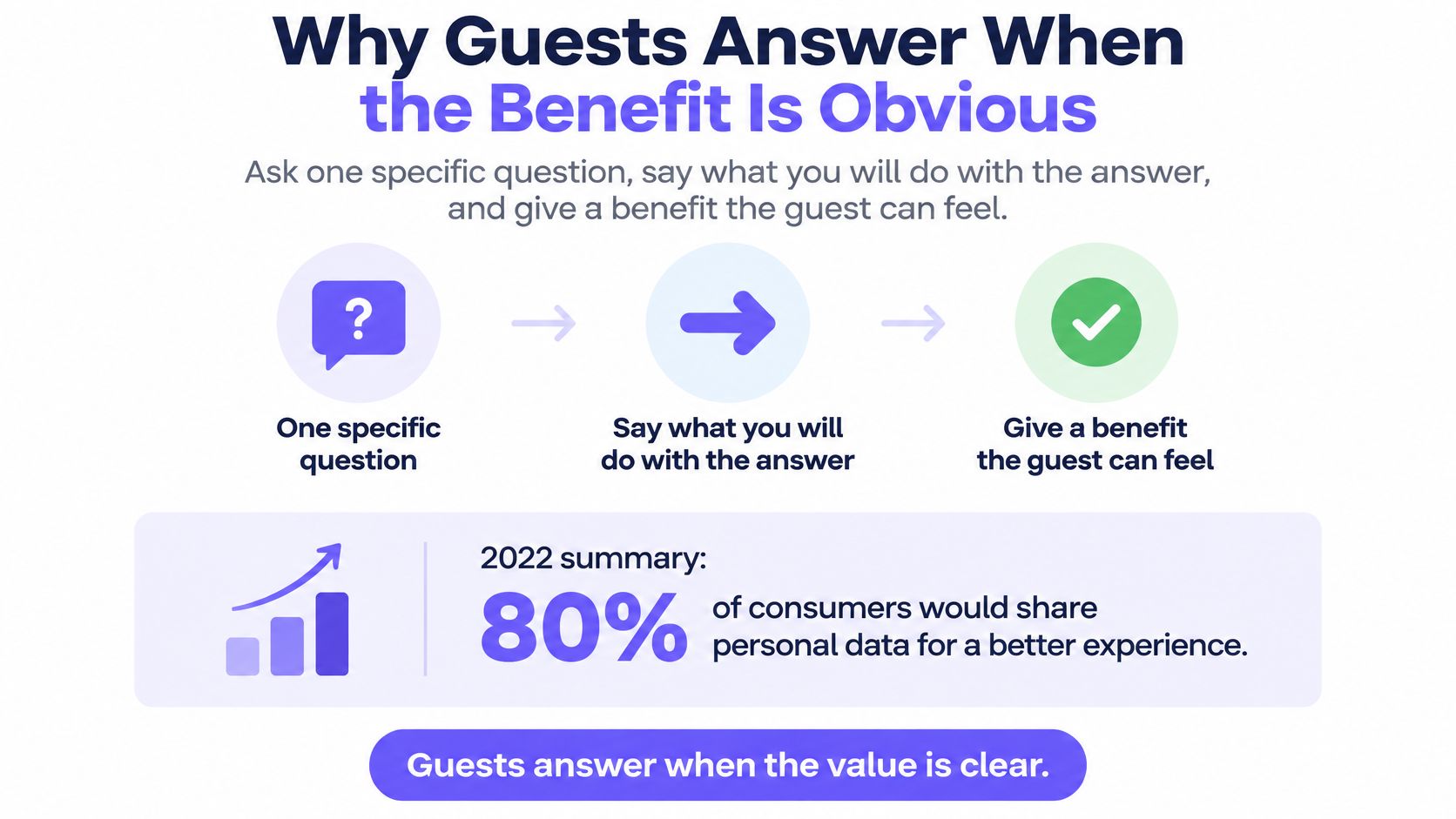
Guests don't answer questions out of generosity toward your database. They answer when the trade feels fair and immediate. The operating rule is simple: ask one specific question, say what you'll do with the answer, and give a benefit the guest can feel.
"Tells us your dietary needs so we can brief the kitchen" passes that test. "Complete your profile for a more personalised journey" doesn't, because the guest can't picture what changes. Specific beats vague every time.
What the willingness numbers actually show
A 2022 study summary reported by Retail Customer Experience found 80% of consumers were willing to share personal data for loyalty-program benefits. It also reported 70% would share it for special discounts or offers, and 71% said they would shop more often with brands that personalize communications.
That same coverage points to an April 2020 survey of 1,000 U.S. adults conducted by Epsilon and GBH Insights, in which 80% wanted personalization from retailers. Two different surveys landing in a similar place suggests guests aren't opposed to relevance. They're opposed to giving information away for nothing.
Trust follows the same pattern. The Attest zero-party data research published in 2024 reports that in its December 2023 survey of 1,500 working-age U.S. consumers, 48.0% said they would be more likely to trust brands that requested zero-party data rather than using passive collection methods.
Why marketers are paying closer attention
Stated data also matters because borrowed signals are getting thinner. A summary of the 2024 Deloitte retail-trends study reported 60% of marketers felt mostly or very prepared for a cookieless future. That's context, not proof cookies have already vanished, but it does explain why voluntarily shared answers carry more weight in planning.
- Relevant offers: A guest states they're interested in weekday dining, so weekday offers stop being a guess.
- Better service: A dietary requirement reaches the kitchen before the guest has to repeat it at the table.
- Chosen contact: A preferred channel means the next message arrives where the guest wants it.
Good question design still decides whether anyone responds. If you're working on completion rates, the practical guidance on how to lift survey response rates is worth applying before you blame guests for silence.
The limits you shouldn't ignore
Those surveys differ by year, country, sample and wording. They don't combine into one global benchmark, and they don't promise your guests will answer your form.
What they support is narrower and more useful. Willingness rises when people understand the exchange and expect something meaningful back. Willingness isn't a blank cheque to ask anything, ask often, or ask at the worst possible moment in the visit.
How to Collect Answers with Surveys and Forms
Collection works when it's built backwards from a decision. Don't start with a form builder and a blank page. Start with what staff or your next message will do differently once the answer exists.
The workflow below keeps that order. Each step either improves the answer you'll get or protects you from collecting something you can't use.
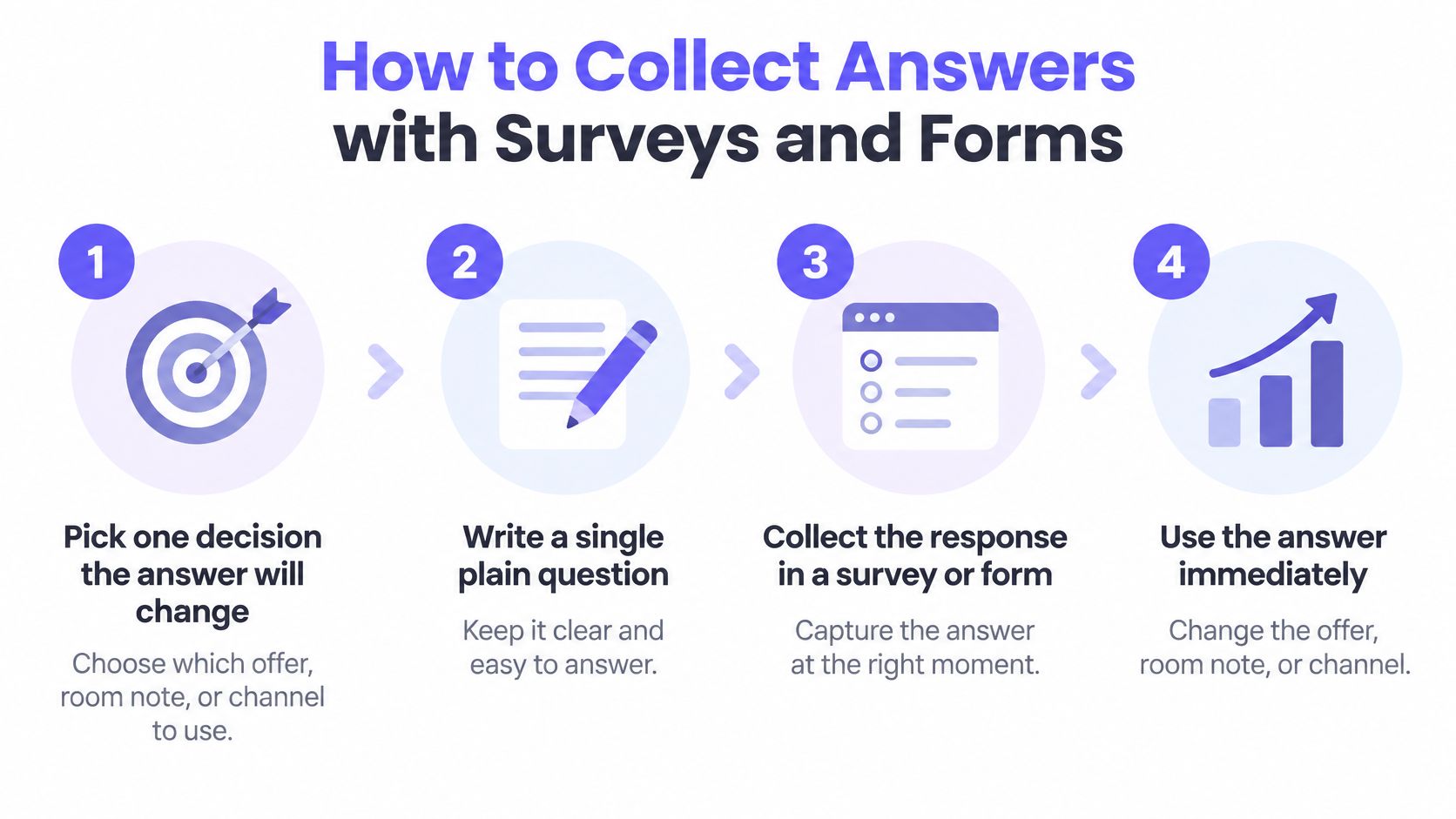
The seven step venue workflow
- Pick one decision the answer will change: Choose which offer to send, which room note to add, or which channel to use. If nobody can name that decision, you don't have a question yet, you have curiosity.
- Write a single plain question with a visible benefit: "Tell us your dietary needs so the team can brief the kitchen" works because the purpose sits inside the question. Avoid stacking two questions into one field, such as occasion and frequency together.
- Choose the moment carefully: Use a WiFi welcome, a booking confirmation, a QR code on the table, a kiosk, or a short post-visit form. Keep it to a few fields, because a long form at the door competes with the guest trying to sit down, order or check in.
- Use question types that store cleanly: Use single choice for occasion, multi-select for dietary needs, a date field for a celebration, and a separate yes or no for marketing. Free text has its place for detail, but it won't segment reliably without someone reading every entry.
- Save the answer with its provenance: Store timestamp, form name, question version and source, then attach the answer to the guest matched on email. Purple Engage's forms and surveys tools write answers back to that guest record, so the response isn't stranded in a spreadsheet.
- Set an expiry for time-sensitive answers: A trip purpose, a one-off event or a renovation period preference shouldn't live forever. Decide at collection when the answer stops being safe to act on.
- Show the guest how to change or delete it: Give them a route to update a preference or remove it. People share more readily when they can see they aren't locked into a statement they made months ago.
Three slips that waste the effort
The first slip is length. Every extra field is a small toll on attention, and guests pay it with abandonment rather than complaints. You'll see the cost as silence, not feedback.
The second is asking a question you won't act on. If a guest tells you they prefer quiet tables and nothing changes on the next three visits, you've taught them that answering is pointless. Trust spent that way is hard to earn back.
The third is burying marketing consent inside the preference question. Someone stating a dietary need is giving you service information. They aren't automatically agreeing to promotional messages, and your form shouldn't pretend otherwise.
Staff test: If the team can't say what they'll do differently with the answer, don't ask it yet.
A lighter touch can still teach you something
Not every exchange needs to read like admin. A short, well-framed quiz can make stated preferences feel like play rather than paperwork, which is why a prompt to check your eco-friendly travel habits works as a model of tone for travel venues. The guest gets a result, you get a stated set of habits and interests, and neither side pretends the exchange is anything else.
Keep the principle, whatever the format. One decision, one clear question, one visible benefit, and a clean record of what was said and when.
Zero-Party Examples for Restaurants Hotels and Retail Venues
Examples make the distinction stick better than definitions do. Each scene below follows the same three beats. A question gets asked, an answer gets stored, and a specific action changes because of it.
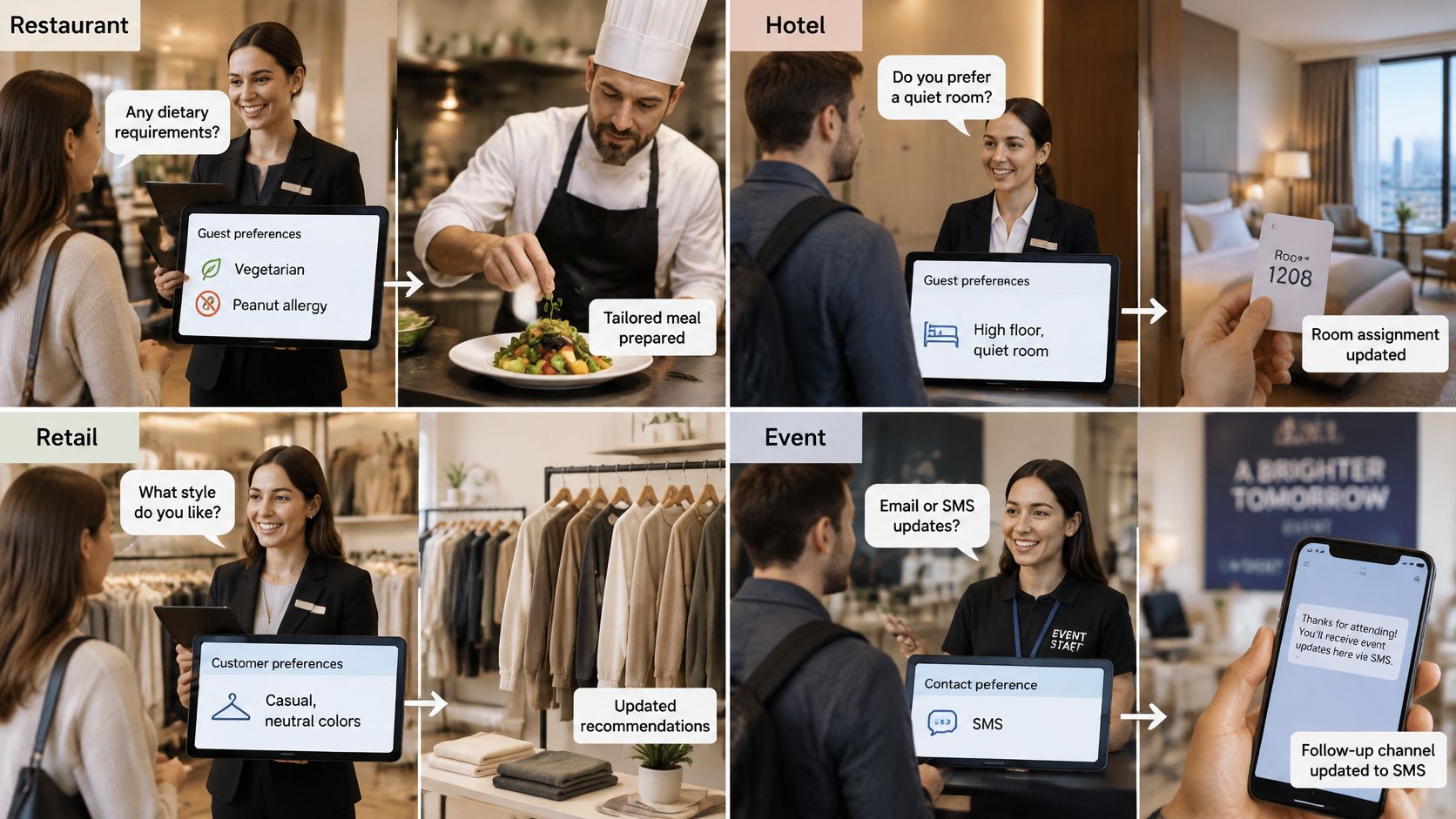
The image below shows how different those collection moments look across venue types, even though the underlying pattern stays the same.
Restaurant and bar scenes
Say a restaurant asks, "Any dietary requirements?" during booking or on a post-visit form. The stored answer might be vegetarian, or a specific allergen note. The changed action is practical: the pass gets briefed before service, and meat-led offers stop reaching someone who told you they don't eat meat.
Notice what didn't happen. The answer didn't create a consent flag, and it didn't rewrite the guest's order history. It added meaning the till couldn't supply on its own.
A bar or café can ask a different question. "What usually brings you in?" might offer after-work, weekend or remote-work options. Someone who picks remote-work is a plausible candidate for a quiet-hour offer with good WiFi and table space, while the after-work guest isn't. The occasion routes the offer, so you aren't blasting the whole list and hoping.
Hotel and retail scenes
A hotel asks before arrival about preferred room type, trip purpose and any celebration date. The stored answers might be a quiet upper-floor room, leisure rather than business, and an anniversary next month. Front desk gets a better pre-stay note, and a timed message can acknowledge the occasion.
The booking system still owns the reservation itself. Dates, rates and room inventory aren't zero-party data just because the guest typed them. The preferences layered on top of the booking are the stated part.
A retail venue with guest WiFi might ask which categories a shopper cares about, plus whether they prefer email or SMS. Categories set the theme of the next message. The channel choice decides where it lands.
| Venue | Question | Stored answer | Action it changes |
|---|---|---|---|
| Restaurant | Any dietary requirements? | Vegetarian or allergen note | Briefs the pass and suppresses meat-led offers |
| Bar or café | What usually brings you in? | After-work, weekend or remote-work | Routes a quiet-hour offer to the matching occasion |
| Hotel | Room type, trip purpose and celebration date | Preferred room type, business or leisure, date | Shapes the pre-stay note and a timed message |
| Retail with guest WiFi | Preferred categories and channel | Categories plus email or SMS | Sets the next message theme |
The short video below is a useful pause point if you want to see the idea explained before moving into the governance side.
Keeping multi-site answers comparable
If you run several sites, use the same question wording everywhere. "Weekday dining" at one restaurant and "midweek meals" at another will frustrate anyone trying to compare segments. Shared wording keeps the data comparable, while the actual offers can stay local to each site.
Two other fields belong in this family. A satisfaction score is a stated judgement about a visit, useful for service follow-up. A stated purchase intention, such as planning a group booking, signals future plans behaviour hasn't shown yet.
Each example works for the same reason. Staff can name the different action the answer triggers, in one sentence, without hand-waving.
Preferences Consent and What You Already Observed
Return to the vegetarian order one more time, but look at it as a records problem. A purchase history might show a guest bought vegetarian food twice. That could mean a firm preference, a visiting friend, or the only dish left on a set menu.
A form response where the guest states they actively prefer vegetarian options removes the guesswork. That's why zero-party data works as a semantic layer over transactional records, rather than a replacement for them.
Three records you must not merge
The confusion starts when one field gets asked to do three jobs. Keep these records separate, even if they sit on the same guest profile.
- Preference record: What the guest says they want, such as dietary requirements, communication choices, satisfaction scores or visit reasons.
- Consent record: Whether email, SMS, WhatsApp or advertising contact is allowed, and on what basis.
- Event record: What happened, including visits, spend, bookings, WiFi logins and check-outs, which decides eligibility today.
A TechTarget comparison of zero-party and first-party data makes the underlying distinction by data-generation mechanism. A purchase, WiFi login, booking or page view is generally first-party behavioural data, while a survey answer or preference selection is an explicit assertion by the individual, so segmentation doesn't need a model inferring intent from noisy proxies.
Accepting WiFi terms belongs firmly outside the consent record. That agreement covers network use. It isn't permission to send marketing, however convenient it would be to treat it that way.
What to store on every answer
Store each response with a timestamp, the source form, the question version, the consent status at the time, and an immutable change history. If a guest updates a preference, you want the new answer to govern while still being able to see what changed and when.
Write down the purpose, field meaning, retention period and permitted activation channels for each field. It sounds like paperwork. It is what stops a dietary answer given for tonight's service drifting into unrelated campaign targeting a year later.
Then re-check eligibility immediately before email, SMS, WhatsApp or advertising activation. An old preference must never be treated as perpetual permission to keep sending.
A preference explains what to say. Consent decides whether you may say it. Events decide whether it's still true today.
How the three records work together
Say a guest selects weekday dining as their preferred occasion. That preference can put them into a weekday offer path. A recent booking or purchase then decides whether they're eligible right now, and gives you the outcome to measure afterwards.
For a plain-language sense of how venues explain data handling to guests, the privacy details for group bookings at an escape room operator show the kind of specifics guests look for before they share. Your own wording should be at least that clear about purpose and contact.
Before activating any answer, check the consent rules for each market you operate in. For en-gb sites, that means UK GDPR and PECR for electronic marketing messages, and it's worth following structured guidance on managing consent and unsubscribes for venue email rather than relying on habit.
Your action from here is a labelling exercise. Mark every field as preference, consent or event before it goes anywhere near a journey. Fields that can't be labelled cleanly probably shouldn't be used yet.
Test One Stated Preference Before You Scale
Stated answers feel trustworthy because they came straight from the guest. That's exactly why they need testing. An explicit answer can still be wrong, dated or collected so clumsily that it misleads everyone who uses it.
Scale too early and you'll automate your mistakes across every site. Test one preference properly and you'll know whether it earns wider rollout.
Where stated answers mislead
People sometimes answer what sounds reasonable rather than what's true. A guest might select healthy options in a survey, then order what they fancy at the table. That's response bias, and it doesn't make the guest dishonest, it makes the signal partial.
Others skip fields, pick the default, or tap the first option to get through the form. Those answers look identical to considered ones in a database. Treating them with equal confidence is a quiet error.
Answers also go stale. A birthday stays fixed, but a trip purpose, a weekday dining habit or a dietary choice can shift with a new job, a new address or a new year. A preference captured for one visit shouldn't continue to govern communications long afterwards.
Duplicates create a third problem. If a guest submits twice and only the last row survives, a rushed second answer can overwrite a better earlier one. A Twilio explainer on first-party versus zero-party data makes the same quality point, noting zero-party data reduces inference error but can introduce response bias and stale attributes, so controls should include required-field logic, clear question wording, duplicate-response handling, expiry dates for time-sensitive preferences, and provenance at answer level.
A small pilot that proves something
Pick one high-traffic site and one question tied to an action this month. Dietary needs for the kitchen or visit occasion for a weekday offer both work, because the changed action is easy to observe.
- Write the benefit beside the question: State what changes for the guest, right where they're deciding whether to answer.
- Store the answer on the guest record: Keep one current answer per question, with provenance, rather than scattering versions across tools.
- Keep marketing opt-in separate: In our platform, only an explicit opt-in is treated as marketing consent, and accepting WiFi terms doesn't grant it. That separation is deliberate, because a disclosed answer never authorises every later use.
- Approve the audience before sending: Have a person check who's included, and exclude anyone who's opted out even if an import still contains them. Our consent checks run twice, imports can't undo an opt-out, and erasure stays erased.
Our guest WiFi login is the most reliable mechanism we offer for capturing verified, GDPR-compliant first-party data in a physical venue. That behavioural foundation gives your stated preference something solid to be tested against.
Measuring visits, not applause
Measure with a randomised holdout. By default, 5% of every new campaign and automation in our platform is held back for measurement, so you can compare contacted guests against withheld ones.
Compare incremental visits, bookings or purchases, not opens and clicks alone. Report a confidence range, and check subgroups such as your dietary segment, because an average lift can hide a group you annoyed.
Form completions aren't success either. A question can collect beautifully and still change nothing at the till. Judge the pilot on extra visits or purchases the contacted group made beyond the holdout.
Decision rule: One stated preference, one site, one measured outcome. Scale only what survives the holdout.
This approach turns zero-party data into governed, testable decision data. The explicit answer selects the audience, behavioural events enforce the conditions, and the experiment estimates the commercial effect. For multi-site venues already capturing WiFi, tills, bookings or stays, we keep one guest record, one consent ledger and survey answers attached to that record, so the test and the rollout use the same foundation.
Start with one question your guests will happily answer, and let Purple Engage attach that stated preference to the same guest record that already holds WiFi sign-ins, purchases, bookings and stays. You'll get one consent ledger, survey answers you can segment on, and holdout measurement that shows whether the answer drives extra visits. Visit us today and put your first zero-party question into service.