
How to increase survey response rate in 2026
See how to increase survey response rate with a short post-visit invite, two reminders, and an incentive test against a no-reward group.
An initial survey invitation produced a 6.2% response rate, but a sequence with reminders reached 31.2% in a 15,651-person web-survey experiment. The operational lesson isn't to write a cleverer subject line. It's to give people who missed the first request another sensible opportunity to answer.
For venue marketers working out how to increase survey response rate, there are two separate scores to improve: how many eligible guests complete the survey, and which guests remain absent. A busy restaurant can collect more answers while still hearing mostly from its regulars. Build the invitation, reminder and channel rules around both scores.
Table of Contents
- Response Lifts Worth Acting On
- How to Time the Invite and Reminders
- Questions Guests Will Finish on a Phone
- Test a Reward Against No Reward
- Reach Guests Who Usually Stay Silent
- Launch One Post-Visit Survey This Week
Response Lifts Worth Acting On
A response lift only matters if it changes who answers. A sequence can raise completions by giving absent guests another sensible opportunity. It can also increase the total while still missing the occasional visitors whose feedback is hardest to replace, so judge completion and respondent mix separately.
The web experiment above found that extra contact mattered more than small wording changes. Use its results as a reason to test a staged sequence, while keeping expectations tied to your own audience and survey.
Published lifts in survey response
The figures below retain their original settings. Percentage-point increases, percentage lifts and response-rate ratios aren't interchangeable.
| Tactic | Evidence | Reported lift | Use it when |
|---|---|---|---|
| Opening web invitation only | Web experiment described above | 6.2% response | Establish the baseline before adding contacts |
| First reminder to nonrespondents | Same experiment | +10.3 percentage points | The first invitation hasn't produced a completion |
| Final reminder | Same experiment | +8.6 percentage points | The field period is approaching its close |
| One further reminder | Same experiment | +6.1 percentage points, 31.2% total | Test the marginal benefit; keep the routine sequence restrained |
| Money included with the invitation | Meta-analysis of 38 mail-survey studies | 19.1% average increase | A prepaid benefit is affordable and disclosed upfront |
| Nonmonetary reward with the invitation | Same mail-survey analysis | 7.9% average increase | The benefit is simple and isn't tied to favourable answers |
| Prepaid reward versus promised reward | Same mail-survey analysis | Upfront rewards outperformed rewards delivered only after return | Set reward delivery terms before launching an incentive |
| Approximately US$0.42 incentive | 2024 JMIR mHealth study | 35% greater completion likelihood than no incentive | Pilot a modest benefit rather than assuming a large reward is necessary |
| QR mixed mode versus paper without an incentive | 2025 Interactive Journal of Medical Research study | 88.7% versus 81.5% participation | Offer an additional route instead of relying on paper alone |
Don't subtract or multiply these results to forecast a campaign. The studies involve different audiences, survey modes and reward arrangements. The mixed-mode comparison doesn't isolate a universal QR-code effect, so treat an extra response route as a distribution test.
Choose a lever, not a bundle
Start with a reminder experiment because it changes the contact process without introducing reward redemption. Send only to guests who remain eligible and haven't completed the survey. Keep the questionnaire and audience rules stable while comparing the sequences.
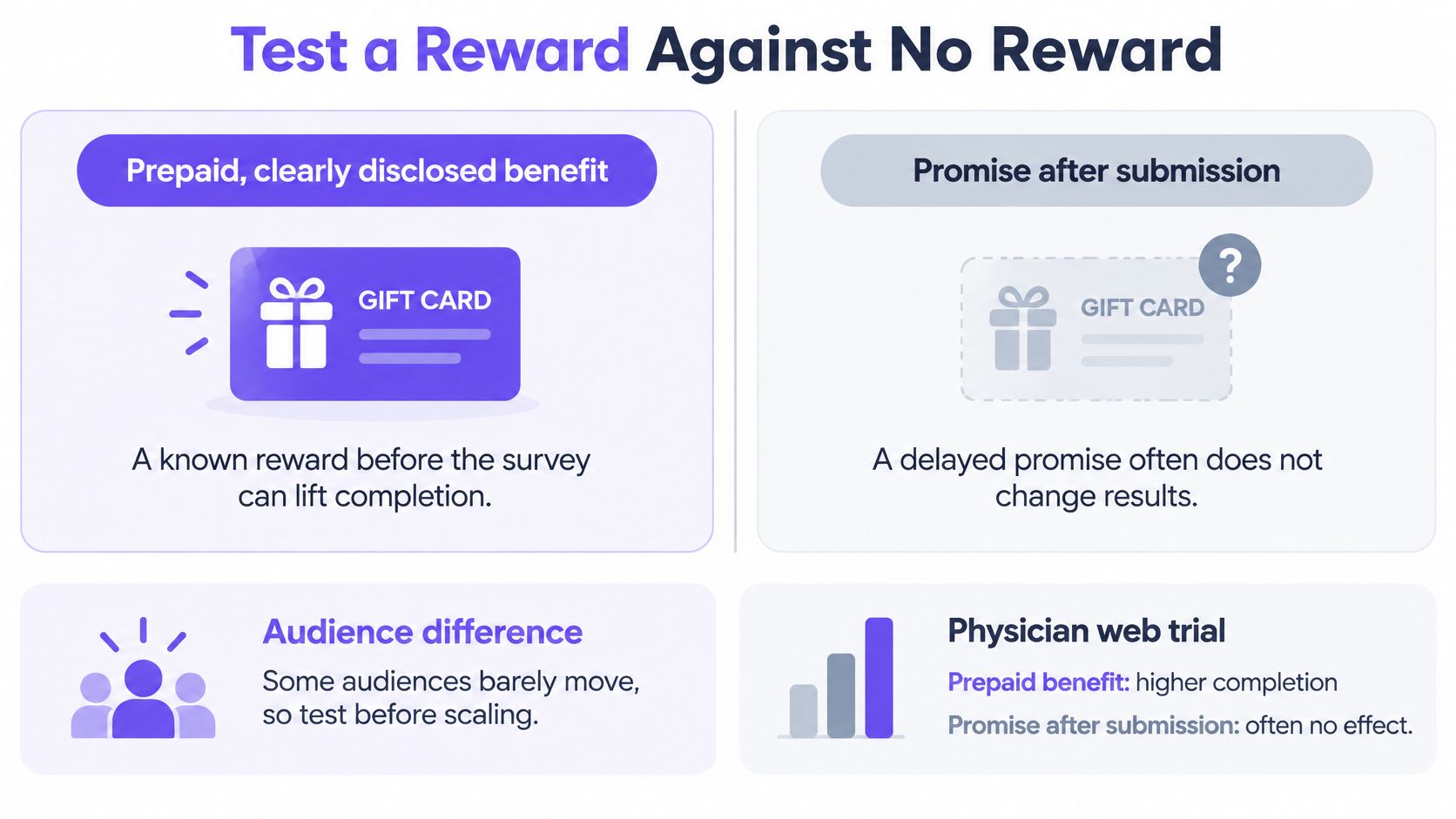
If budget allows, run a separate incentive pilot. A reward supplied upfront is different from a reward merely announced upfront and delivered after submission. The mail-survey analysis didn't find an equivalent effect from rewards promised only after return.
For a practical checklist covering invitation wording, questionnaire friction and distribution, the Formbricks survey response strategies are a useful companion to the experiment.
Practical rule: Don't introduce a new reward, a new channel and a new reminder schedule simultaneously. You won't know which change earned the extra responses.
Choose a reminder sequence and, separately, a prepaid-incentive test if appropriate. Judge each against completed responses and the mix of guests answering. More replies from already-engaged visitors won't tell you why occasional guests stopped coming.
How to Time the Invite and Reminders
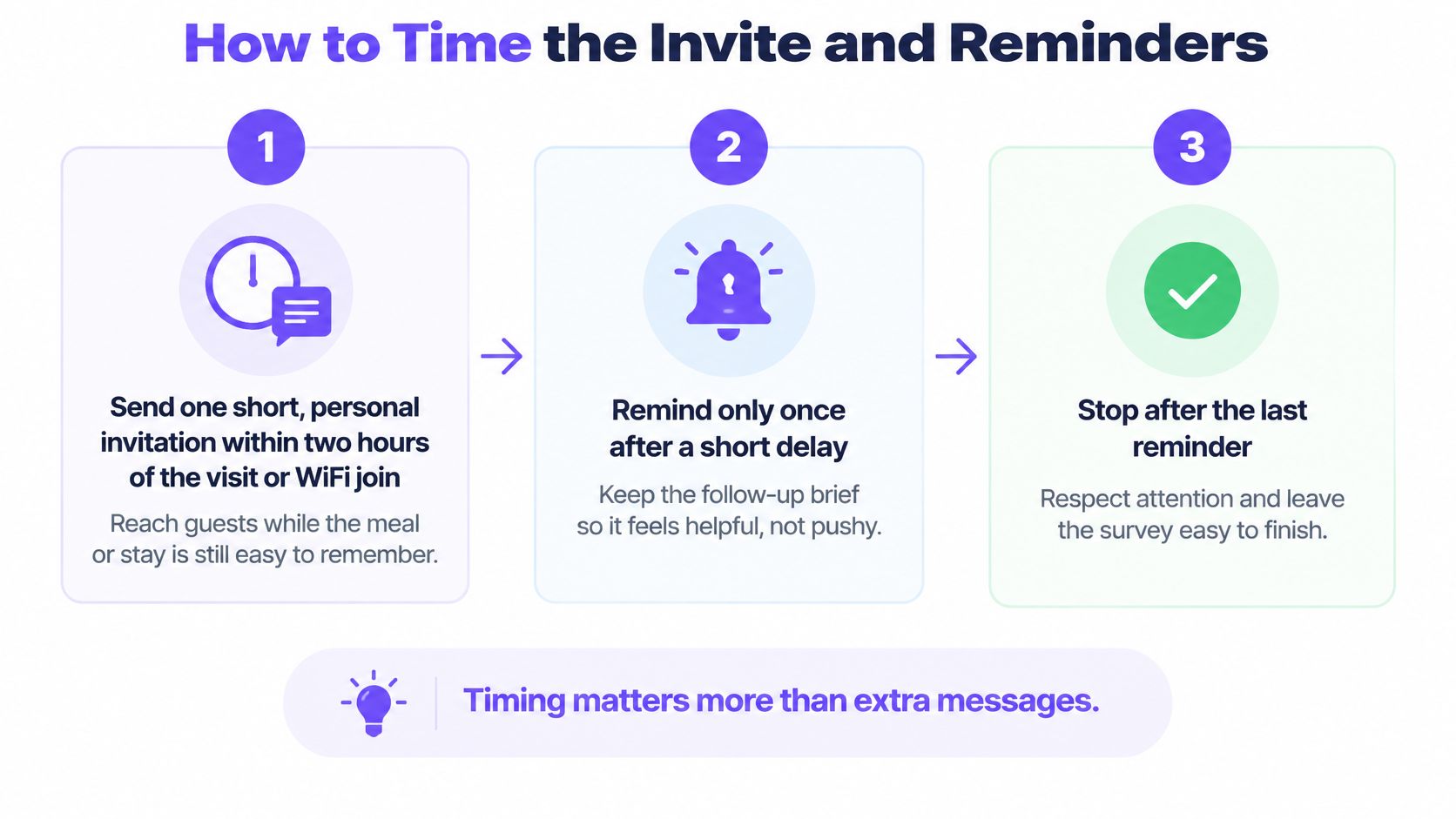
A reminder can recover a missed opportunity, but it also consumes attention. Set the closing date and exclusion rules before scheduling the first message.
In a German online business-survey experiment, a second reminder sent two days before field closure increased participation among previously nonresponding firms by 8.9 percentage points, compared with no additional reminder, according to the Journal of Survey Statistics and Methodology study. That supports a deadline-aware follow-up, not an automatic resend the next morning.
Load the sequence with exclusions built in
Send the invitation after the relevant experience. Use a recorded visit, completed meal or checkout rather than an arbitrary list-upload date. A WiFi join can trigger a request, but don't assume the guest has finished eating or completed their stay.
Explain the request in the message. Name the venue, the visit and the operational purpose. State a completion-time estimate only after testing the actual questionnaire, and give the guest a single primary survey action.
Check eligibility again before every send. Remove completers, opted-out guests and anyone inside your invitation cooldown. A person who opened the email but didn't submit remains a nonrespondent; a person who submitted through another channel doesn't.
Schedule the reminder around a real deadline. Allow space for the initial invitation to work, then contact eligible nonrespondents before closure. Don't invent urgency by calling a survey the last chance if it will remain open indefinitely.
Change the opportunity, not just the subject line. Try a different hour. Change channel only when the guest has permission for that channel, and make sure every route updates the same completion status.
Keep an additional-contact holdout. Randomly leave some eligible nonrespondents without the extra reminder. Compare submitted questionnaires and opt-outs, not just clicks, before making that contact permanent.
Make the message easy to recognize
A usable invitation could read:
Thanks for visiting our restaurant today. We'd like your feedback on the meal and service so the manager can decide what to improve. The survey is optional, and the invitation explains how we'll use your answers.
Add the tested time estimate, a clearly labelled survey button and the relevant privacy information. Don't surround the button with menu promotions, booking offers and social links.
A review-request email template can help with recognizable sender details and visit-specific wording. Keep the survey objective distinct, though: private operational feedback isn't a request for a public endorsement.
Record delivery failures separately and keep the eligible-invitation denominator stable. Otherwise, teams can make a weak campaign look stronger by changing who counts after the send.
The avoidable failures are operational: messaging completers, treating WiFi registration as SMS consent, and declaring victory because more people opened an email. None establishes that the venue collected more usable feedback.
Questions Guests Will Finish on a Phone
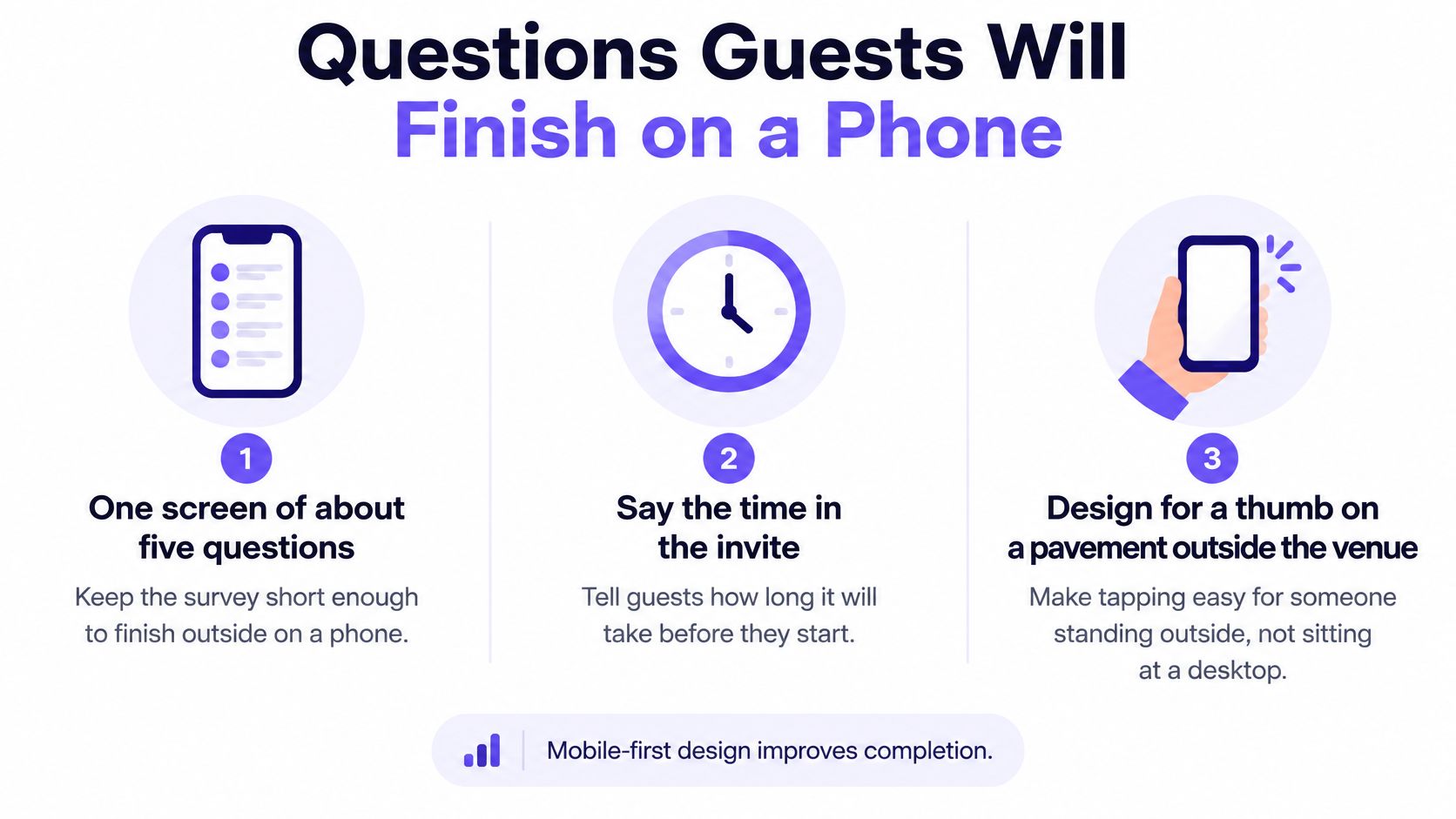
Design for a guest standing outside the venue with a phone in one hand, not an analyst sitting at a desktop. Every question should earn its place by informing a decision someone will make.
Start by naming that decision. If the restaurant manager needs to investigate slow service, a detailed brand-awareness questionnaire is the wrong instrument, however polished it looks.
Match the question to the action
Use an overall experience question first, then the operational item the manager can act on. Finish with an optional comment rather than making every guest compose a written explanation.
- Overall recommendation: Use a consistent recommendation scale when comparing trends across sites. Don't change its wording halfway through the reporting period.
- Specific satisfaction: Use a clearly labelled satisfaction scale for the room, meal or service interaction. Keep the direction consistent throughout.
- Concrete problem: Offer a single-select list such as waiting time, temperature or cleanliness when the answer determines who handles the issue.
- Context: Ask only for information you can't reliably obtain from the visit record. Don't make returning guests re-enter their booking details.
Avoid matrix grids, tiny controls and compulsory account creation. Show a manageable question at a time, with a visible back control and a clear indication of progress.
Branch only when the answer changes what you need to ask next. An unhappy guest might need a targeted follow-up about the problem; a satisfied guest shouldn't receive additional marketing questions as a reward for responding.
A bistro survey that stops at the decision
Say a bistro wants to understand whether kitchen execution or waiting time needs attention. Its questionnaire could ask guests to rate the overall visit, score the food, say whether the wait was acceptable and leave an optional comment.
If visit reason matters to the analysis, add a simple choice such as work lunch, celebration or casual meal. Don't add demographic questions merely because the survey builder offers them.
A useful guest survey ends when the manager has enough information to act, not when the marketing team runs out of things to ask.
Offer the languages the site serves. Use a receipt QR code as another entrance to the questionnaire, not as a substitute for reaching guests who don't stop to scan it.
Before launch, have colleagues complete the whole journey on their own phones. Check that labels remain visible, tapping doesn't select the wrong answer, required fields give understandable errors and optional comments can be skipped.
The post-visit feedback guide for hotels and restaurants provides a useful venue-specific starting point. Edit any starter questionnaire against the decision your manager needs to make, then time the finished version before promising guests how quickly they can complete it.
Test a Reward Against No Reward
A reward can cost money without producing a meaningful improvement. In a randomized physician web-survey experiment, completion was 11.6% with a modest book offer versus 10.7% without it, a difference that wasn't statistically significant, according to the JMIR trial.
The lesson isn't that incentives fail. It's that the audience and offer matter enough to require a control group. Don't import a response lift from another industry into the venue budget.
Run the holdout fairly
Treat prepayment, disclosure before starting and fulfilment after completion as different design choices. Record exactly which arrangement you're testing rather than labelling every offer an incentive.
- Freeze the rest of the campaign. Keep invitation copy, questionnaire, send timing and reminder eligibility equivalent. Only the benefit should differ.
- Randomly assign eligible guests to reward and no-reward groups. Keep each guest in the same arm across their invitation and follow-up.
- Describe the benefit precisely. Explain eligibility, fulfilment and any restrictions before guests invest their time. Use a discount or credit only where legal review and operational capacity support it.
- Choose the minimum worthwhile improvement before launch. Use a power calculation to size the pilot, rather than stopping when the first encouraging replies arrive.
- Check usability as well as volume. Flag duplicate submissions, implausibly rushed answers and repeated patterns. Apply the same exclusion rules to both groups.
Never make the reward conditional on a positive score. You're buying the guest's time, not their approval. Keep any public-review request outside the incentivized survey process.
What to record in an incentive test
Calculate every measure separately for the reward and no-reward arms.
| Metric | How to calculate |
|---|---|
| Completed-survey rate | Completions divided by eligible invites |
| Partial completion | Starts that never submit; compare their share of starts between arms |
| Cost per usable response | Reward cost plus send cost, divided by usable completions |
| Opt-out rate | Opt-outs divided by invites |
| Score shift | Mean score versus the no-reward arm, using the same question and scale |
The cheaper response isn't automatically the better response. A discount can bring in more regulars because they already expect to return, while leaving occasional visitors almost untouched.
Inspect who answers within each arm. Compare visit frequency, site and other appropriate guest attributes, then examine whether the operational conclusions change.
Decision threshold: Keep the reward only when the additional usable feedback justifies its cost and doesn't leave the missing-guest problem unresolved.
Also name an owner for fulfilment. An offer that requires guests to chase a manager creates a service problem in the very process meant to measure service. Check redemption instructions and staff handling before the pilot goes live.
Reach Guests Who Usually Stay Silent
A higher response rate isn't proof of a fairer sample. If regular guests respond more often, a successful-looking campaign can still leave the operator guessing about first-time visitors and people who don't return.
A randomized trial involving 36,001 patients across 46 US hospitals found that a phased web, mail and phone protocol produced the highest response rate and better representativeness, according to JAMA Health Forum. For venue teams, the relevant principle is to investigate who a channel misses rather than endlessly polishing the same email.
Report participation by guest group
Compare invited guests with respondents by visit frequency, spend band, site, language and channel where those attributes are available and appropriate to use. Use known guest information; don't infer sensitive characteristics from names or comments.
Keep invitation coverage separate from willingness to respond. A guest who never had an eligible contact route isn't the same as someone who received the request and declined.
This guide to segmentation helps frame useful audience cuts. The practical question is whether each group has a reasonable route into the survey, not whether marketers can create ever narrower lists.
Channel rules for reaching quiet guests
| Channel | Who it reaches | Use when | Watch for |
|---|---|---|---|
| Post-visit SMS invitation | Guests who opted into texts | Prompt contact and a carefully timed follow-up | Fast starts aren't necessarily completed responses; never text without permission |
| Mobile web link in email | Guests who supplied email for this purpose | A default route without texting consent | Verify the permitted use of the address |
| Receipt or counter QR code | Guests who notice and choose to scan | A second entrance alongside direct invitations | Check whether loyal or satisfied guests dominate |
| Postal or phone follow-up | Guests missed by digital routes | A targeted later phase where permissions allow | Cost, staff time and consistent question wording |
| Reminder at a new hour or channel | Eligible nonrespondents | An alternative opportunity to answer | Cross-channel duplication and existing exclusions |
SMS isn't a universal fix. In a randomized mixed-mode study, adding SMS to paper produced a 62.05% self-administered response rate, compared with 48.65% when web access was added instead, according to the Journal of Survey Statistics and Methodology. That's a result for a particular mode combination, not permission to text every guest on file.
A WiFi email address doesn't establish SMS consent. Offer a non-SMS path for people without texting permission or reliable mobile access.
Allocate the next experiment to the group still missing. That may mean translated invitations, an alternative mode or targeted follow-up, rather than more contact with regulars who already answer. Put break-offs and opt-outs beside completions so a fast channel doesn't win by hiding its costs.
Launch One Post-Visit Survey This Week
Ship a bounded survey, not a complete feedback programme. Pick a visit type with a reliable trigger, a clear owner and an operational question the venue manager wants answered.
Start without a reward so you can establish the ordinary response pattern. If the initial audience is poorly defined, paying people to answer won't repair the eligibility rules.
A launch checklist the coordinator can use
- Choose the trigger. Use a recorded meal, stay or other completed interaction. Verify that the guest is eligible for the intended survey channel.
- Assign the owner. Name the person who will review responses and route service issues. Don't collect complaints into an unattended inbox.
- Build the branded questionnaire. State its purpose, use the tested completion-time estimate and provide a direct mobile route. Keep privacy information accessible.
- Approve the invitation and follow-up together. Check the sender name, destination, closing date and exclusion logic before either message goes live.
- Protect frequent visitors. Apply an invitation cooldown across sites and channels, rather than treating each venue as a separate opportunity to ask.
- Save the reporting definitions. Record eligible invites, submissions, starts without submission, delivery failures and opt-outs. Keep anonymous QR responses separate if you can't establish their invitation denominator.
Our post-visit NPS automation sends two hours after a WiFi join and never twice in 30 days. Choose a completed-visit trigger instead when joining WiFi would place the request before the experience you want the guest to assess.
Make the next decision from answers, not opens
After the launch cohort has had its full response window, compare the invited audience with the people who submitted. Check first-time versus regular visitors, differences between sites and whether unresolved service issues need immediate attention.
Track return visits separately from feedback participation. A guest can complete a questionnaire without returning, or return without ever clicking the survey.
Don't add another message merely because the headline response looks disappointing. If people start but abandon the questionnaire, fix the form. If occasional visitors rarely receive the invitation, fix coverage. If eligible guests receive it but remain silent, test another contact opportunity.
Give the venue manager a short action list alongside the scorecard: the issue to investigate, the person responsible and the next review date. A feedback process earns its place when staff use the answers, not when the marketing dashboard accumulates submissions.
Purple Engage connects guest records, branded surveys and consent-aware post-visit journeys so you can collect feedback without repeatedly asking the same visitors. Visit Purple Engage to build a targeted survey and use guest segments to identify who still isn't being heard.