
What is WiFi marketing? a 2026 guide for venues
What is WiFi marketing? Learn how venue guest WiFi turns sign-ins into consented customer relationships, and how to measure what it actually earns.
WiFi marketing is using a venue's guest WiFi sign-in, with the guest's explicit marketing consent, to build a customer profile that supports emails, offers and measured campaigns. More than 13 billion WiFi devices had been installed globally by 2019, so the network a guest joins in your café, hotel or store is already a habit rather than a novelty.
You've probably got the hardware side sorted. The access points are on the ceiling, the guest network is live, and someone on your team pays the broadband bill every month. What you don't have is a way to tell whether any of that connectivity ever brought a person back through the door.
That gap is what this guide is about. A sign-in is permission to be contacted, not a sale, and the two get confused constantly. One is a legal and technical event that happens in about fifteen seconds on a phone. The other is a visit you can count, ideally against a group of guests who didn't get your message. Keeping those separate is the whole discipline.
Table of Contents
- What WiFi Marketing Means for a Venue
- How a Guest Login Becomes a Marketing Record
- Campaigns You Can Build from a WiFi Record
- Key Considerations for Hospitality and Retail Operators
- Consent Rules Every Operator Must Get Right
- Proving a WiFi Campaign Caused the Visit
- Set Up Your First Consented Campaign
What WiFi marketing Means for a venue
A cloakroom works like a simple record system. A guest hands over a coat and gets a ticket. The ticket identifies the coat, not the person, and it gives no right to phone them about next season's collection. Guest WiFi works in a similar way, with one important addition: the guest can leave contact details and choose whether to hear from you.
That choice is the line between network access and marketing. A sign-in can connect a phone to the internet. It becomes a marketing record only when the guest gives explicit consent. Accepting WiFi terms does not give marketing consent. The yes has to be separate, clear and tied to the channels you plan to use.
Three parts do the work:
- The connection: internet access delivered through a captive portal, the login page that appears before the browser goes anywhere else.
- The permission: a separate, explicit opt-in to marketing, naming the channels you'll use.
- The relationship: the emails, texts, offers, surveys and measured return visits that follow on that one profile.
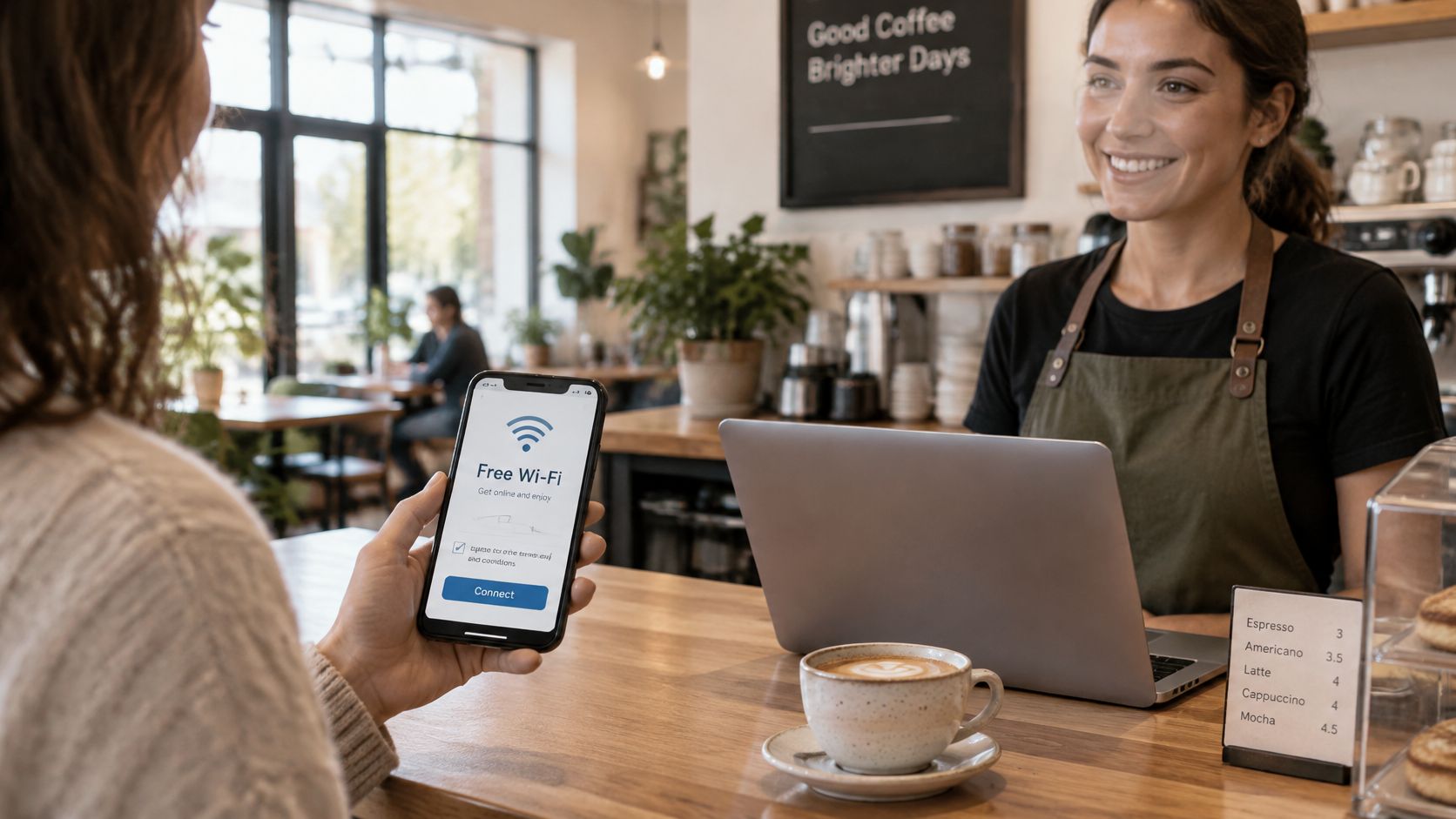
The reason this channel feels familiar is practical, not historical. Guests already connect to WiFi in cafés, hotels and shops without thinking much about it. That repeated habit makes the login page a familiar place to explain consent in plain language. IEEE record of that wireless LAN milestone
What WiFi marketing is not: free WiFi on its own, tracking strangers who never agreed to anything, or messaging every device that joined the network. Hotels already apply this consent logic elsewhere in the guest journey, whether they're designing a spa booking flow or pausing to compare electric resort shuttles for arrivals. The WiFi is the door. Consent is what turns a visitor into someone you're allowed to write to.
How a guest login becomes a marketing record
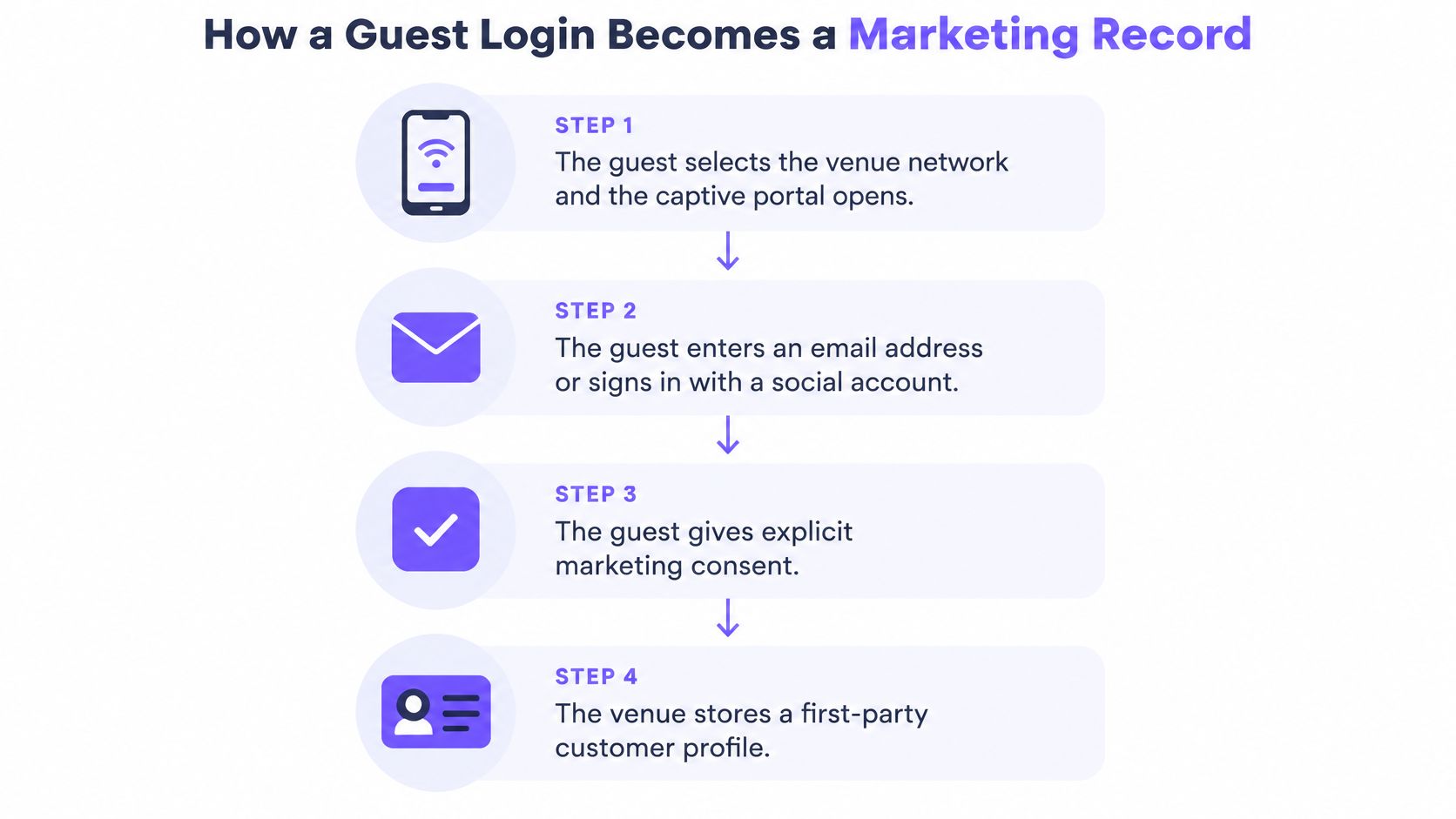
A guest can walk in, buy a coffee and leave without giving you a name. The captive portal is the one moment they volunteer it, so treat that exchange as identity plus permission rather than a shortcut to promotion.
The seven steps, and why each one exists
- The guest selects your network and the portal opens. This interception is the whole opportunity. Miss it and the visit stays anonymous.
- They enter an email address or sign in with a social profile. Email is the identifier that later matches a till receipt, a booking or a stay to the same human, which is the problem identity resolution is meant to solve.
- They accept the network terms and get online. Access must not hinge on a marketing agreement, or the agreement is not freely given.
- They opt in to marketing, or decline, as a separate choice. Only the explicit yes counts. Purple Engage collects GDPR-compliant consent at the captive portal, where the guest makes a conscious choice to opt in.
- The system stores the record with a timestamp, the exact wording shown and the privacy-notice version. Months later, that is your proof of when and why permission was granted.
- Visit, dwell, purchase, booking and survey events attach to the same profile. When a guest connects through a captive portal, enters their email, accepts terms and opts in, Purple stores that in a centralised CRM with their email, visit date, dwell time and preferred location.
- Segments and journeys read only the permissioned attributes. A guest who said yes to email but not SMS should never appear in a text send.
Where the portal's job stops
NIST guidance on public-use wireless networks recognises captive portals as a mechanism for presenting legal disclosures, and warns that public wireless connections may provide little or no confidentiality unless appropriate protections are used. Treat the portal as an identity-and-consent boundary, not a security layer: encrypted transport, the fewest fields you can justify, written retention and deletion rules, and only permissioned attributes passed to your CRM or messaging tools.
Practical rule: the design test is whether a guest can connect, decline marketing, change their mind later, and have that withdrawal reach every channel without anyone cleaning a list by hand.
A healthy setup looks boring. The guest who declines still gets online, and the guest who opts in shows up in the record with a visit date and a location attached. When later reports name a returning visit, they are counting a permissioned profile, not a device that once passed through range.
Campaigns You Can Build from a WiFi Record
Once the record exists, it becomes a menu of triggers. Read the outcome column before the campaign column, because the outcome is what you'll be judged on.
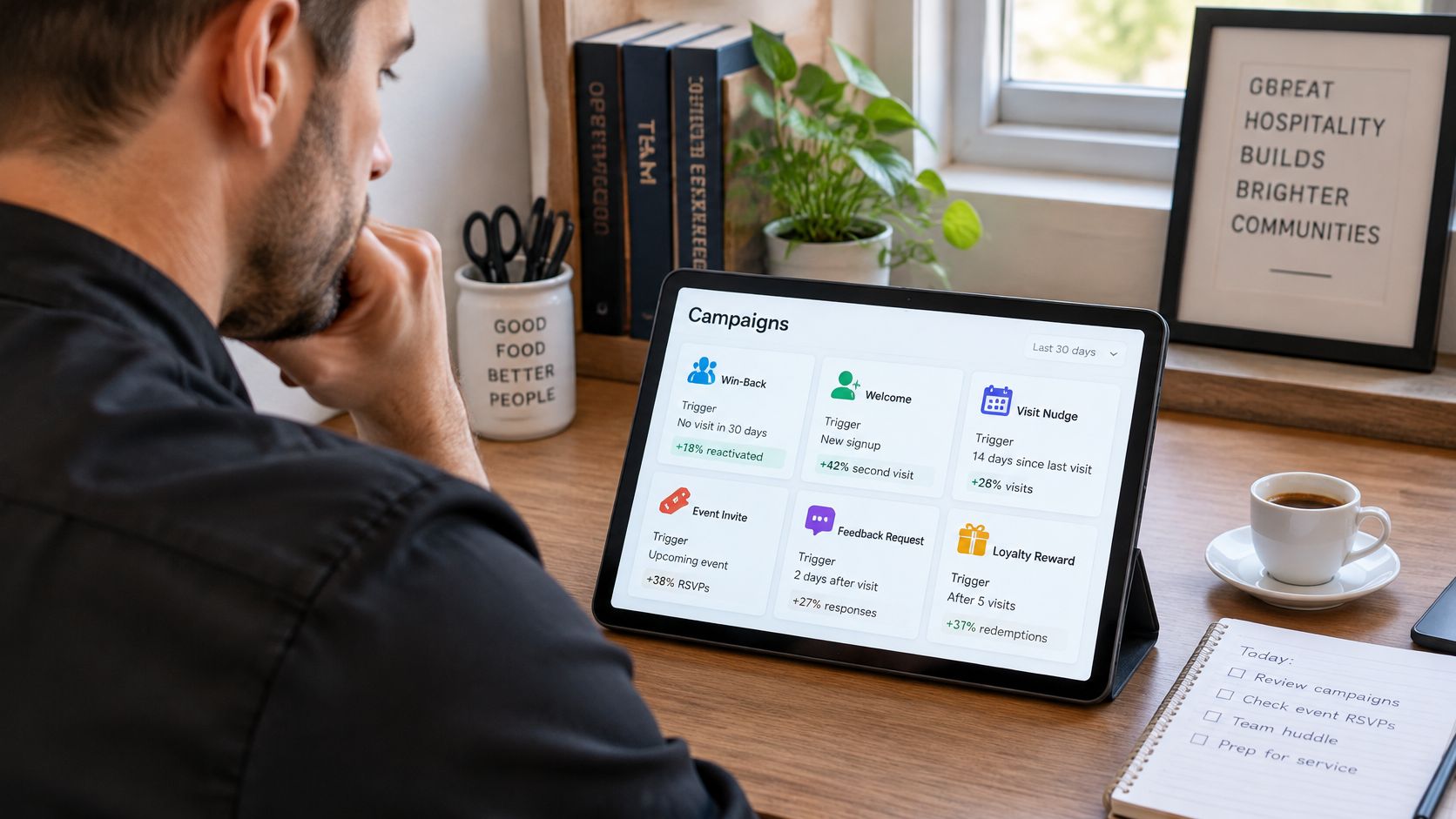
| Campaign type | Trigger | Outcome to measure |
|---|---|---|
| Win-back for lapsing regulars | No visit within the venue's lapse window | Return visits against a holdout group |
| Welcome after first sign-in | Joins your WiFi | First visit or booking within a set window |
| Birthday or milestone offer | Date stored on the guest profile | Visits and spend in the offer month |
| Booking follow-up | Completes a booking | Repeat bookings against a control group |
| Survey after a stay or visit | Checks out of a stay or fills in a form | Response rate and answers written to the record |
| Location-relevant offer | Joins WiFi at a specific site | Redemptions and visits at that site |
Say a restaurant group with several sites sends a birthday offer to consented guests whose profile holds a birth date. They hold back a random share of that same audience, send nothing to them, and report visits by site for both groups. The campaign report then reads as footfall, not enthusiasm.
What a connected device can and can't tell you
A review of brick-and-mortar tracking technologies in the ACM Digital Library separates customer-flow analysis, behaviour analysis, space management, people counting and location-based advertising as distinct use cases, and describes work where WiFi channel-state information classifies shopper states such as pausing near an entrance to view a promotion versus moving quickly toward an intended item. Clever, and still not a purchase. Device detection is incomplete, shared devices distort identity, and signal-derived inference slides into sensitive profiling if you don't disclose it.
So pair network events with explicit identifiers and transaction or booking outcomes, and disclose analytics purposes separately from marketing. In retail the triggers are identical, but the outcome should be a receipt matched through a consented identifier.
For your first campaign, pick the trigger whose outcome is easiest to count. Win-back usually wins that argument, because a return visit is a single unambiguous event.
Key Considerations for Hospitality and retail Operators
Hospitality accounted for 31.60% of the global WiFi analytics market in 2025, the leading end-user vertical, according to Mordor Intelligence's WiFi analytics market report. Restaurants, hotels and bars got here first because guests sit still long enough to log in.
- Hospitality: many guests visit once or stay briefly, so the welcome message and the booking follow-up carry most of the value. Tie the sign-in to a stay or reservation record, and send the survey while the visit is still fresh. A neighbourhood restaurant serving fresh handcrafted pasta in NYC has the same opportunity as a chain, just with a shorter list and faster feedback.
- Retail: visits are unbooked and often anonymous, so the sign-in may be your only identifier. The test that matters is whether a store visit can be matched to a receipt using a consented identifier and nothing else.
Multi-brand groups, franchises, landlords and shared venues rarely share one privacy notice or retention period. Check the consent version and the wording the guest saw before a record moves between brands. Purple WiFi Limited is trusted at 80,000+ venues in 90 countries, and the recurring lesson across that footprint is that reach figures aren't results.
Consent rules every Operator must get right
Accepting WiFi terms does not grant marketing consent. Only an explicit opt-in does. That single sentence separates a lawful programme from a expensive mailing list, and it's the rule we build around: no opt-in, no marketing message, regardless of how the guest got online.
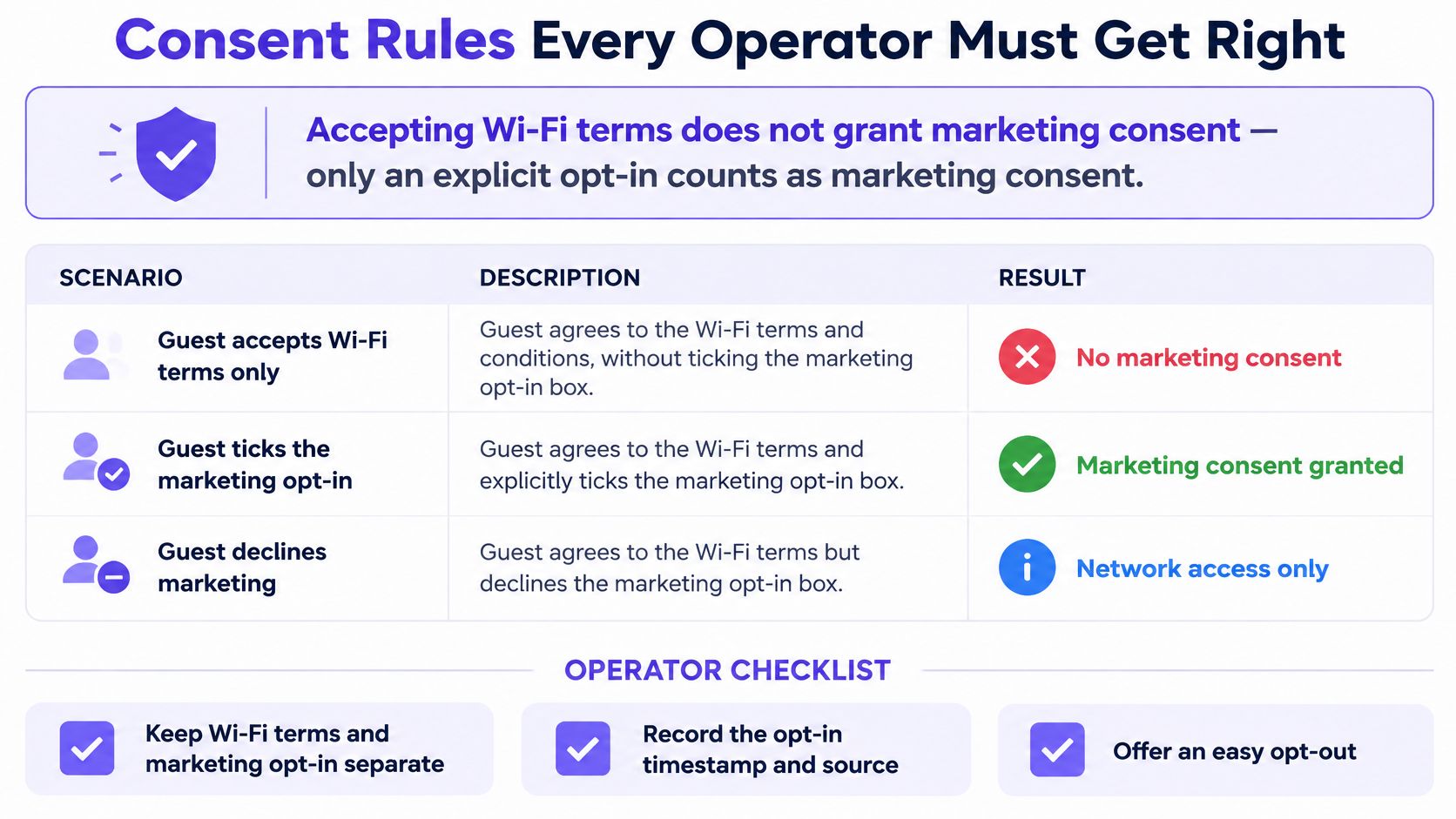
| Guest situation | Required handling |
|---|---|
| Accepts WiFi terms but declines marketing | Gets internet access and receives no marketing messages |
| Opts in to email, then withdraws | Suppressed on every channel before the next send, including imported copies |
| Wants SMS but not email | Permission kept per channel; sends only on the channel allowed |
| Consented under an older privacy notice | Record the notice version; re-ask if the purpose has changed |
| Uses a shared device | Signals treated as unreliable identity; no personalization beyond consented attributes |
| Visits a second brand in the same group | Check the consent version and wording shown before sending |
Why opt-outs have to outlive the mailing list
The hard cases aren't on the portal, they're after it. A guest withdraws, but their email already sits in an advertising audience, a spreadsheet export and a franchisee's own tool. Guidance on what WiFi marketing involves stresses that access shouldn't depend on marketing agreement, that consent must be affirmative and purpose-specific, and that GDPR-style rules reject silence, inactivity and pre-ticked boxes. Suppression therefore has to run before every send, against every copy of the record, not once against one list.
Versioning is what makes this provable. Store the wording, the purpose and the notice version alongside the timestamp, so an auditor can see exactly what the guest agreed to. Where the risk is higher or the address quality is doubtful, double opt-in confirms the inbox belongs to the person who typed it.
Fewer, better-consented identifiers beat a bigger list you can't legally use.
Three checks before you launch anything: the portal separates access from opt-in, withdrawn guests are suppressed on every channel, and email, SMS, WhatsApp and advertising permissions are held separately.
Proving a WiFi campaign Caused the visit
A strong open rate tells you people read your email. It doesn't tell you they came in because of it. Guests who opt in to marketing are often your keenest regulars, so they were likelier to return anyway, and crediting the campaign for their visit flatters your numbers.
The replacement is a randomised holdout. Take your consented, eligible audience, split it at random, send to one group and withhold from the other, then compare visits, bookings or spend. Braze's overview of marketing attribution challenges points toward incrementality testing and structured experimentation rather than touchpoint attribution alone, and the same logic applies whether you're counting covers, room nights or receipts.
What to set up before you send
- A control group big enough to read. If the withheld group is tiny, the comparison swings on a handful of visits and tells you nothing.
- A fixed measurement window. Decide the counting period before launch, and don't extend it because the result looks weak.
- A confidence range on the uplift. Our own measurement uses deliberate holdouts to estimate incremental visits, bookings or purchases with a 95% range, and incrementality testing is the discipline behind that number.
- Contamination checks. Control guests may see the offer on a shared device, hear about it from a friend, or receive it through another channel you forgot to exclude.
If the observed uplift sits inside its confidence range, the campaign is unproven. Don't scale it, and don't rewrite the story to make it look like a win.
One honest limit: visits come from a connected WiFi system, so a measured return visit is a lower bound, because guests who never joined the WiFi aren't counted. For the long view, we measure customer lifetime value by cohort, comparing WiFi-opted-in guests against walk-in guests, which shows what the consent programme is worth over years rather than weeks.
Set up your first consented campaign
Start with one check, not one campaign. Open your own portal on a phone, decline the marketing opt-in, and confirm you still get online. If you can't, fix that before you write a single subject line.
- Confirm the opt-in wording names each channel you intend to use, such as email, SMS or WhatsApp, and that the privacy notice is readable on a small screen.
- Run the consent scenarios above end to end, including a withdrawal, and verify the guest is suppressed everywhere before the next send.
- Choose one trigger with a countable outcome. Win-back against your own lapse window is the usual starting point.
- Hold back a random control group of consented guests, sized so the uplift can be read with a confidence range rather than guessed at.
- Run for a full cycle, then compare visits or bookings between the two groups. Purple Engage is an all-in-one marketing system for physical spaces that turns every WiFi sign-in into a return visit and proves which campaigns did it, working with Purple WiFi or without it.
- Scale only what clears its range. Everything else gets redesigned or retired.
Your first campaign is a test of consent handling and measurement, not of copywriting. Judge it on whether the plumbing held and whether the number was readable. A mediocre email that produces a clean, honest result teaches you more than a beautiful one nobody can verify.
If you want the consent ledger, the guest record and the holdout measurement in one place, that's what we built Purple Engage to do, across WiFi sign-ins, till receipts, bookings and stays. Bring one trigger, one control group and one outcome you can count, and see what the uplift looks like at your own sites. Visit Purple Engage to walk through the setup with your own venue data.