
Webhook vs API for Venue Integrations: A Practical Guide
Webhook vs API explained for venue and hospitality teams. Compare latency, reliability, security, and see which to choose for WiFi, POS, bookings, and stays.
You're six weeks into a multi-site rollout. WiFi capture is live, the registers are connected, bookings are flowing in, and marketing wants one simple thing. When a guest buys, books, joins WiFi, or checks out, send the right message at the right moment. Then a purchase webhook arrives twice and issues two single-use offers. A WiFi sign-in vanishes during a receiver restart. Nobody chose a bad vendor. You treated webhook vs API as a choice between two interchangeable pipes, and production exposed the difference.
Table of Contents
- Why Venue Teams Get This Choice Wrong
- What Webhooks and APIs Actually Do
- Comparing Webhooks and APIs Across the Criteria That Matter
- Which Pattern Fits Each Venue Event
- Designing a Receiver That Does Not Break in Production
- Why the Real Choice Is Webhook Plus API
Why Venue Teams Get This Choice Wrong
A restaurant group connects Purple WiFi for sign-ins, Square or Epos Now for receipts, ResDiary for reservations, and, for its rooms business, Mews for stays. Each vendor says it supports integration. Each means something slightly different. One pushes events, one expects you to poll, one does both but with different fields and retry behavior.
The team wires the fastest path first. A POS sale triggers a thank-you journey with an offer. The POS doesn't get a fast enough response, retries, and the receiver processes the same sale again because it never stored the event ID. The guest gets two messages and, worse, two redeemable codes.
The missed event is the quieter failure
On the same weekend, the receiver is offline for a deploy. WiFi joins queue at the sender for a while, then attempts run out. There's no scheduled API read to recover them, so those guests never enter the welcome journey. Reporting looks merely soft, not broken. Nobody pages anyone for missing sign-ins.
Practical rule: Treat a webhook as a signal that something may have happened, not as proof of current state. Prove state before you send, issue, or redeem anything.
These aren't edge cases. They're the normal behavior of distributed systems, as outlined in guidance on combining webhooks with APIs for recovery. Delivery is generally at least once, events can arrive late or out of order, and an unavailable receiver creates gaps unless you've designed reconciliation.
Venue teams get this wrong for three understandable reasons.
- They ask which tool wins: The useful question is which pattern fits each event, WiFi join, POS sale, booking, or checkout, given its latency need and cost of error.
- They trust the payload: A payload is a snapshot at send time. Consent, eligibility, and spend can change before a retry lands hours later.
- They skip recovery: Happy-path demos don't show duplicate deliveries, reordering, or a receiver that's down during Saturday service.
This is a working brief for IT, data, and CRM leads at restaurants, hotels, and retail venues. You'll get the core mechanics, a criterion-by-criterion comparison, an event-by-event recommendation, and the receiver design we'd want reviewed before any multi-site launch. The goal isn't to declare a winner in webhook vs API. It's to stop duplicate campaigns and missed journeys.
What Webhooks and APIs Actually Do
Start with who initiates the call. That single fact explains most of the trade-offs that follow.
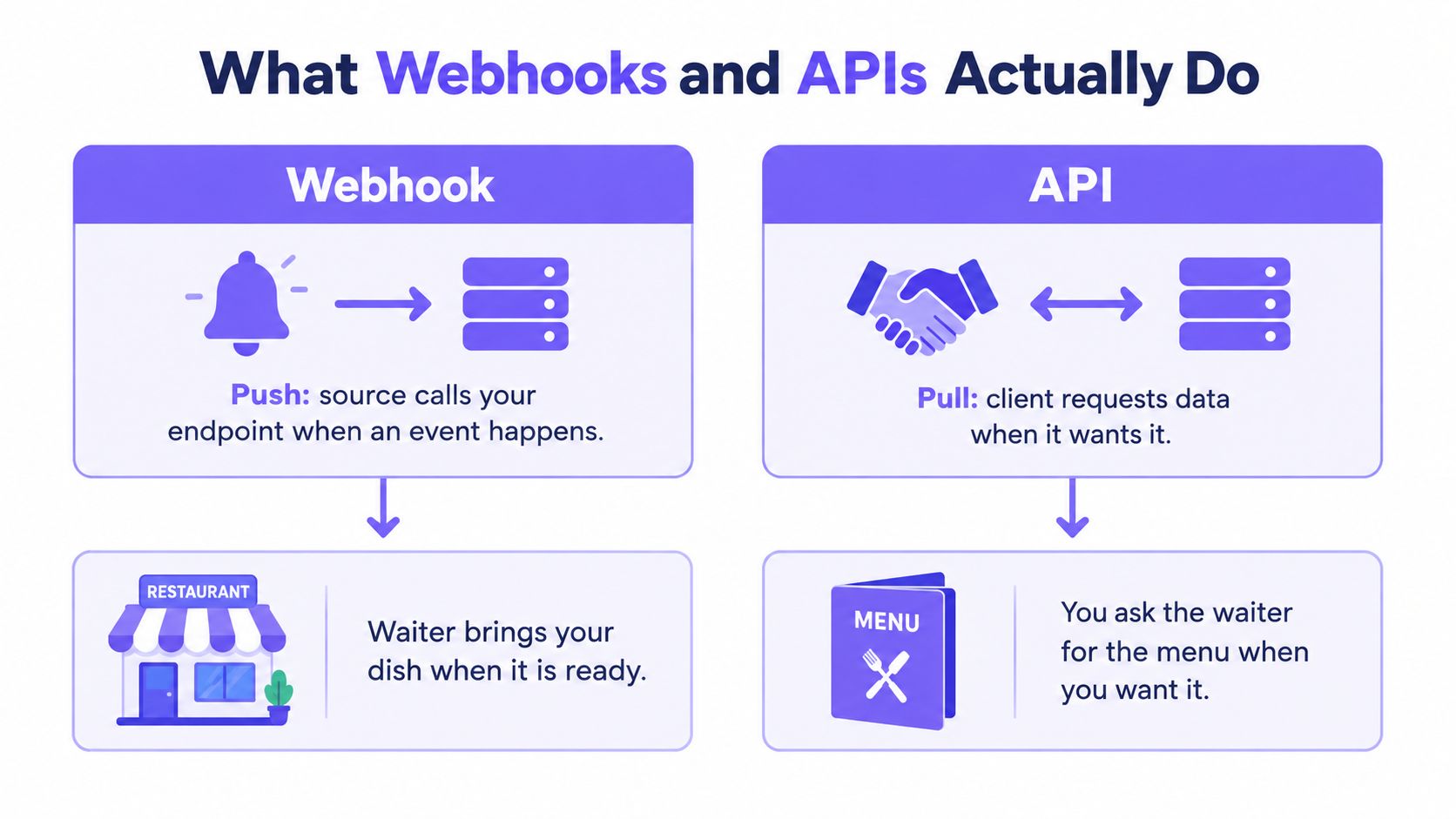
An API uses a pull model. Your client sends an HTTP request when it needs data or wants to perform an action, and the server responds. A webhook uses a push model. The source system sends an HTTP request to an endpoint you've preconfigured when an event occurs, such as a purchase, booking, opt-in, or account update. That distinction is set out in Svix's State of Webhooks research on API provider adoption.
The venue analogy holds up well. An API is you asking the waiter for the menu when you want it. A webhook is the waiter bringing your dish when it's ready, without you flagging anyone down.
The mechanics you're configuring
Both patterns use HTTP, usually carry JSON payloads, pass metadata in headers, and communicate success or failure through response codes. The direction reverses, and so does the operational burden. With an API, you hold credentials, choose timing, and handle pagination and rate limits. With a webhook, you expose a publicly reachable URL, authenticate incoming traffic you didn't initiate, and must respond quickly under load you don't control.
- POS sale: The register sends a webhook when a transaction closes, so a receipt or feedback journey can start without polling every register.
- Stay history: Your platform calls the PMS API to fetch a guest's past stays, reconcile a checkout, or backfill a missing week.
- Segment refresh: A marketing platform pulls updated records through an API on a schedule, rather than reacting to each field change.
They're complementary layers, not substitutes. Research examining 100 established API providers found 83% offered a webhook service in the 2023 study, and a follow-up reported adoption rising to 85%, as documented in the State of Webhooks research. Providers aren't replacing APIs with webhooks. They're adding event delivery on top.
The push side also brings obligations the pull side never does. A webhook endpoint has to verify signatures, tolerate duplicate deliveries, and log every event for later reconciliation, because the source will fire again whether you're ready or not.
If you're routing both through shared infrastructure, it's worth understanding what is an API gateway from GoReplay, because gateways often handle authentication, rate limiting, and routing for API traffic, while webhook receivers need their own verification and queueing in front of them.
Draw it on a whiteboard before you sign off a design. Label the initiator on every arrow. If your team can't say who calls whom for a WiFi join versus a stay-history lookup, you're not ready to discuss vendors.
Comparing Webhooks and APIs Across the Criteria That Matter
Forget generic pro and con lists. Score both patterns against direction, latency, request volume, failure behavior, security exposure, and governance. The chart below sets out the six criteria visually before the detailed table.
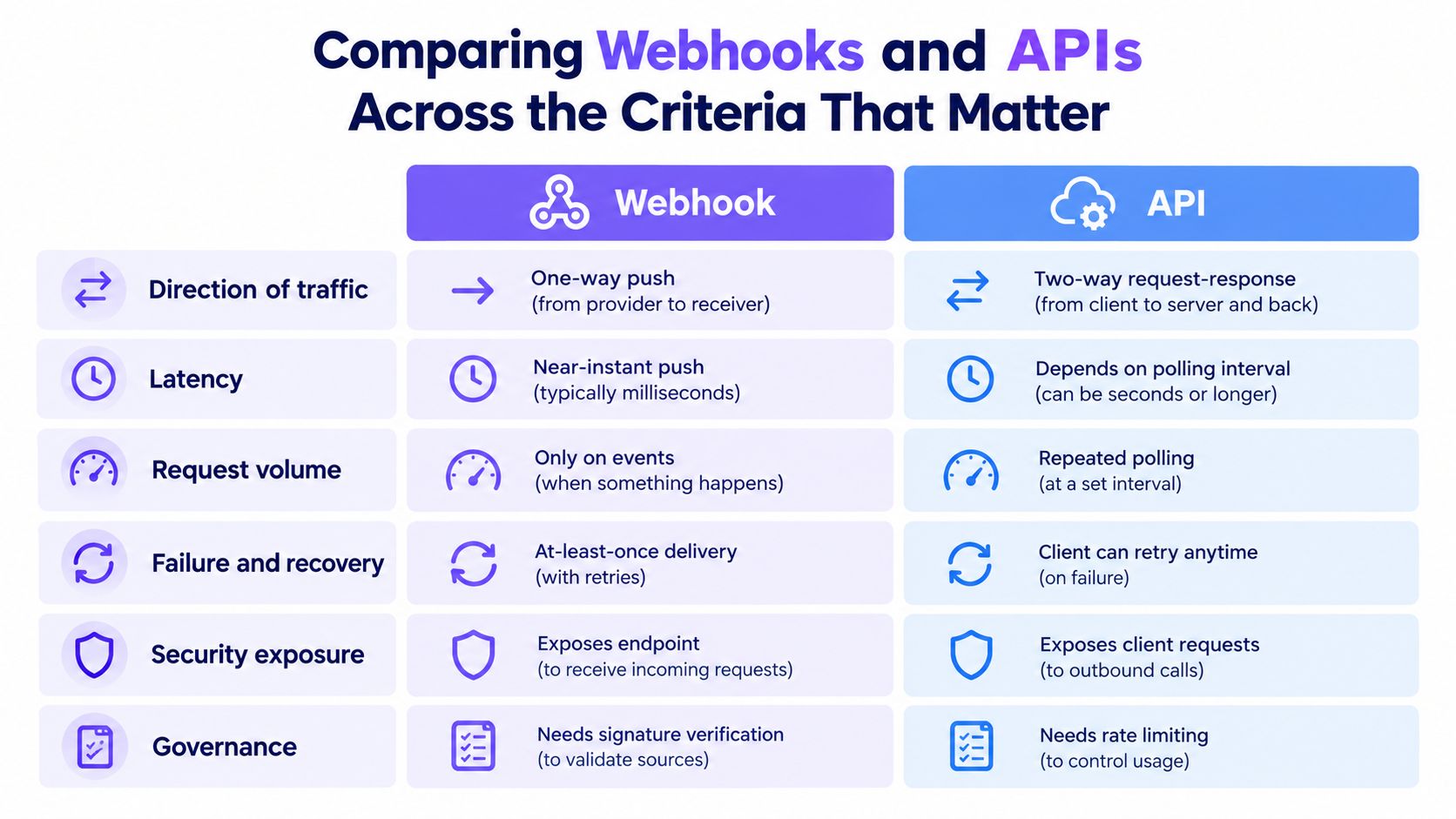
Webhook vs API Across Integration Criteria
| Criterion | Webhook | API |
|---|---|---|
| Direction of traffic | Source pushes to your endpoint on an event | Client pulls from the source on demand |
| Latency | Near real time, reported as under one second in the comparison below | Bounded by your polling interval |
| Request volume | Requests mainly when changes occur | Repeated calls even when nothing changed |
| Failure and recovery | At least once, retries, duplicates possible | Client retries anytime, easier reconciliation |
| Security exposure | Publicly reachable receiver, forged and replayed messages possible | Authorize and authorize each client request |
| Governance | Signature checks, append-only logs, dead-letter handling | Scopes, rate limits, audit of reads and writes |
The latency and volume rows are where polling math gets brutal. In a representative comparison in Hook0 documentation comparing webhooks and polling, 60-second polling produces an average 30-second delay and approximately 14.4 million API calls per day when checking once per second across a high-volume scenario. Tightening to 5-second polling averages 2.5 seconds but raises traffic to approximately 172.8 million calls per day, per the same comparison. Those are scenario calculations, not universal benchmarks, so measure provider latency, event frequency, and rate limits in your own region. The direction of travel is still clear. You can't poll your way to real time cheaply.
Failure and recovery cuts the other way. Polling is boring and recoverable. If a fetch fails, you fetch again and reconcile. Webhooks demand queueing, backpressure controls, and replay handling because the sender decides when traffic arrives, including during your busiest service or your deploy window.
The following walkthrough reinforces the direction and timing difference before we get into security.
Security exposure is asymmetric, not two versions of the same job. API security centers on authenticating each client request. Webhook security adds defending a public endpoint against forged, replayed, malformed, and duplicated messages, as explained in SuprSend guidance on webhook versus API security. That means signing the raw request, validating timestamp freshness, using constant-time comparison, enforcing HTTPS, and making processing idempotent.
Governance follows from that. Ask whether an incoming event can safely change a guest record or trigger a send across many sites, time zones, and approval rules. When you're reviewing Purple Engage integrations or any other directory, don't stop at whether a logo exists. Ask which events push, which you must pull, what retries look like, and how you'd prove a record is correct after an outage.
Which Pattern Fits Each Venue Event
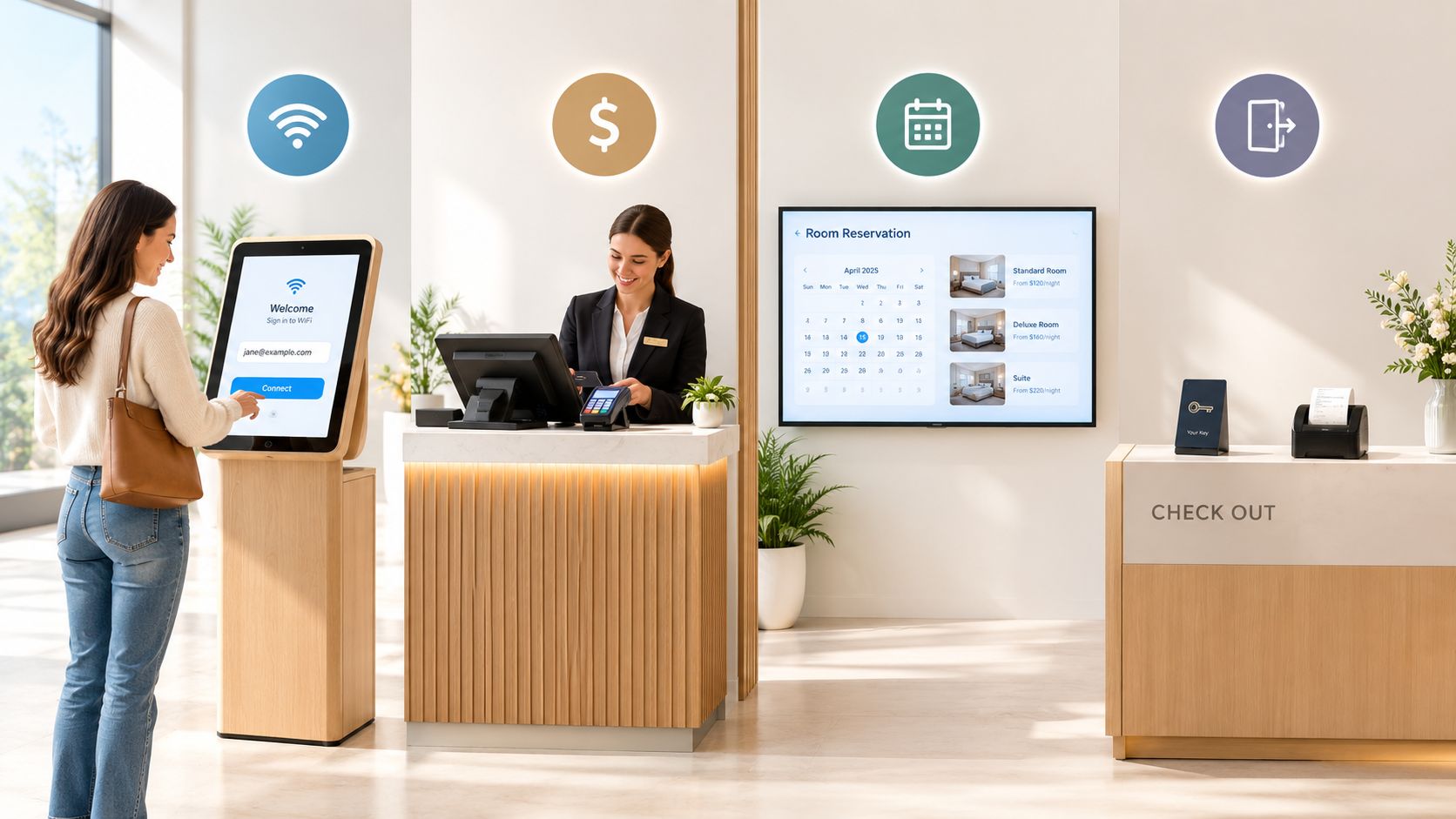
Score each event on two questions. How quickly must you react, and what's the cost of acting on stale or duplicated data? The image below is a useful reminder that these events start as physical moments in a venue, not as rows in a database.
WiFi sign-ins
Use a webhook as the trigger. A guest who just joined is on site now, so a welcome message, on-site offer prompt, or survey invitation loses value with delay. Polling for joins adds latency for no benefit.
Don't let the payload alone create the record. Persist the event ID, then confirm identity and consent before enrolling the guest in a journey. A periodic API read catches joins missed while your receiver was down.
POS sales
Webhooks fit sales for the same reason, with higher stakes. A closed transaction can trigger a receipt, review request, or spend-based segment update while the visit is still fresh. If you're evaluating a register such as the Toast integration for Purple Engage, check exactly which transaction states emit events, whether refunds and cancellations emit separate events, and how a partially paid bill appears. Those details matter more than the word webhook on a datasheet.
The failure mode here is expensive. Duplicate sale events can double-count spend, corrupt attribution, and issue duplicate offers. Make handlers idempotent and treat the API record as authoritative for final spend.
Bookings and reservations
Bookings need both, weighted toward the API. A webhook for a new, changed, or canceled reservation lets you react quickly, confirm, remind, or release a journey step. But bookings change state repeatedly. Party size shifts, times move, deposits land.
A booking webhook tells you to look. It shouldn't be the last word on what the booking now is.
Fetch current state through the API before sending anything guest-facing. If you act on an early payload after a cancellation webhook was missed, you'll remind a guest about a table they no longer have.
Hotel checkouts and stays
Checkouts trigger post-stay surveys and review requests, so a webhook gives you timely initiation. Stay history, room revenue, and folio detail belong to API reads. They're historical, paginated, and subject to correction after checkout.
Relying on webhooks alone for stay records is the classic error. One receiver outage and entire stays go missing from segmentation. Use scheduled API reconciliation to close the gap, and backfill through the API when you onboard a property. Purple Engage, for context, combines WiFi sign-ins, POS receipts, bookings, and hotel stays into a single guest record, which only works if each source has both a trigger path and a recovery path.
Designing a Receiver That Does Not Break in Production
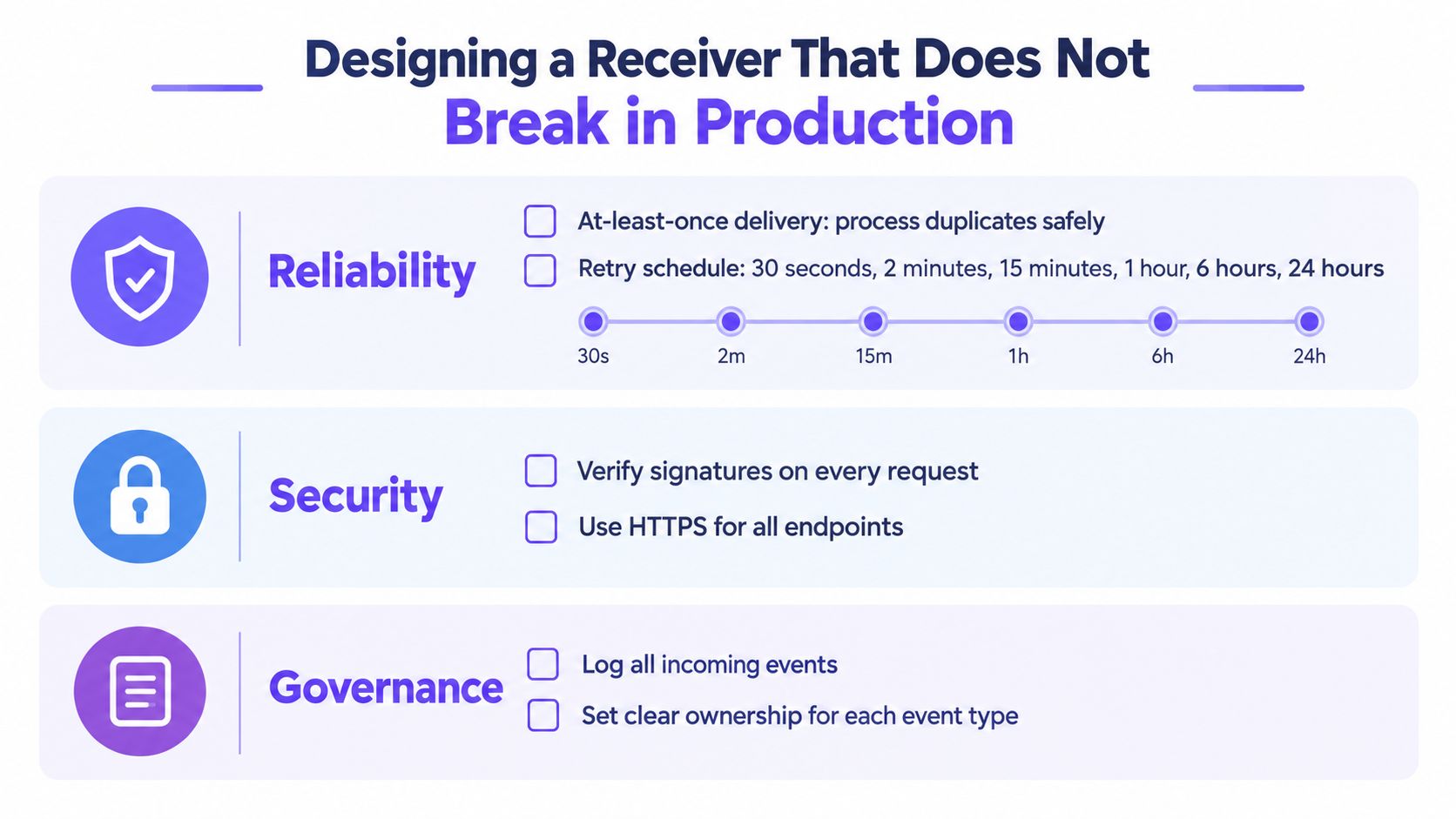
Reliability isn't a vendor feature you buy. It's a set of decisions you make before the first venue goes live. Design for at-least-once delivery, not exactly once, and everything else follows.
Acknowledge fast, process later
Authenticate the request, durably enqueue it, then return success. Treat only a 2xx response as acknowledgment, as set out in Svix guidance on webhook delivery guarantees. Don't run segmentation, offer issuance, or message sends inside the request handler. Slow handlers cause timeouts, timeouts cause retries, and retries multiply your duplicates.
A documented schedule uses delays of 30 seconds, 2 minutes, 15 minutes, 1 hour, 4 hours, 12 hours, and 24 hours, for eight total attempts over approximately 41 hours, with exponential backoff and jitter, per the Svix guidance linked above. That's the window your design must survive. A retry landing a day later is normal, not anomalous.
Make duplicates harmless
Store the provider's stable event identifier and use it as an idempotency key. If you've seen it, acknowledge and skip the side effect. Exhausted deliveries go to a dead-letter queue with replay support, so an operator can inspect and reprocess them rather than discovering gaps through guest complaints.
For teams streaming events into downstream infrastructure, this no-code webhook Kafka integration from Streamkap is a useful reference for moving webhook events into Kafka without hand-building the ingestion layer. Whatever you choose, the queue sits between receipt and business logic. That's essential.
Verify before you trust
- Verify the HMAC signature on the raw body: Parse first and reserialize, and you'll break valid signatures or accept invalid ones.
- Check timestamp freshness: A valid old request replayed today must be rejected, which protects you against captured payloads being resent.
- Compare in constant time: Ordinary string comparison can leak timing information.
- Authorize per source: A signature from your booking provider shouldn't be able to write POS-shaped events.
Standardization is improving. The Open Webhooks specification converges on common identifiers, timestamps, and HMAC-SHA256 signatures, and RFC 9421 provides a standardized HTTP message signature framework. Don't wait for universal adoption. Implement the controls now.
Re-check consent at the last moment
Governance is where venue marketing diverges from generic integration advice. Keep append-only audit logs, handle venue time zones explicitly, respect regional processing requirements, and re-check current consent and eligibility immediately before any send or offer issuance. A guest can opt out between the original event and a retry 12 hours later. Your handler must honor the later choice, not the earlier payload.
Why the Real Choice Is Webhook Plus API
The honest comparison isn't webhook vs API. It's webhook only versus webhook plus API. Webhook only loses in production.
Retries create duplicates. Events arrive out of order, so a cancellation can land before the booking it cancels. A brief outage creates gaps nobody notices until a segment undercounts regulars or a campaign claims credit for visits it didn't cause. Latency benchmarks don't capture any of that.
The consistency pattern that works
- Persist the provider event ID on receipt, before any processing.
- Make every handler idempotent, so a second delivery changes nothing.
- Fetch current state through the API before any side effect, message, offer, segment change, or redemption.
- Run scheduled reconciliation against the source snapshot to find missed, reordered, or corrected records.
Treat the webhook as a doorbell and the API as checking who's at the door. That framing aligns with webhook vs API for builders from WebinOne, which covers the builder-side implementation choice. For venue teams, the operational consequence is what matters. The guest record, like the unified view described in Purple Engage guest data, is only trustworthy if every source feeding it has a recovery path, not just a trigger.
Design test: If your receiver went offline for an hour on your busiest Saturday, could you prove tomorrow that every WiFi join, sale, booking, and checkout was recovered exactly once in effect? If not, you don't have a hybrid design yet.
Skip reconciliation and the costs compound. Duplicate journeys annoy guests and waste offer budget. Stale segmentation targets people who visited yesterday as if they'd lapsed. Attribution overstates incremental impact because purchases were double-counted or checkouts were missed. None of these show up as integration errors in a dashboard. They show up as marketing that slowly stops being believed.
Build the hybrid the first time. It's less glamorous than a real-time demo, and it's the difference between an integration that survives a multi-site rollout and one your team stops trusting. Choose webhooks for low-latency signals, APIs for authoritative state and recovery, and refuse to ship either one alone for anything that can send a message or issue an offer.
If you're planning a multi-site rollout and want WiFi, POS, bookings, and stays feeding one guest record with signed webhooks, a public API, and consent checked again before sending, explore Purple Engage and review its integrations against the hybrid checklist above. Bring your hardest event, the POS sale or checkout you can't afford to duplicate, and test whether the design recovers it after an outage.