
SMS Marketing for Restaurants That Actually Drives Visits
A practical guide to SMS marketing for restaurants covering consent, Twilio setup, message templates, segmentation and measurement that ties back to visits.
Send two to four texts a month, celebrate the open rate, report the redemptions. That's the standard playbook, and it's how operators end up discounting visits they already owned while telling the board SMS is working. If you can't show an extra cover, booking or order that wouldn't have happened anyway, you don't have a channel. You have an expensive announcement system.
Table of Contents
- Why Most Restaurant SMS Programmes Look Better Than They Are
- Building a Consent Base You Can Actually Defend
- Wiring Up Twilio and Your Sending Account
- Choosing the Right Message for the Moment
- Setting Frequency by Segment Instead of by Calendar
- Measuring Incremental Visits Instead of Opens
- A 30-Day Launch Checklist for Restaurant SMS
Why Most Restaurant SMS Programmes Look Better Than They Are
Visibility isn't persuasion. Industry summaries commonly report that more than 95% of marketing text messages are opened, with some restaurant sources placing the figure at 98%, against email at roughly 20–25%, and one restaurant source reports that about 90% of customers open text messages within three minutes of receiving them, according to Olo's summary of why SMS matters for restaurants. Those numbers explain speed. They don't prove a single extra visit.
That distinction matters because demand in restaurants moves by daypart, weather, local events and cancellations. A same-day text can be seen before service in a way email rarely is, which makes SMS useful for a quiet Tuesday, a freed table or a waitlist update. It doesn't follow that every opened message changed behaviour.
What a defensible programme has to prove
Define success before you send anything. A defensible programme for SMS marketing for restaurants answers three questions for every campaign.
- Consent: Can you prove this guest agreed to marketing texts, not just that you hold a number?
- Relevance: Did frequency reflect this guest's visit cadence and intent, not a flat calendar rule applied to everyone?
- Incrementality: Did recipients visit, book or spend more than a comparable group you deliberately didn't text?
If you can't answer the third question, don't scale the first two. You'll only grow list size, discount cost and opt-outs faster.
An open rate tells you a phone lit up. It tells you nothing about whether the kitchen needed another cover that night.
Most guides invert the order. They start with templates, argue about send counts, then bolt on measurement at the end using clicks. Reverse it. Build a consent ledger you can defend, wire your sending account properly, choose messages by purpose, set frequency by segment, and hold back a control group from day one. Each operational choice exists to make the measurement believable, not to make a dashboard look busy.
That's a harder standard than chasing opens. It's also the only one that survives a finance review when someone asks what happened to margin after message fees, discounts and unsubscribes.
Building a Consent Base You Can Actually Defend
Consumer acceptance gives you permission to ask, not permission to send. A reported consumer survey found that 84% of people had opted in to receive texts from at least one business, up from 71% two years earlier, and a later summary citing a 2026 survey reported 85.6% opted in compared with 61.8% in 2021 in SlickText's compilation of SMS marketing statistics. Those are different surveys, so don't treat them as one clean time series. The direction is consistent though. Business texting is mainstream, which raises the bar for getting consent right.
What counts as opt-in, and what doesn't
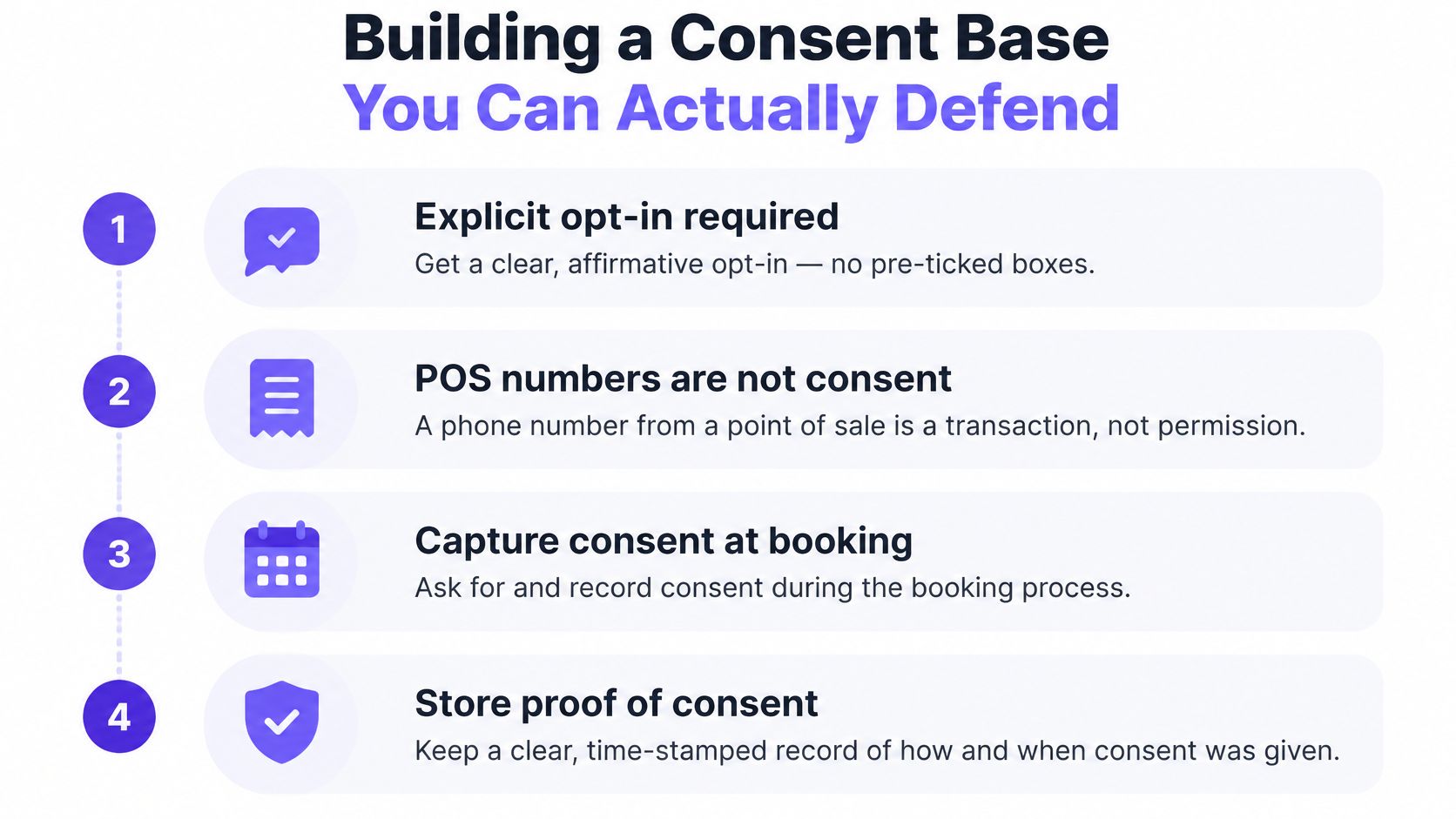
A phone number on a till receipt isn't consent. Neither is a number taken to confirm a booking, quote a wait time or send a digital receipt. Those are service contacts. Marketing consent needs a separate, clear action where the guest understands they'll receive promotional texts and can stop them.
Write that action in plain language at each capture point.
- Guest WiFi: Use an unticked box or clear toggle, separate from email. Say what you'll send, for example offers and event news from the venue group, and that replying STOP ends it.
- Booking flow: Keep confirmation texts distinct from marketing. A guest agreeing to a reminder hasn't agreed to a Tuesday offer.
- Online forms and loyalty sign-up: Don't bundle channels. Email consent and SMS consent are different decisions, and bundling them contaminates both lists.
- In-venue prompts: QR codes and table cards work if the landing page repeats the exact wording and stores it. Staff shouldn't add numbers from conversation.
One ledger, checked twice
Multi-site operators get caught when each venue keeps its own list. A guest opts out at one site, gets imported from another spreadsheet, and receives the next campaign anyway. That isn't a data error. It's a governance failure.
Hold consent in one ledger against a single guest record. Check it at campaign approval and again immediately before send, because opt-outs arrive between those moments. Make opt-outs durable so imports, POS matches and WiFi sign-ins can't reverse them. Suppress first, segment second.
Venue handover checklist: Exact opt-in wording saved. Source and timestamp on every record. Marketing consent separate from service messages. Opt-out tested from a real handset. Suppression runs before every send, not weekly.
Keep proof you can produce under challenge, including the wording shown, the capture point and when consent changed. If a venue can't show that trail, pause its sends until it can. A smaller, provable list will outperform a larger list you've assembled from transactions, and it won't put the whole programme at risk the first time a guest asks why you texted them.
Wiring Up Twilio and Your Sending Account
Ask one question before you connect anything: whose account do the messages bill to? If sends run through a platform's pooled account with a markup attached, you can't reconcile cost per campaign, and cost per campaign is the denominator in every incremental-visit calculation you'll run later.
Own the account. Document every decision inside it.
Two choices shape the account itself. A long code supports replies and feels local, which suits reservations and two-way service. A short code suits higher-volume promotional sending and reads more cleanly in opt-in prompts; UK operators should confirm sender registration requirements and check how the sender displays on major networks before launch. Then set your region to match your data governance and lock geo permissions to the countries you serve, because open permissions are a fraud and cost risk you don't need.
Two more govern guest-facing behaviour, and each has a measurement question attached. Can you prove a STOP reply wrote back to your consent ledger? A keyword logged only inside a sending console nobody checks doesn't count, so test it end to end from a real handset. Can you show which sends were promotional? Quiet hours should block those late at night and early morning by venue time zone, while service messages tied to live bookings get defined separately, in writing.
Connect Twilio to your venue marketing platform so sends use your account and your numbers. Purple Engage, for example, sends SMS through an organisation's own Twilio account with no platform markup on message costs, which you can review in the Twilio integration details for Purple Engage. Whichever platform you use, insist on that billing model and on approval controls so nothing sends without a named human sign-off.
Borrow rigour from appointment-led sectors where timing and wording stay tightly controlled. The discipline behind SMS reminder templates for clinics applies here: confirmation, reminder and follow-up messages each carry a distinct purpose and shouldn't blur into promotion.
Keep an artefacts file from day one: sender registration, consent wording by capture point, opt-out test evidence, quiet-hours rules and who can approve sends. When a complaint lands, that file is your defence. If you can't produce it quickly, the setup isn't finished, however good the first campaign looked.
Choosing the Right Message for the Moment
Stop building a library of generic templates. Group messages by purpose, then decide whether each one is service-critical or promotional. That single distinction protects guests from feeling punished for booking with you, because a confirmation and a waitlist alert shouldn't consume the attention you'd otherwise spend on an offer.
Match purpose to copy and call to action
A promotional text needs one reason to act today and one link. A reservation reminder needs date, time, party size and a way to amend. A waitlist update needs speed and a short reply window, not brand storytelling. Win-back copy should acknowledge absence without sounding needy, and it should go only to guests who've lapsed by your segment definition.
Review requests deserve restraint. Ask uniformly after a recorded visit, don't gate unhappy guests away from public reviews, and don't attach an incentive. Operational alerts, such as a closure or menu change affecting a booking, should be factual and sent only to affected guests.
Keep promotional copy under a single segment where you can. Shorter messages reduce cost and force clarity. Put the venue name early, state the offer or update plainly, and end with one action.
Restaurant SMS message types at a glance
| Purpose | Trigger | Length | Example opening |
|---|---|---|---|
| Promotion | Quiet daypart, capacity gap | Short, one segment | [Venue] Tonight only, early tables get... |
| Reservation reminder | Booking approaching | Short, factual | [Venue] Reminder, table for 2 tomorrow at... |
| Waitlist | Table becomes available | Very short | [Venue] Your table is ready, reply YES... |
| Win-back | No visit beyond your lapse threshold | Short, personal | [Venue] We've missed you, here's... |
| Review request | Recorded visit completed | Short, neutral | [Venue] Thanks for visiting, tell us... |
| Operational alert | Change affecting a booking | Factual, targeted | [Venue] Update about your booking on... |
Compare the alternatives. Email carries menus, stories and multiple links better. Social reaches people who haven't consented to direct messages. SMS wins when timing is tight and the action is singular. If your message needs three explanations, it's probably an email wearing a text costume, which is why it helps to plan channels together, as set out on this digital marketing page covering how channels support each other rather than compete.
If a guest would be annoyed to receive the message while sitting in your restaurant, don't send it to them at home.
Write two variants only when you have a measurement question, such as offer framing or send time. Random creative tinkering without a holdout teaches you nothing except which copy your team preferred in the office.
Setting Frequency by Segment Instead of by Calendar
A guest of a twelve-site group does not experience your programme as twelve separate calendars. She experiences it as a pile-up: a Tuesday offer from one site, a Thursday event blast from another, a win-back from a third, all inside a week. The two-to-four-a-month rule survives because it is easy to brief. Nobody checked it against how guests receive messages, and the gap shows in the 2025 Restaurant Consumer Insights Report: 40% of diners belong to multiple restaurant lists, 46% value personalization based on past orders and preferences, and among Gen Z, 42% prefer short, direct texts while 45% engage with text messaging. Your competition is every other venue in her messages app.
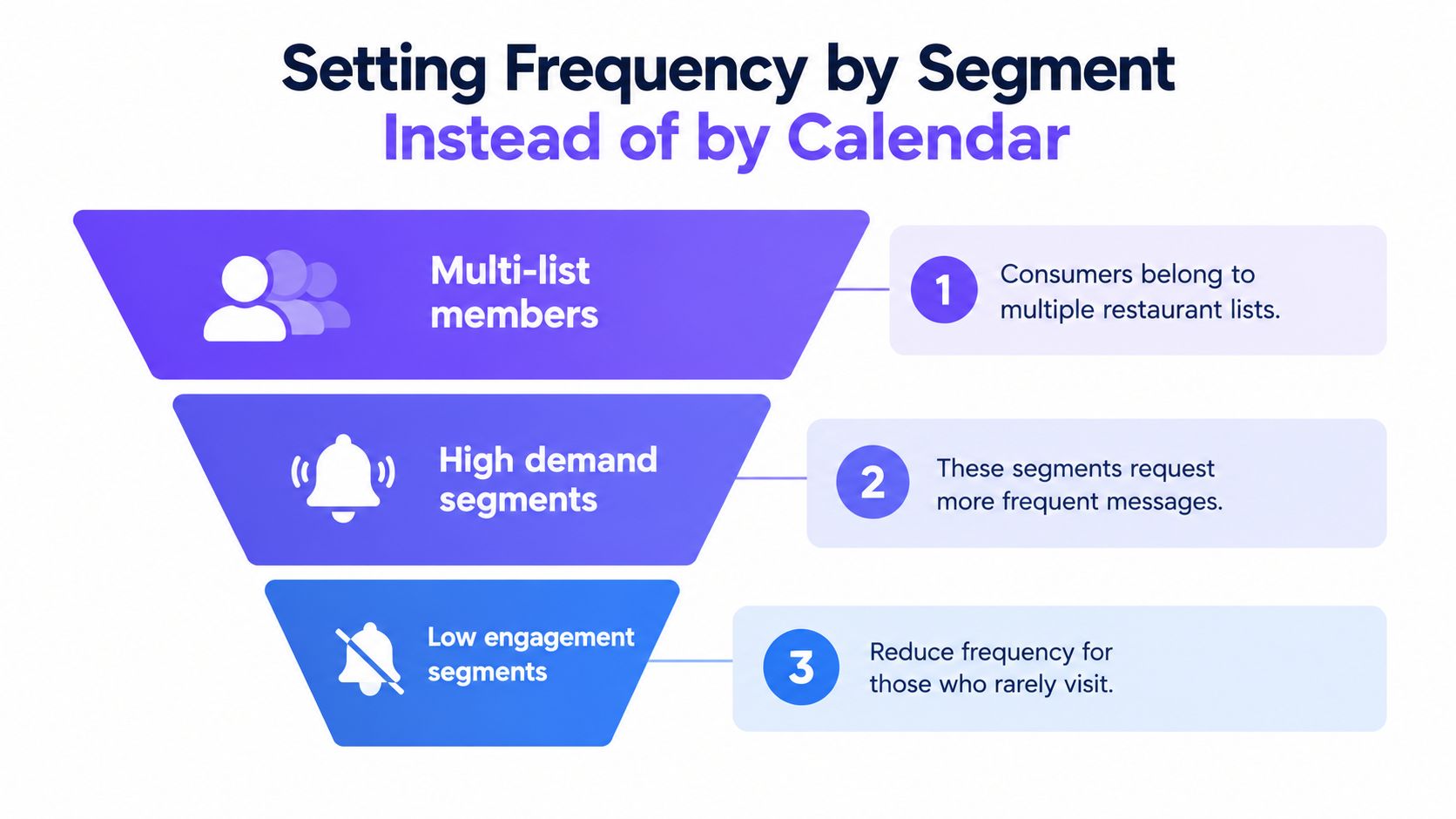
Set one group-level cap before any venue sends anything. Then divide that allowance across segments using your segmentation rules for visits, spend and recency, and write the rules per segment:
- Frequent diners get recognition, event access and booking prompts. Discounts stay rare, because repeated offers mainly teach loyal guests to wait for a code.
- Lapsing guests get one win-back, triggered by a lapse condition such as no visit in the last 45 days. No response means silence, not a second nudge.
- Event-led guests hear about dates matching past attendance or stated interests. Your full events calendar is your problem, not theirs.
- New subscribers earn the second message. Confirm what they signed up for, deliver it, and watch early opt-outs before sending anything promotional.
Keep service-critical sends outside the promotional budget, and resist smuggling an offer into a reminder. Consent was given for different things, and guests can tell the difference even when your reporting can't.
Testing cadence works the same way as testing copy: hold back a random slice of a segment, vary pressure on the rest, and read incremental visits and opt-outs together. Suppress anyone who visited or redeemed very recently from the next promo, because a thank-you followed by a discount looks careless. Frequency is a set of rules you revise as behaviour changes. Treating it as a fixed number is the mistake.
Measuring Incremental Visits Instead of Opens
Say a campaign reaches 10,000 guests and logs 400 redemptions. Did it work? You cannot know until you ask how many of those 400 would have booked anyway. Published return figures for restaurant SMS read like jackpot stories, while one 2025 source reports that 48% of consumers prefer connecting with restaurants by text in SevenRooms guidance on increasing restaurant sales. Guests want the channel. Whether your message caused the visit is a separate question, and standard campaign dashboards never ask it.
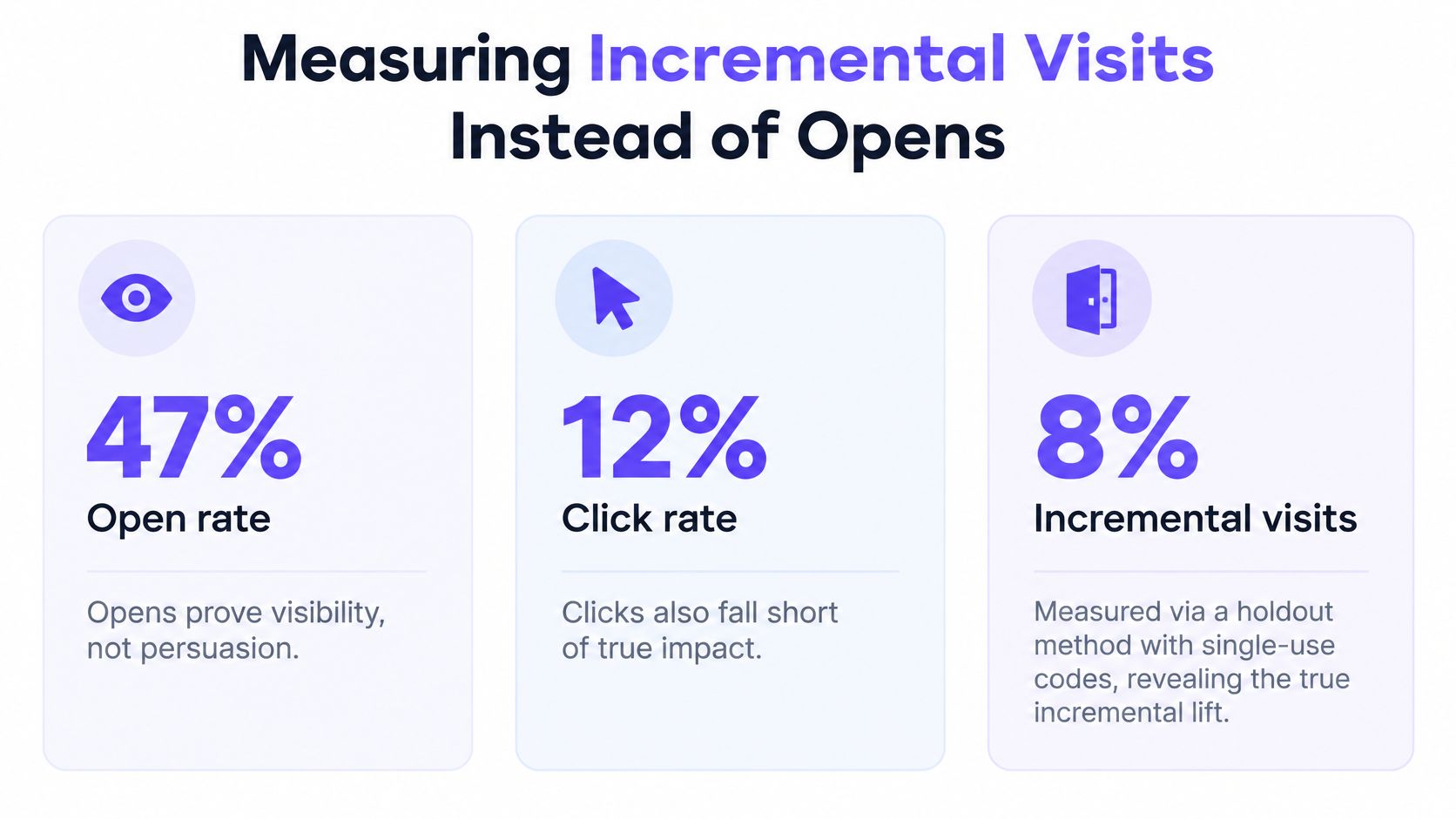
The answer is a holdout. Randomly exclude a control group from each significant campaign, matched to recipients on recency, frequency and spend. Compare visits, bookings and spend over a defined window, and state the gap as a range rather than a single heroic number. That range is what the text caused.
Redemption counts cannot do this on their own.
A shared code posted on social media destroys attribution and invites leakage, so issue single-use codes tied to a guest record when you run an offer. Track booking links too, but treat last touch with suspicion: a guest may see your email, an ad and a booking reminder before redeeming the SMS code.
Attribution also fails while your data sits in separate systems. Connecting SMS exposure with POS, booking, WiFi and stay records, as described in the measurement approach based on deliberate holdouts, is what shows whether a lapsed guest returned or a regular collected a discount on a visit they had already planned. For the wider set of operational measures worth bringing into that review, Modern Lyfe hospitality metrics is a useful reference for framing performance beyond campaign clicks.
Review the same small set of numbers every month, and make each one answer a question.
| Report this | Because it answers |
|---|---|
| Incremental visits or bookings, recipients versus holdout, stated as a range | Did the text create extra visits? |
| Net revenue after discounts, message fees and cannibalisation | Did it pay for itself? |
| Opt-outs, complaints and delivery failures by segment and venue | What did the send cost the list? |
| Repeat visits by responders without another code | Did the offer build a habit or rent a transaction? |
Report opt-outs and complaints on the same page as revenue. If a campaign only looks good when you hide the cost to the list, it isn't good.
If regulars drive most of your redemptions and the holdout visited at a similar rate, the campaign subsidised demand instead of creating it. Change the audience or the offer before the next send. Every message should ship with its measurement question attached, and a send you cannot evaluate is a send you should not have made.
A 30-Day Launch Checklist for Restaurant SMS
Run this sequence in order. Don't let a venue skip ahead because it has a quiet week to fill.
- Week 1: Finalise consent wording for WiFi, bookings, forms and loyalty, and load it into one ledger with durable opt-outs.
- Week 2: Register your sender, restrict geo permissions, set quiet hours, connect Twilio and test STOP from real handsets.
- Week 3: Build segments for frequent, lapsing and event-led guests, set a group-level frequency cap, and write one template per purpose.
- Week 4: Launch to a limited segment with a randomised holdout and single-use codes, then review incremental visits before expanding.
Do this week: Pick one segment, one message purpose and one holdout. If you can't name all three, you're not ready to send.
If you're ready to run SMS marketing for restaurants on consented, unified guest data with holdout measurement built in, explore Purple Engage and see how WiFi, POS, bookings and stays come together in one record. Start with your consent ledger and first controlled campaign, and prove the extra visits before you scale.