
What is behavioral segmentation? a venue Marketer's guide
What is behavioral segmentation? Learn how venues group guests by visits, spend and survey answers to send relevant offers and measure results.
Behavioral segmentation groups guests by actions you can observe, such as how often they visit, what they spend and how they respond to a survey. A 2025 survey of 3,300 consumers found that 71% said they wanted brands to learn from their shopping habits over time, according to CITE Research's survey for Attentive.
Many venue managers have a database full of names, a newsletter that goes to everyone, and little idea which guests read it or return. They may recognize regulars across the bar, yet struggle to identify them in their marketing records.
The problem is often fragmented information. A till records purchases, a booking system records reservations, and a WiFi portal records visits. When those signals sit apart, it is harder to see a guest's pattern or decide what action to test.
Table of Contents
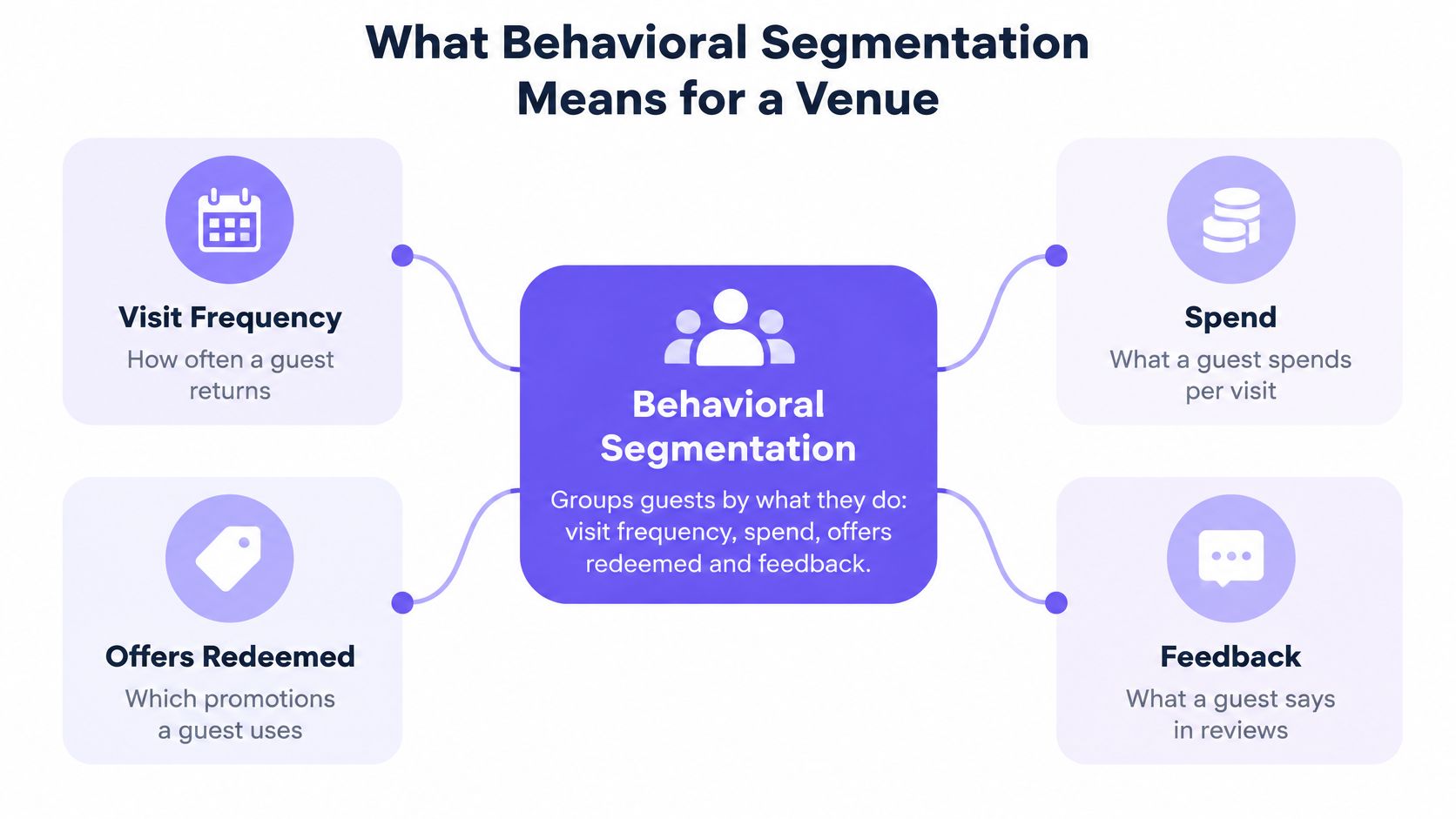
- What Behavioral Segmentation Means for a Venue
- The Guest Signals Behind Every Segment
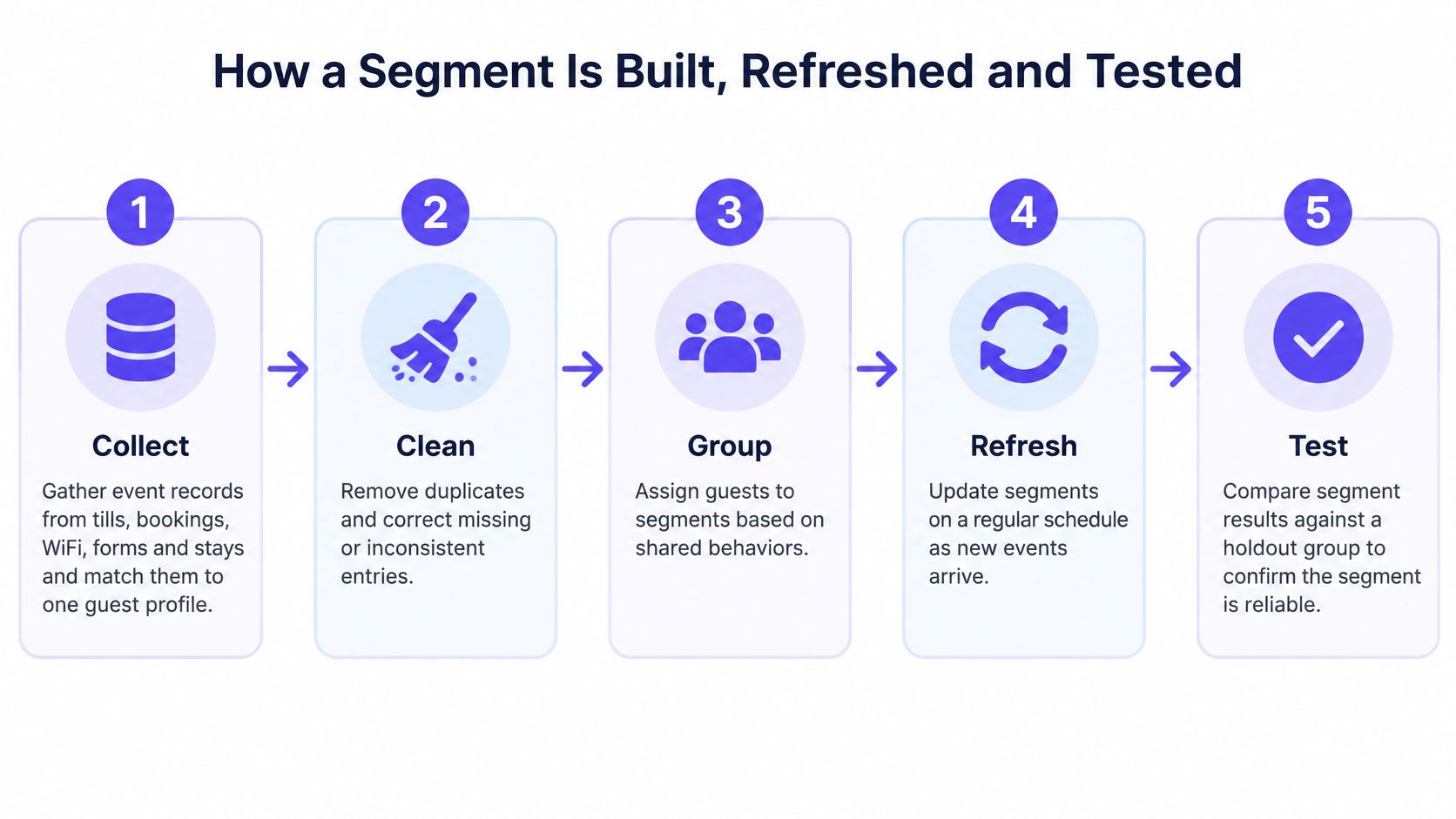
- How a Segment Is Built, Refreshed and Tested
- Segment Examples for Restaurants, Hotels and Retail
- Using Segments in Guest Journeys
- When Behavior Misleads and How to Check It
- Start With One Measured Segment This Month
What behavioral segmentation means for a venue
A behavioral segment is a group of guests defined by actions you can point at in your records. The market segmentation reference on Wikipedia describes the practice as grouping customers by observed actions or responses rather than by age, income, location or other descriptive traits, with typical variables covering purchase frequency, spending level, brand loyalty, recency of interaction and response to promotions.
The idea is older than many assume. Wendell R. Smith published "Product Differentiation and Market Segmentation as Alternative Marketing Strategies" in the Journal of Marketing in 1956, arguing that a heterogeneous market could be treated as smaller, relatively homogeneous groups with different preferences. That was the break from mass marketing. Everything since has been an argument about which differences matter.
Think about a bar manager who knows the Tuesday crowd by their usual order. She doesn't need their postcodes. She knows the fella in the corner drinks Guinness and leaves before nine, and she knows the group of four who arrive at seven and order food. She serves them better because she's reading behavior, not demographics.
Demographic segmentation sorts guests by age, income or postcode and then assumes everyone in that box wants the same thing. Two 34-year-olds on the same street can be a fortnightly big spender and a once-a-year visitor. The box tells you nothing useful about what to send them on Thursday.
The behavioral version is operational in a way demographics rarely are. Because each group is tied to a recorded event (a visit, a booking, a redeemed offer, a completed survey), a segment can trigger a message, an offer or a follow-up without a human deciding case by case. Recent visitors, high-frequency spenders, lapsed regulars, booking customers and guests who responded to an offer are all groups you can define today from data you already hold.
| Basis | Demographic segmentation | Behavioral segmentation |
|---|---|---|
| What it uses | Age, income, postcode | Visits, purchases, bookings, survey answers |
| Example group | Guests aged 25 to 34 living within three miles | Guests who visited three times in the last 30 days |
| Changes when | A guest moves or gets older | A guest visits, spends or stops visiting |
| Can trigger a message | Rarely, because it describes who someone is | Yes, because it links to a recorded event |
Every segment answers one question: what has this guest done, and what should we do next? If you can't answer both halves, you've built a mailing list with a fancy name. Venues that get the physical experience right already understand this instinctively, which is why a good craft beer pub reads its room rather than its spreadsheet.
The guest signals Behind every segment
A segment is only as good as the signals feeding it. The research on dynamic segmentation in machine learning sets out the causal logic plainly: past behavior is evidence of current intent. Recency captures declining engagement, frequency approximates habit strength, and monetary value indicates economic potential.
Those three form the backbone. Everything else is context.
A guest who hasn't been in for 45 days is sending a different signal from one who came three times last month. A guest whose average spend sits in your top decile is a different commercial proposition from a guest who buys a coffee and leaves. Neither fact tells you what to say. Together they tell you who to say it to.
| Signal | What it measures | Venue example | Why it matters |
|---|---|---|---|
| Recency | Days since last visit or purchase | Guest has not visited for a set number of days | Shows whether engagement is fading |
| Frequency | Visits or orders in a set window | Three or more visits in the last 90 days | Shows habit strength |
| Monetary value | Total or average spend | Average spend above a set threshold | Shows economic potential |
| Tags | Labels staff or rules add to the record | VIP, allergy note, private dining interest | Adds context the till does not hold |
| Survey answers | Stated preferences and feedback | Prefers vegetarian menus | Supports content matched to taste |
| Booking and stay history | Reservations, check-ins, room nights | Booked for a party of six but never arrived | Shows intent beyond a single transaction |
| WiFi visits | Sign-ins on the venue network | Returns on weekdays only | Captures footfall from guests who do not buy |
Where fixed thresholds go wrong
Set a rule once and it starts lying to you. Seasonality, promotions and a new menu all shift what normal looks like. A Christmas rush reads as sudden loyalty. A quiet August reads as mass lapse. The guests didn't change their relationship with you. The calendar did.
The fix is to re-check rules at each refresh interval rather than treating them as permanent. Purple Engage builds segments on visits, spend, tags and survey answers that refresh within about a minute, so a guest who books this afternoon stops qualifying for a win-back rule before the next send goes out.
Practical rule: if you cannot name the exact event that put a guest into a segment, the signal is too vague to act on.
Match the signal to the goal. Recency drives win-back. Frequency drives loyalty recognition. Spend drives premium invitations. Survey answers drive content that reflects what guests want to read. A single segment trying to do all four jobs will do none of them well. The mechanics of getting that data into one place are covered in this guide to first-party data for venues.
How a segment is built, refreshed and Tested
The review of segmentation methods in information systems research makes the case that segmentation only becomes analytically valuable when it connects to targeting and is measured against a counterfactual. That word does the heavy lifting. A counterfactual means someone who looked just like your target and got nothing.
Here is the sequence that produces a segment you can defend.
Collect and match. Pull event records from tills, bookings, WiFi sign-ins, forms and stays, then match them to one guest by email. Duplicate records wreck everything downstream, so resolve identity before you write a rule.
Turn history into features. Convert each guest's record into measurable values: days since last visit, visits in a window, average spend, time between visits. Numbers you can compare, not prose in a notes field.
Pick the method by the shape of the data. The review of 105 segmentation publications found that k-means is the most commonly used method across use cases, but it assumes fairly compact, distance-based clusters and requires you to choose the number of groups. That makes it a poor fit when guest behavior is sparse, skewed, seasonal or constantly moving. Rule-based thresholds such as three visits in 90 days are easy to explain to a manager. Gaussian-mixture models suit guests who sit between two groups. Density-based or hierarchical methods handle irregular, shifting boundaries.
Normalize and cap spend. One large party booking can distort an average enough to pull a whole cluster off course. Normalize monetary variables and cap extreme values before grouping.
Write the operating rules. Every segment needs an action, an eligibility rule, a refresh interval and exclusion logic. A win-back journey for lapsed high-value guests should suppress anyone who bought this week, or you'll train your best customers to wait for a discount.
Hold back a control group. Randomly withhold eligible guests from each segment and send them nothing. This is the only way to know whether your message did something.
Compare and report with a range. Measure the difference in visits or spend between the contacted group and the held-out group, with uncertainty attached.
Choosing a segmentation method
| Method | How it groups guests | Best fit |
|---|---|---|
| Rule-based thresholds | Explicit rules such as three visits in 90 days | Easy to explain, but misfires when seasonality shifts behavior |
| K-means clustering | Groups guests by distance into a chosen number of clusters | Most common in published work, suits compact clusters only |
| Gaussian mixture models | Assigns probabilistic membership to each group | Handles guests who sit between two segments |
| Density-based or hierarchical methods | Finds irregular groups and shifting boundaries | Suits sparse, skewed or seasonal behavior |
Open rates and clicks describe engagement. They do not prove the segment caused extra visits. A 45% open rate with no measurable footfall is a campaign that reached people who would have come anyway.
The segment is working when the contacted group beats the held-out group by more than the margin of uncertainty.
Segment Examples for restaurants, Hotels and Retail
Take a restaurant with 3,000 guest records and no idea which ones to email on a wet Tuesday. Define lapsed regulars as three or more visits in 90 days with none in the last 45. Exclude anyone who has booked this week, so the win-back offer doesn't reach guests already coming back. Hold back a random tenth of the eligible group and send them nothing.
Now the offer has a verdict attached. If the contacted group returns at a meaningfully higher rate than the held-out group, the rule earns its place. If it doesn't, you've saved yourself a discount you didn't need to give.
A bar runs the same logic differently. Its pattern is habit, not spend: four or more weeknight visits in 60 days earns early access to events, refreshed weekly. A shop wants the opposite of a discount for its best customers. Top 20% of spend in the last six months gets a preview of new ranges, because discounting your strongest buyers trains them to wait.
Hotels need one extra discipline. Run segments per property, so a guest who stays at your Manchester hotel doesn't get promoted at your London one. That's how Purple Engage recommends structuring it, and it's the difference between relevance and a reminder that you don't know which building they're in.
| Venue type | Segment | Rule | Action | Refresh |
|---|---|---|---|---|
| Restaurant | Lapsed regulars | Three or more visits in 90 days, none in the last 45 | Win-back offer with a held-back group | Daily |
| Bar | Weekday regulars | Four or more weeknight visits in 60 days | Early access to events | Weekly |
| Cafe | First-time visitors | First visit in the last 14 days | Welcome offer and short survey | Daily |
| Hotel | Returning guests | Two or more stays in 24 months | Direct-booking perk | Monthly |
| Hotel | Booked, not arrived | Booking made this year with no check-in | Reminder to stay | Daily |
| Retail | High-spend shoppers | Top 20% of spend in the last six months | Preview of new ranges | Weekly |
The 2025 CITE Research figure matters here for a reason beyond flattery. 71% of consumers want brands to learn from their shopping habits over time. A segment built on a habit the guest can see in their own behavior (they know they come in on Thursdays) feels like service. A segment built on a demographic guess feels like surveillance. Car washes make the same calculation when guests weigh a single visit against a recurring plan, and the answer usually comes down to how well the business reads their pattern; this comparison of single wash versus membership puts the decision in those terms.
Run three checks on any segment before it goes live: the rule (can you state it in one sentence?), the action (what specifically does the guest receive?) and the refresh interval (how quickly does the group correct itself?).
Using segments in guest Journeys
A segment that fires once is a campaign. A segment that moves a guest through a sequence is a journey, and the difference is in the exit rules.
Welcome. A cafe guest whose first visit was in the last 14 days gets a welcome offer and a short survey. They leave the journey the moment the survey is answered, or when 14 days pass. Keeping them in past that point means sending a welcome message to a regular.
Loyalty. Weekday bar regulars who reach four weeknight visits in 60 days join an early-access list, refreshed weekly. The entry rule is the same one that defines the segment, which keeps the two from drifting apart.
Win-back. Restaurant guests with three visits in 90 days and none in the last 45 enter the lapsed regulars journey. The held-back portion receives no offer, so the result stays honest.
Booking reminder. A hotel guest with a booking this year and no check-in gets one reminder before arrival. One. A second reminder is a nag, and a nag costs you the next booking.
Exit. A guest who books, buys or opts out leaves every active journey immediately. No exceptions, no "just this once" sends.
Set a message cap per guest per week. When someone qualifies for two segments at once, decide which takes priority before the send, not during it. A guest who is both a weekday regular and a lapsed regular is a data conflict, and resolving it in the moment produces incoherent messaging.
A journey ends the day the guest does the thing you wanted. Everything after that is noise.
Tie each journey's refresh interval to its trigger. A daily-refreshed segment closes a journey within a day of the guest returning; a monthly one leaves them in a welcome sequence for three weeks after their second visit. For the wider discipline of mapping those exits and entries, see this explanation of what a customer journey map is. The same habit logic scales to programming: a bar that tracks who turns up for monthly events at The Ten District can invite its repeat attendees first and find out whether the invitation moved a visit.
When behavior Misleads and how to check it
A guest who hasn't visited in 45 days may be lapsing. They may also be traveling, ill, changing jobs or reacting to a poor experience last time. The review of behavioral segmentation pitfalls in the sciences puts the question sharply: when does a behavior represent intent rather than circumstance? Treating inactivity as a fixed preference produces irrelevant offers, suppresses real demand and makes guests feel watched.

So treat "no visit recently" as a trigger for testing, not proof that a discount is required. That single shift changes how you design the campaign, because you're now running an experiment rather than executing a punishment.
Two limits worth naming
Identity. The same person can appear under three emails, two devices, a household member's record and a property-specific profile. Merging those records changes what the segment means and sometimes changes whether you're allowed to use it. Confirm the match before you build a rule on top of it.
Consent. Segments built from WiFi, till and booking data need purpose-specific consent and durable opt-outs. Oracle and Skift's hospitality research found that roughly three-quarters of travelers were interested in AI analyzing their data for more personalized offers or service, but about 45% of that interest depended on explicit consent for that purpose. Check suppression immediately before every send, and be able to explain why a guest qualified.
Three misconceptions to drop
Segments are not personality types. They're time-stamped observations with an expiry. A "lapsed regular" today is a "returning regular" next month.
More segments are not better. Each one costs you an action, a refresh rule and a control group. Six well-run segments beat forty that nobody maintains.
A big list is not a well-defined segment. Size measures reach, not definition. If you can't say why each guest qualified, you have an audience, not a segment.
Working out whether any of this pays is a measurement question, and the same discipline applies to all marketing spend; this guide to what marketing ROI is covers the accounting side.
Start with one measured segment this month
Pick the smallest version of this that produces a real answer.
Choose one question at one site. For example: do lapsed regulars return after a win-back offer? Not "does marketing work", which is unanswerable.
Check the signals exist. You need visit dates, spend, tags and a consent status per guest. If one is missing, fix collection before writing the rule.
Set the attribution window. Purple Engage recommends starting with a 14-day window for restaurants, then adjusting to match how often your guests naturally return. A monthly-visiting base needs a longer window than a weekly one, or you'll measure your own impatience.
Build the rule and the control. Use three or more visits in 90 days with none in the last 45. Send only to opted-in guests. Hold back a random control group from the same segment and give them nothing.
Compare and decide. When the window closes, compare visits between contacted and held-out guests. Purple Engage measures extra visits against a held-out control group with a range, so the difference comes with uncertainty attached rather than as a bare percentage.
A clear result looks like this: the contacted group beats the held-out group by more than the margin of uncertainty, and every guest who received a message had given consent.
Then decide. Scale it, adjust the rule, or drop it. A segment that fails its test has still taught you something worth more than a month of guesswork, and you now know which signal to try next.
Purple Engage combines WiFi sign-ins, till sales, bookings and survey answers into a single guest record, which is what makes a rule like "visited three times last month but hasn't been back in 30 days" something you can send against. Segments refresh within about a minute, offers go out through email, SMS or WhatsApp under one consent ledger, and the extra visits are measured against a held-out group rather than inferred from opens. If you want to see what your own lapsed regulars are worth, visit Purple Engage and start with one segment.