
What is review gating and how to ask for reviews fairly
What is review gating? Learn how filtering guests before a review request breaks Google policy and how venues can ask for reviews fairly.
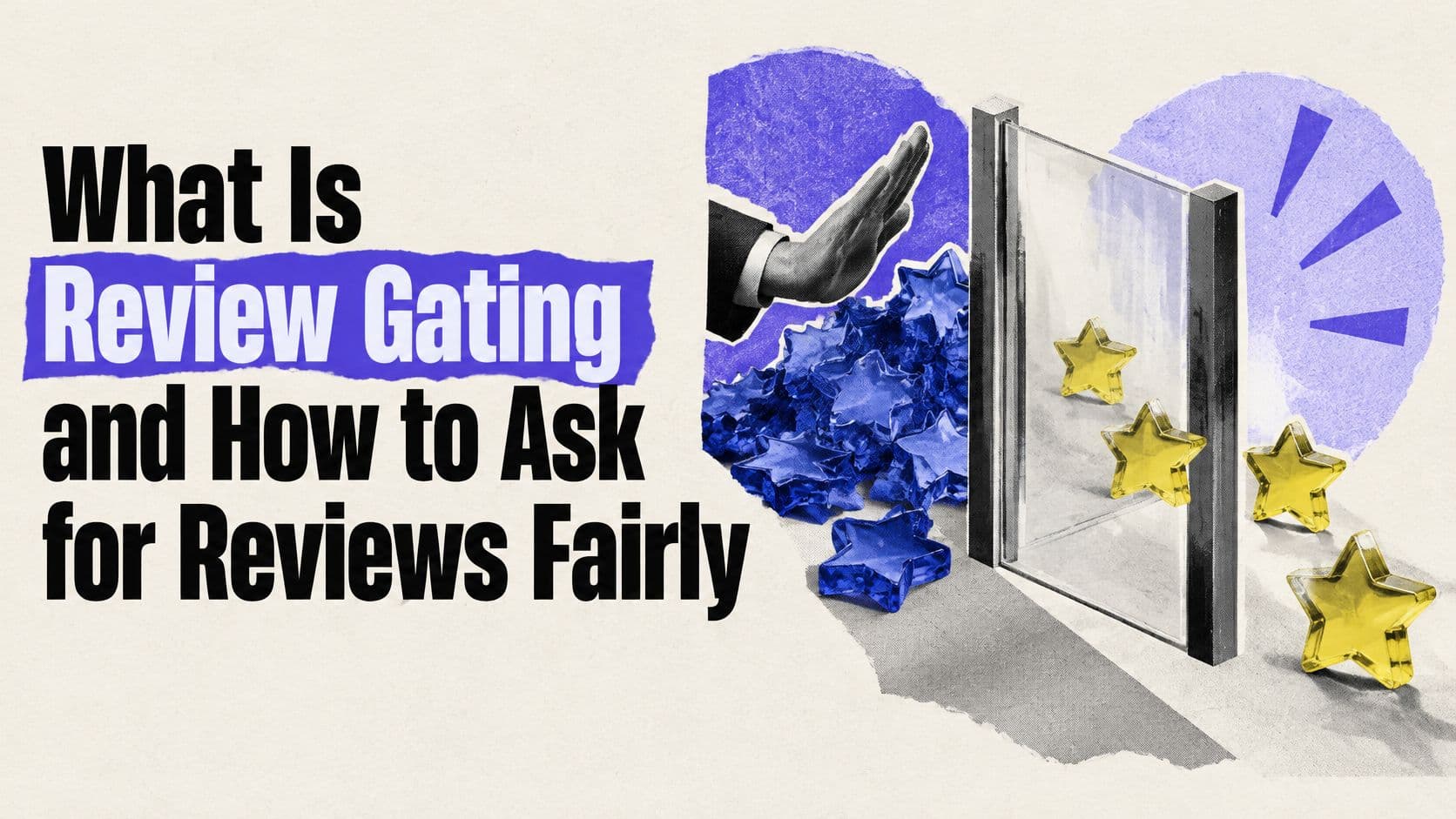
Review gating means asking customers for feedback first and letting only satisfied customers reach public review sites, while dissatisfied customers are routed to a private channel. If the public score looks strong, how would you know whether it reflects every guest or only the happiest slice?
That question matters because most explainers focus on bought reviews. Gating usually involves real customers and real wording, so it can look harmless. The distortion happens earlier, when a business chooses who is invited to appear in public. A rating built that way isn't a measure of the venue. It's a measure of the filter.
Table of Contents
- Review Gating in Plain Terms
- How the Gated Funnel Works, Step by Step
- Gated and Fair Requests Compared Side by Side
- Why Google and Regulators Treat Gating as a Risk
- Running Fair Review Requests Across Venues
- Gated and Fair Invitation Wording
- Audit Your Review Requests Before Your Next Campaign
Review gating in Plain Terms
What is review gating in one sentence? It's collecting feedback from customers and then letting only the satisfied ones reach a public review site, while unhappy customers are routed to a private channel.
Think of a bouncer who admits only guests who already look pleased. The line outside looks like the whole crowd, but it's only the happiest slice. The core problem is selection bias. The public average no longer represents every customer, so a polished rating can hide a large group of unhappy guests.
Say a 60-seat restaurant emails 300 diners a survey after their meals. It sends the 4 and 5-star responders to Google and routes everyone else to an internal inbox. The public score rises, while slow service, cold food, and billing complaints never appear where future diners look.
The FTC's 2024 final rule materials described the practice as asking past purchasers for feedback and inviting only those who provide positive feedback to post online reviews. That framing shows why the issue isn't tone or honesty in individual reviews. It's whether the published set represents the full customer population.
Contacting an unhappy guest privately is not gating. It becomes gating when access to the public review link depends on that guest's answer.
You can see the contrast when you browse client feedback on SEO services and ask whether negative as well as positive experiences had the same route into public view. The test is simple. Did every eligible customer get the same chance to post publicly?
How the gated funnel works, step by step
The funnel below shows where an ordinary follow-up turns into a filter.
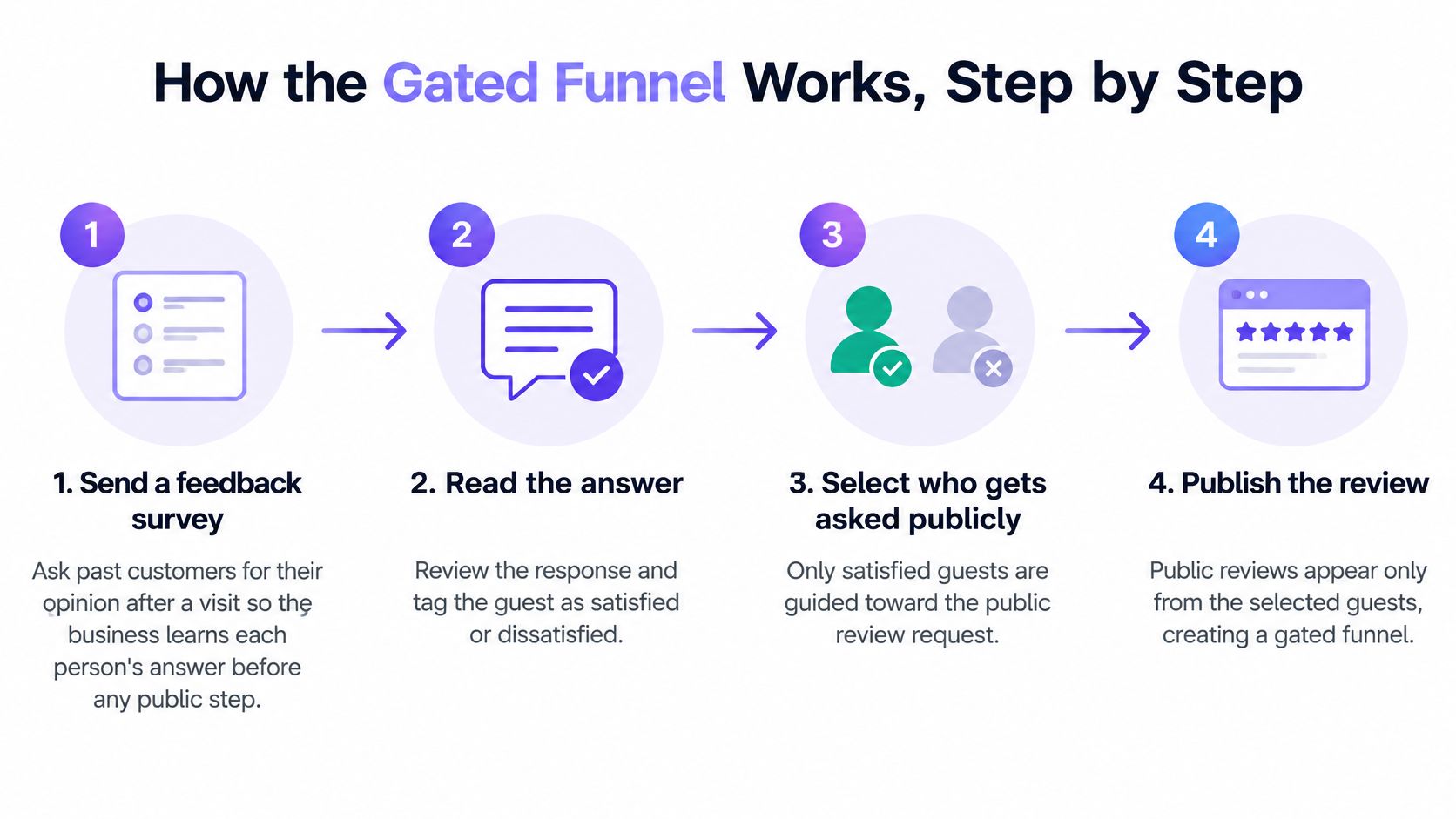
Send a feedback survey after the visit. The business asks how the meal, stay, or appointment went before offering any public step. A common slip is presenting this survey as the review itself, which lets the business see sentiment first.
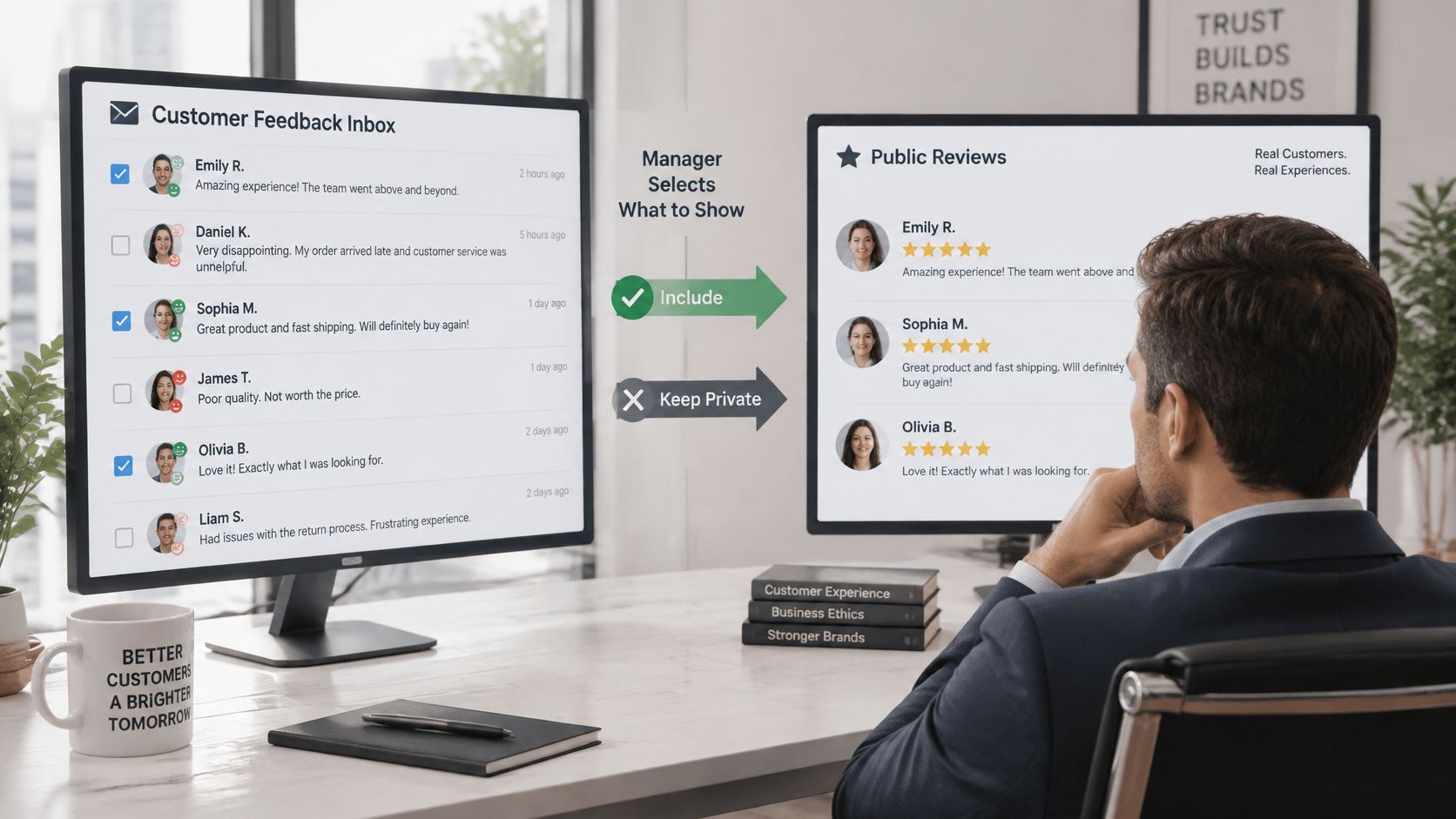
Read the answer and tag the guest. Staff, or more often a score threshold in the review tool, labels the guest satisfied or dissatisfied. That tag isn't neutral data. It's the input that decides what happens next.
Branch on sentiment. This is the gate. Satisfied guests see a public review link. Dissatisfied guests get a private complaint form or a support email instead, and they don't receive the public invitation at all.
Publish what the selected group writes. The public sample now contains mainly people who already liked the experience. The average climbs because unhappy guests were removed before publication, not because service improved.
The video walkthrough below helps you map the same branch points against your own tool.
Google's Business Profile guidance prohibits discouraging negative reviews or selectively soliciting positive reviews, and treats manipulated activity as fake engagement that may be removed. A defensible design works in reverse. After a verified visit, send every eligible guest the same invitation, and offer support separately without replacing the review option.
Eligibility should rest on an operational fact, such as a recorded visit. It shouldn't rest on sentiment, spend, loyalty status, or a prior complaint. Log eligibility, delivery, click-through, and destination, so you can show routing wasn't sentiment-dependent.
Run one check on your current flow. Does every eligible customer see the same public link, regardless of how they answered?
Gated and fair requests Compared Side by Side
Hold your current process against this checklist. The rows separate a filter from a fair request more clearly than any policy statement does.
| Practice | Gated workflow | Fair workflow |
|---|---|---|
| Who gets the public review link | Only guests who answered well | Every eligible guest after a recorded visit |
| What survey answers decide | Who posts publicly | Only service recovery, never publication |
| Eligibility basis | Sentiment, spend or loyalty status | Operational fact such as a verified visit |
| Incentives | Offered for positive ratings | None, for any rating |
| Negative feedback | Diverted to a private channel and kept out of public view | Handled privately without blocking public posting |
| Records kept | Often only the sent list | Consent, invitation, delivery and click logs |
| Platform risk | High, removal and profile restrictions | Low when the process is uniform |
The One-Question Test
Could a dissatisfied guest still post publicly using the same link and the same invitation as a satisfied guest? If yes, you're looking at a fair workflow. If the unhappy guest would need to find your profile alone because your email sent them elsewhere, the design is gated.
That distinction often gets lost in tool settings. A survey may look like customer research, but if its score controls the next screen, it's functioning as a publication filter. Likewise, a list built only from loyalty members or high spenders can recreate the same bias without an explicit survey branch.
A fair design doesn't mean ignoring complaints. Managers can still call an unhappy guest, refund a dish, or fix a room problem. The difference is sequence and access. Service recovery happens alongside the review invitation, not instead of it, and the guest keeps both choices.
Why Google and Regulators Treat gating as a risk
Gating creates risk even when nobody buys reviews and nobody requires positive wording. Selective publication is the problem itself, because future customers read the resulting rating as if it came from the full guest base.
Three Layers of exposure
The first layer is platform enforcement. Google Maps' contribution policy prohibits discouraging or prohibiting negative reviews and selectively soliciting positive ones, and says biased or incentivized reviews may be removed. A workflow can therefore fail on Google even before any legal question arises.
The second layer is the FTC rule. The FTC Consumer Reviews and Testimonials Rule, effective October 21, 2024, prohibits fake or false reviews, sentiment-conditioned review purchases, undisclosed insider reviews, deceptive company-controlled review sites, and certain review-suppression practices.
The third layer is broader deception law. The FTC states the specific rule doesn't itself cover every instance of gating, but warns gating can still violate Section 5 of the FTC Act depending on the facts. So "not named in the rule" isn't the same as safe.
Four Misconceptions to test
- Nobody pays, so it's fine. Test whether dissatisfied guests can still post publicly. Payment isn't required for selection to mislead.
- Asking privately first is legal everywhere. Platform rules and regulator exposure differ, so check each market you operate in rather than treating one answer as universal.
- A private form is service recovery. It's only fair if the public invitation never depends on the answer. Send the same link for every response.
- Targeting regulars is good marketing. Loyalty and spend filters recreate the bouncer. Test eligibility against a recorded visit instead.
Google can also impose profile restrictions, including temporarily preventing new reviews or unpublishing existing ones. For practical controls that sit alongside this risk picture, review the strategies for managing Google reviews and our Google review requests checklist for restaurants.
For groups, prohibit sentiment branching, ban incentives tied to review direction or revision, keep consent and delivery records, and require human approval for campaign logic. One locally built survey journey can expose the wider group, so central review matters.
Running fair review requests across venues
A fair system needs rules that local managers can't reinterpret site by site. These seven rules keep the public sample intact while still giving you useful private feedback.
Trigger after every recorded visit. Send to every guest who has opted in, within about 24 hours. Purple Engage asks every guest for a review after a recorded visit, with no score gating and nothing offered in return.
Keep one review link per site. Test it on a phone before launch. The wrong location link doesn't just frustrate guests, it pollutes your site-level reporting.
Cap frequency. Use one request per guest every 90 days, with at most one reminder within seven days. You're asking for a considered review, not chasing a conversion.
Remove incentives entirely. Discounts, free drinks, and loyalty points don't belong in review requests for any rating. Even a neutral-sounding reward changes why a guest writes.
Offer support in parallel. Give unhappy guests a clear route to a manager, but never let that route replace the review invitation in the same message.
Log the routing. Record each invitation, delivery, click, and destination. In Purple Engage, consent is one ledger, checked at approval and again before every message, which helps you prove who was eligible and why.
Measure more than stars. Track publication rate, rating distribution, reply time, repeat visits, and service-recovery outcomes. Our guide to automated review request emails for venues shows how to structure those sends without a sentiment branch.
What Success Actually looks like
BrightLocal's historical trends research reported that consumer trust in online reviews has declined substantially from its 2016 to 2017 peak, when 84% of consumers said they trusted reviews as much as personal recommendations. In that environment, volume, recency, and visible replies to criticism carry more weight than a polished average.
An A/B test must not withhold invitations from guests who look unhappy. That recreates the filter you're trying to remove.
Judge the program as a measurement system. If fair requests reveal a weaker distribution at one site, that's not a reputation failure. It's the first honest signal you've had about where service needs work.
Gated and fair invitation wording
Wording exposes the gate faster than a flowchart does. Read these two versions from the same restaurant scenario and watch who receives the public link.
Gated version
A survey asks, "How was your meal?" Guests who answer four or five stars receive, "Thanks! Leave us a review here," followed by the review link. Everyone else receives, "Sorry it fell short, tell us what went wrong."
The second message sounds caring, but it withholds the public route. Only the first group ever sees the link. This is also where poor audience definition causes damage, a point covered in the customer targeting advice from Growth 4 Trades. If you profile likely promoters and invite only them, you've built the same gate without a survey.
Fair version
After a recorded visit, every guest receives the same email. "Thanks for dining with us on [date]. If you have a moment, here is our review link for this site. If anything fell short, reply to this email and our manager will follow up."
The complaint route sits inside the same message. It never replaces the review link, and it isn't triggered by a low score because there's no score question in front of it. You can adapt the structure from our review request email template.
Two rules keep the fair version clean. First, attach no reward, discount, or points to the review. Second, if you send a reminder, send it within seven days and cap requests at one per guest every 90 days.
Swap test: Move a guest who gave a poor rating into the fair email. If they'd receive exactly the same message and link, the process passes.
Audit your review requests before your next campaign
Run this audit on your live flow, not on the process you think you have. Tool settings and local edits often tell a different story.
- Trace every branch. Flag any sentiment, spend, or loyalty condition that decides who sees the public link.
- Confirm one invitation. Check that each eligible guest after a recorded visit gets the same invitation and the correct link for their site.
- Search incentive settings. Remove any discount, free drink, or points offer tied to leaving a review.
- Check consent records. Confirm consent is recorded for each guest and opt-outs stick across every tool you use.
- Test the complaint route. Make sure it exists, reaches a named owner, and doesn't replace the review invitation.
- Verify human approval. By default nothing reaches a guest until you approve it, and the approval card shows how many guests the plan reaches after consent, named sample recipients, and what cannot be undone.
Record findings in a dated sheet, so the next audit shows what changed and who approved it. Start this week with one site. Fix any sentiment branch you find, then roll the same rules out across the group.
Purple Engage sends the same review request to every guest after a recorded visit, with no score gating, no incentives, and consent and approval controls behind each send. If you want fair review requests that hold up across every venue in your group, visit Purple Engage to see how the Reviews channel works.