
What is in a pre-employment background check
Learn what is in a pre-employment background check: identity, criminal, work history, and work authorization rules for hospitality hires.

A pre-employment background check confirms identity and role-relevant history, most often criminal records, and may add employment, education, driving, credit, or work authorization checks only when the job needs them. For a hospitality operator, the useful question isn't how much information you can buy, but which information helps you make a lawful decision about this particular job.
A breakfast server, a hotel shuttle driver and a kids-club supervisor shouldn't automatically receive the same screening package. A longer check isn't automatically safer, especially when extra searches produce irrelevant information, mistaken identities or findings nobody knows how to interpret.
Table of Contents
- Common Items Inside a Pre Employment Background Check
- A Risk Check Rather Than a Pass or Fail Test
- Consent Rules Before Any Third Party Report
- Criminal Record Depth by Role and Country
- Credit Employment and Education Only When Relevant
- Wrong Reports and Automated Risk Scores
- Set a Proportionate Check for Hospitality Roles
Common Items Inside a Pre Employment Background Check
A typical check starts by establishing who the applicant is, then comparing their claims with records relevant to the role. Build the package from the duties outward, rather than choosing a screening provider's largest bundle.
What a pre-employment background check can include
| Component | What it looks at | When it usually applies | Hospitality example |
|---|---|---|---|
| Identity | Legal name, date of birth, address history, photo ID | Nearly every hire | Every front-of-house and kitchen role |
| Criminal history | Convictions and, where lawful, cautions or police information | Most screened roles, limited to job-related risk | Cash handling and late-night venues |
| Employment verification | Employers, job titles and dates claimed | When work history affects the decision | Chefs, supervisors and duty managers |
| Education and licenses | Degrees, food-safety cards, liquor licenses | When a credential is required or claimed | Liquor license holders and certified kitchen leads |
| Right to work | Legal permission to work in that country | Every hire where the law requires it | Every paid hospitality role |
| Driving record | License status and serious motoring offenses | Only when driving is a duty | Hotel shuttle and delivery drivers |
| Credit history | Consumer credit report | Selected fiduciary roles, usually later in hiring | Manager who deposits receipts or a finance lead |
| References or character | Interviews about reputation | Selected investigative reports, not routine for every applicant | Senior or safeguarding roles where justified |
Start with a reliable identity match
Use the applicant's identity information to make sure subsequent records belong to the right person. A similar name isn't enough to resolve a criminal-record match, particularly when addresses or other identifiers conflict.
Keep identity verification and right-to-work verification separate in your workflow. Knowing who someone is doesn't establish permission to work, and establishing permission to work doesn't verify their employment claims.
For a useful companion explanation of what different searches can reveal, VolunteerBadge screening insights can help managers distinguish report contents before selecting a package. Use that distinction when briefing site managers, so a request for a background check doesn't become an undefined instruction to investigate everything.
Understand why criminal records dominate
Criminal screening is common, but that doesn't establish what your business should order: the 2018 SHRM survey of 6,500 HR professionals described in the EEOC's criminal-record guidance found that 92% of organizations conducted background checks, and 98% of organizations that screened included criminal-record searches.
Those figures describe employer practice, not permission to search every applicant at the same depth. A conviction also isn't automatically a reason to reject someone. Assess the offense's nature and seriousness, the time elapsed and its relationship to the duties.
For employment and qualification checks, verify the claims that influenced the offer. A head chef's management history deserves attention if you're relying on it to put them in charge of a kitchen; an unrelated qualification shouldn't become another hurdle for an entry-level applicant.
Before ordering anything, check the rows that fit your server, cashier, night auditor or children's activity role. Next to each check mark, write the duty that justifies it.
A Risk Check Rather Than a Pass or Fail Test
Think of screening as a lock on the staff door, not a personality test. It helps you control a defined risk, but it doesn't tell you everything about the person coming through that door.
The connections matter more than the length of the report.
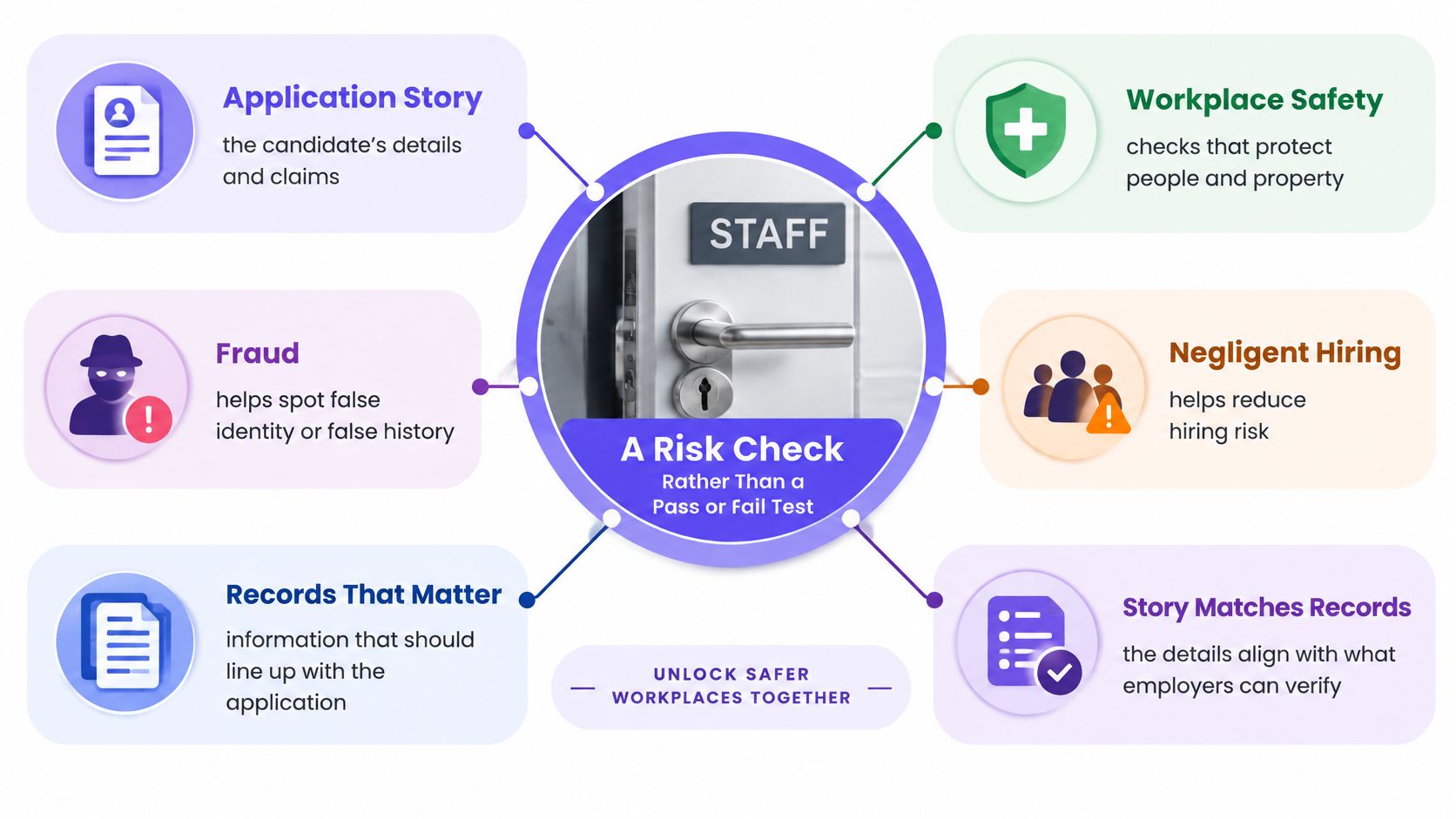
Say a hotel is hiring a breakfast server and a closer who holds the safe keys. Both applicants need a sound identity and work-eligibility process, but the closer's access to cash creates a different decision from the server's responsibility for setting tables and serving breakfast.
For the closer, a lawful criminal search focused on relevant theft or violence risks may help the hiring lead assess those duties. It still won't tell the hotel whether the person follows cash-counting procedures, so training, restricted access and reconciliation controls remain necessary.
Match the evidence to the exposure
Adding a credit report, social-media trawl and barred-list search to both applicants doesn't automatically improve either decision. It can expose the manager to private information unrelated to the job and encourage decisions based on impressions rather than verified facts.
Practical rule: Before adding a search, finish this sentence: “We need this information because the employee will be responsible for…”
The trade-off works in both directions. Over-collection can create compliance problems, while an underspecified package can leave a genuine cash-handling or safeguarding issue unexamined.
A state background check isn't a pass-or-fail test. Likewise, a US consumer report supplies decision-support evidence, not proof that an applicant is unsuitable.
Keep operational controls in the picture
For the hotel closer, ask who can open the safe, who witnesses the count and who checks discrepancies. Don't ask the background report to compensate for a shift where nobody supervises cash access.
For the server, assess service skills and reliability through the recruitment process rather than treating an unrelated record as a shortcut. Read any relevant finding beside experience, references and the actual conditions of the shift.
For another explanation of employment screening, the following video provides additional context.
Even a well-chosen search needs a lawful collection process. A manager's belief that information might be useful doesn't remove the obligation to handle permission, review and applicant communication properly.
Consent Rules Before Any Third Party Report
In the United States, an employer obtaining a report from a consumer-reporting company must follow the Fair Credit Reporting Act, including disclosure, written authorization and applicable adverse-action procedures, as explained in the EEOC's background-check guidance for employers. Such reports can contain criminal history, credit information, employment and education verification, or investigative interviews about character and reputation.
The practical sequence below separates permission to obtain information from permission to make a hiring decision with it.
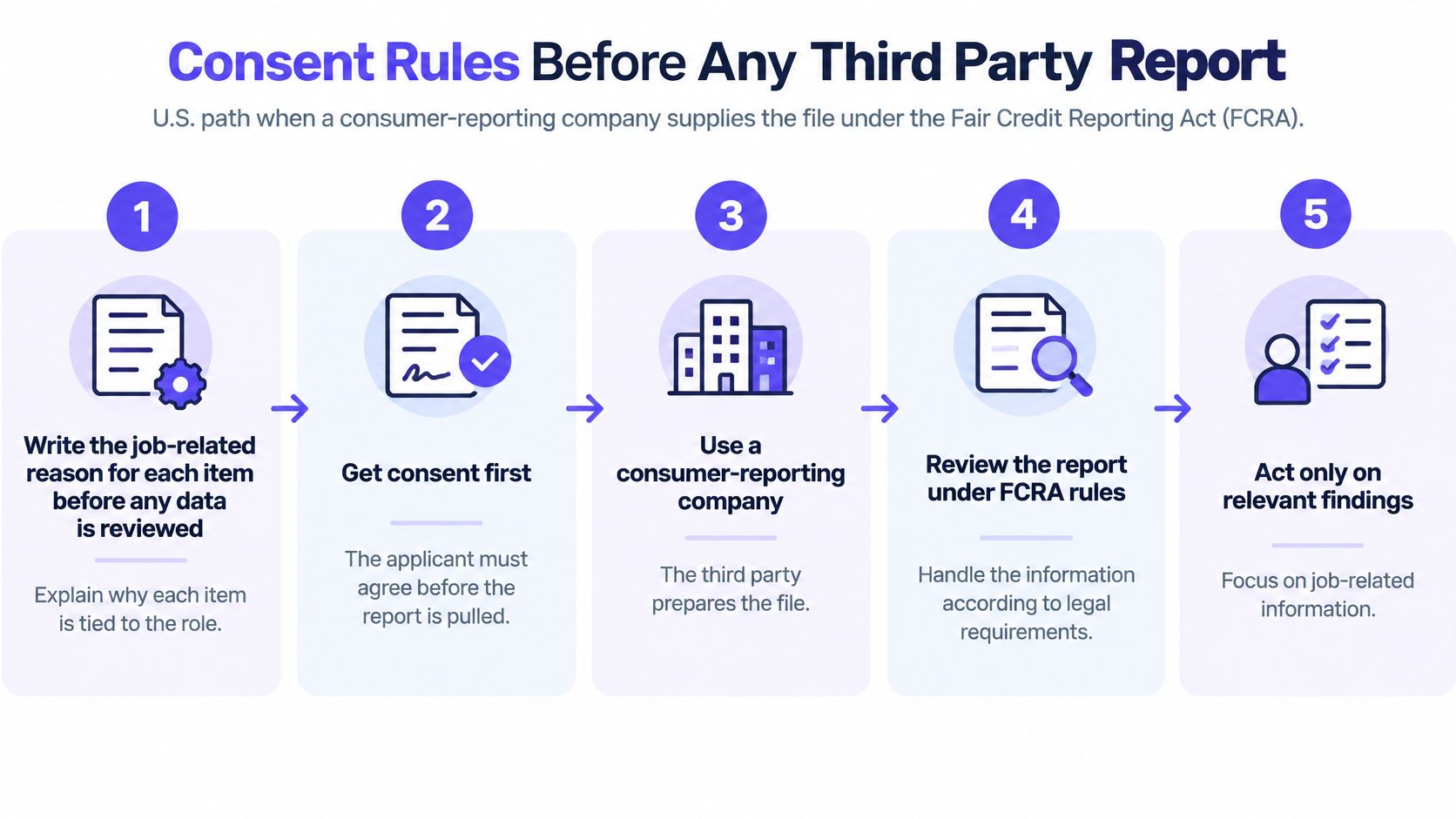
Use a documented hiring workflow
Write the job-related reason before ordering. Identify the duty each component addresses. Without this, site managers can add intrusive searches just because they're available.
Provide a stand-alone written disclosure. Don't bury the notice inside a general application or employee handbook. The applicant should understand that you intend to obtain a background report for employment purposes.
Get written permission. Preserve the authorization with the screening file before requesting the report. A verbal conversation with the duty manager isn't a substitute.
Apply consistent role criteria. Give hiring managers the same written standard for applicants to that role. Otherwise, similar findings can receive different treatment across sites.
Send a pre-adverse-action notice when appropriate. If the report may contribute to rejection, provide the report and a summary of rights before making the final adverse decision. This allows the applicant to see what you're relying on.
Allow an opportunity to dispute or explain. Don't turn a provisional concern into an immediate rejection while a possible mismatch remains unresolved. Follow applicable requirements for the response period rather than inventing a universal deadline.
Send the final adverse-action notice if the decision stands. Identify the reporting agency and include the required information about the applicant's rights. Keep the employer's decision distinct from the agency's role in supplying information.
Consistency doesn't mean a universal package
Employers must not use screening as a proxy for discrimination based on race, national origin, sex, religion, disability, genetic information or age. A neutral-looking criterion still needs scrutiny if managers use it to exclude people for reasons unrelated to the work.
State and local restrictions can also affect when employers ask about criminal history and what they may consider. A multi-site operator should therefore attach jurisdiction-specific instructions to the role standard, rather than sending an identical global order to every location.
Keep the decision trail: Record the purpose, authorization, assessment criteria, applicant response and any required notices, not just the final hiring status.
Restrict access to people who need the information to perform the review. A schedule manager may need to know whether the hiring process is complete without receiving the applicant's full criminal or financial history.
Criminal Record Depth by Role and Country
UK criminal check levels and who may request them
| Check level | What it can show | Who may request it |
|---|---|---|
| Basic DBS | Unspent convictions and conditional cautions | Broadly available |
| Standard DBS | Eligible spent and unspent convictions and adult cautions | Only roles that meet eligibility rules |
| Enhanced DBS | Standard content plus relevant local-police information | Only roles eligible for Enhanced screening |
| Enhanced with barred lists | Enhanced content plus whether the person is barred from regulated work with children or vulnerable adults | Roles eligible for the relevant barred-list check, including qualifying regulated activity |
The levels differ in what they reveal and in who is allowed to ask. Standard and Enhanced checks aren't available merely because an employer wants more reassurance: the requesting organization has to show the role's duties qualify for that depth. A deeper certificate produces more material to weigh, not a safer hire by default.
Establish eligibility before choosing depth
Start with a description of the work, not the preferred certificate. Record the setting, the people the employee serves, the duties and how frequently the contact occurs, then match that description to the disclosure level the role permits.
A hotel kids-club supervisor and a restaurant floor supervisor work in the same building but need different eligibility assessments. A family-friendly brand doesn't, by itself, make every employee on the schedule eligible for the deepest available check.
The recruiting organization owns the decision on level. A site manager working from a job title and an urgent start date is the wrong person to make it. Three failure modes show up repeatedly:
- Too intrusive: requesting a disclosure level the role doesn't permit creates its own compliance risk.
- Too narrow: missing eligible safeguarding work leaves relevant information outside the search.
- Poorly specified: ordering against a broad title such as "hotel assistant" makes the chosen level hard to justify later.
Don't transplant a package across borders
A US criminal search and a DBS check are not interchangeable products. A US screen may pull records from the specific court jurisdictions where the candidate lived and worked, while DBS disclosure follows its own eligibility and record-disclosure framework. "National" coverage means different things in each system, so ask which jurisdictions and record types a search includes rather than assuming the label guarantees completeness.
The same discipline applies within the US: establish which federal or state disclosure system governs the hire instead of treating background check terminology as universal across the country.
Separation of sourcing from screening holds for any workforce category. A guide to the best place to hire medical virtual assistants can help you find remote healthcare support candidates, but where you recruit people and which criminal-record rules apply to the role are two different questions.
Read the disclosure as evidence
For a hotel's children's activity role, document eligibility before the application reaches the screening stage. Then weigh whatever comes back alongside qualifications, references, and the responsibilities the employee will hold. The certificate is one input into a hiring judgment. Treating it as a pass or fail stamp is how proportionate checks turn into automatic rejections the file can't support.
Credit Employment and Education Only When Relevant
Credit screening is a selective tool, not a standard ingredient: 13% of organizations checked credit histories for all candidates, 47% only for selected jobs, and 40% didn't conduct credit checks, according to SHRM survey testimony summarized by the EEOC and discussed in the SHRM and SIOP background-check document.
That distribution supports a useful operational distinction. Checking whether someone has held the management role they claim isn't the same exercise as examining their personal financial history.
Credit requires more than access to a cash register
A finance lead with authority over payments or a general manager responsible for banking receipts may present a role-related reason to consider credit screening. That's the start of the assessment, not automatic legal permission.
Check the relevant restrictions and explain what the financial information would help you decide. Don't assume that debt proves dishonesty, or that serving customers at a cash register creates fiduciary responsibility equivalent to controlling company accounts.
A line cook, barista or breakfast server ordinarily provides no comparable justification through those duties alone. Adding credit screening to those jobs can introduce sensitive information without answering a useful hiring question.
If the manager can't identify the financial authority involved, don't use “handles money” as a catch-all justification.
Verify the claims you relied on
Employment verification should answer a narrow factual question: did the applicant work for the named employer, in the stated role, during the stated period? For a head chef, confirm the experience that persuaded you they could manage service and lead the brigade.
If a former employer supplies only dates and a title, don't describe that response as a performance reference. Nor should missing employment history count against an applicant seeking their first job.
Education and license checks belong where the credential is required or materially influenced selection. Verify a claimed food-safety qualification or personal alcohol license with the appropriate issuer, including whether it is current where that matters.
A casual statement about wine knowledge is better tested through a job-relevant conversation or practical assessment than turned into a broad educational investigation.
- Driving duties: Check the driving record for a shuttle or delivery position, not because a candidate drives to work.
- Required credentials: Confirm the exact certificate or license needed for the assigned responsibilities.
- Claimed experience: Resolve discrepancies that matter to the offer, distinguishing a minor date error from invented management responsibility.
For each additional component, identify who will review the result and what finding could legitimately change the decision. If nobody can name the duty the information protects, remove the item.
Wrong Reports and Automated Risk Scores
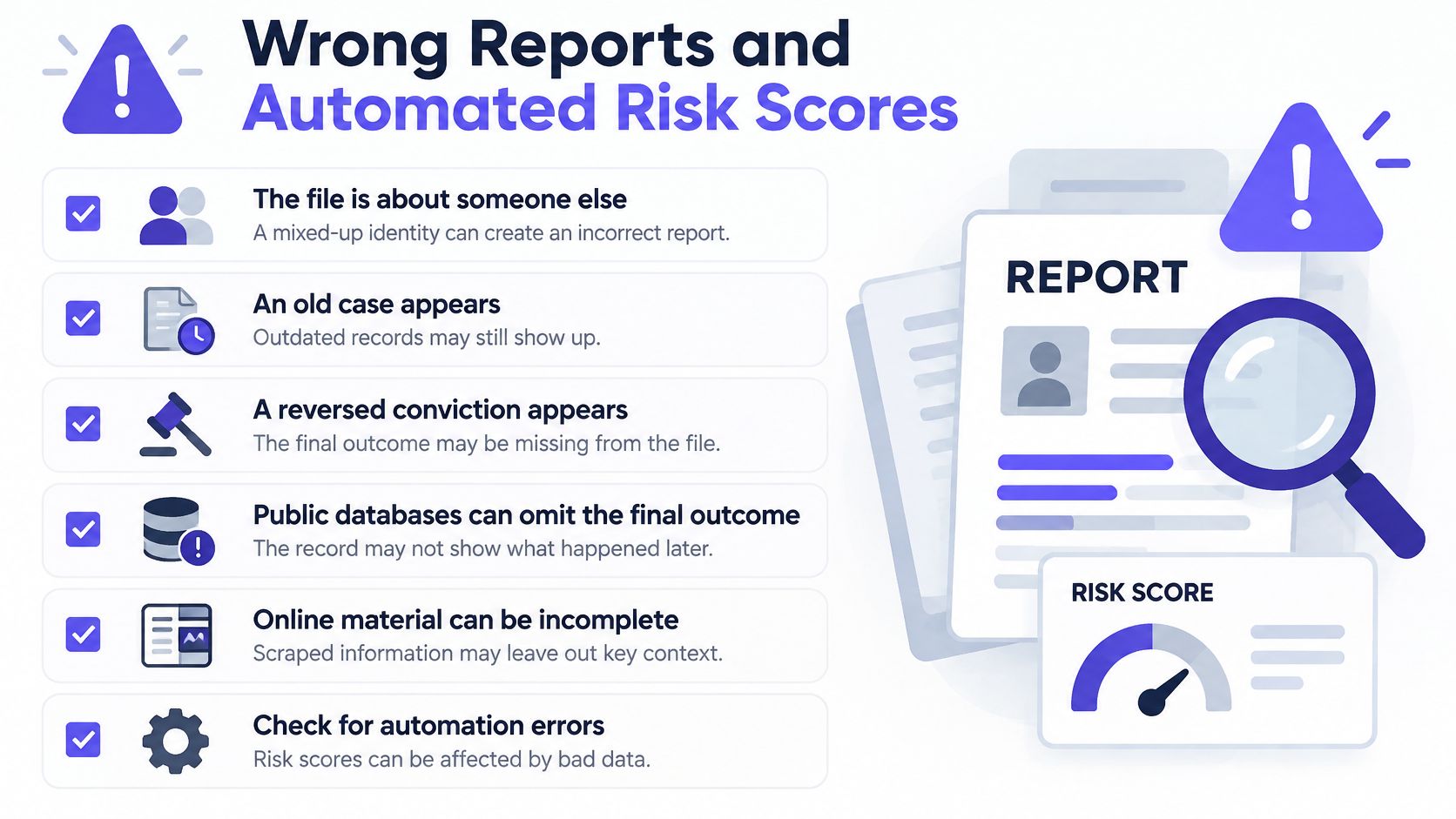
A mixed file, an old arrest with no recorded outcome, a conviction that was reversed but still shows: any of these can land on a law-abiding applicant's report. The Employment Testing guidance document highlights Oregon labor guidance warning that databases may omit final dispositions, and it directs employers to weigh recency, seriousness and job relevance before excluding anyone.
Treat each one as a trigger to verify before deciding.
Give applicants a usable correction path
- Request the report used for the proposed decision.
- Check identifiers, including name, date of birth and addresses, against the applicant's own documents.
- Gather evidence from the court, employer or educational institution that can resolve the discrepancy.
- Submit the correction through the reporting agency's process and notify the employer within the applicable review window.
- Ask for an individualized assessment against the actual duties of the role.
Keep one decision record per applicant that lists the evidence, the reviewer and the outcome. The same discipline behind an audit log, applied to a hiring file, lets a second reviewer reconstruct why a flag was accepted or corrected without the report circulating further.
Separate the score from the decision
The European Commission's AI Act employment guidance classifies AI intended for applicant background checks as high-risk employment AI, including tools that merge records into scores or alerts. A label such as "medium risk" compresses the underlying record into a color; it cannot tell you which entry drove it or whether that entry even belongs to your applicant.
Before acting on a flag, ask five questions. Was the applicant told AI was used? Who reviewed the flag? Which piece of evidence triggered it? How was the model tested for bias? How does the applicant contest the result? If the vendor or the file cannot answer these, the score is not yet evidence.
Automation still earns its place. Matching a name to a record, collecting documents and ranking files for review are mechanical tasks where consistency helps. The hiring judgment is where a person has to explain the trigger, weigh it against the role's actual duties and change course when the underlying record is wrong. Left to run on its own, software repeats a bad match across every file it touches; the reviewer's job is to catch it before the offer does.
Set a Proportionate Check for Hospitality Roles
Use the following as a role-design starting point, subject to local law and the employee's actual duties. Don't treat the packages as blanket permission to order every listed search.
Five hospitality role packages
| Role | Lawful check package | Job-related reason |
|---|---|---|
| Breakfast server | Identity and right to work; employment dates only if experience shaped the offer | Confirm the person can legally work and is who they say they are |
| Cashier or bar closer | Identity, right to work and, where lawful and justified, a criminal search assessed for theft and violence relevance | Cash handling on a late shift |
| Hotel night auditor | Identity, right to work and employment verification; consider credit only where lawful and justified by cash reconciliation and banking responsibilities | Reconciling receipts and bank records |
| Delivery driver or hotel shuttle | Identity, right to work and driving record | Driving is a core duty |
| Kids-club or care role | The check required or justified for the eligible regulated work, including barred lists where eligible | Regulated contact with children or vulnerable adults |
Give every site a clear operating standard
- Define eligibility first. Set the permitted package before collecting applicant information.
- Choose the least intrusive lawful option. A safeguarding role may justify deeper screening; a bar-closing title alone doesn't justify credit screening.
- Apply the role standard consistently. Document legitimate jurisdictional or duty-based differences.
- Name the dispute reviewer. Give applicants a real opportunity to resolve errors and explain relevant records.
- Assign the decision owner. Require someone to assess the evidence rather than accept a certificate or software status as the answer.
Before the next hire, write a one-page matrix recording the role, lawful checks, job-related reasons, dispute reviewer and final sign-off owner. Have each site use that matrix instead of selecting a package under time pressure. That gives the business a practical way to protect guests and cash while treating applicants fairly.
We offer Purple Engage for venue marketing, combining guest records, messaging, and campaigns with shared consent controls and human approval, not employment background screening. If you're applying the same discipline to how your venues use guest data, visit Purple Engage to explore those controls and connected marketing tools.