
Digital coupons and offers for bars and pubs: redemption tracking and ROI
You will be able to issue unique, single-use pub coupons to a consented guest WiFi list and hold back a random 10% holdout. You can then calculate net offer profit from incremental visits.
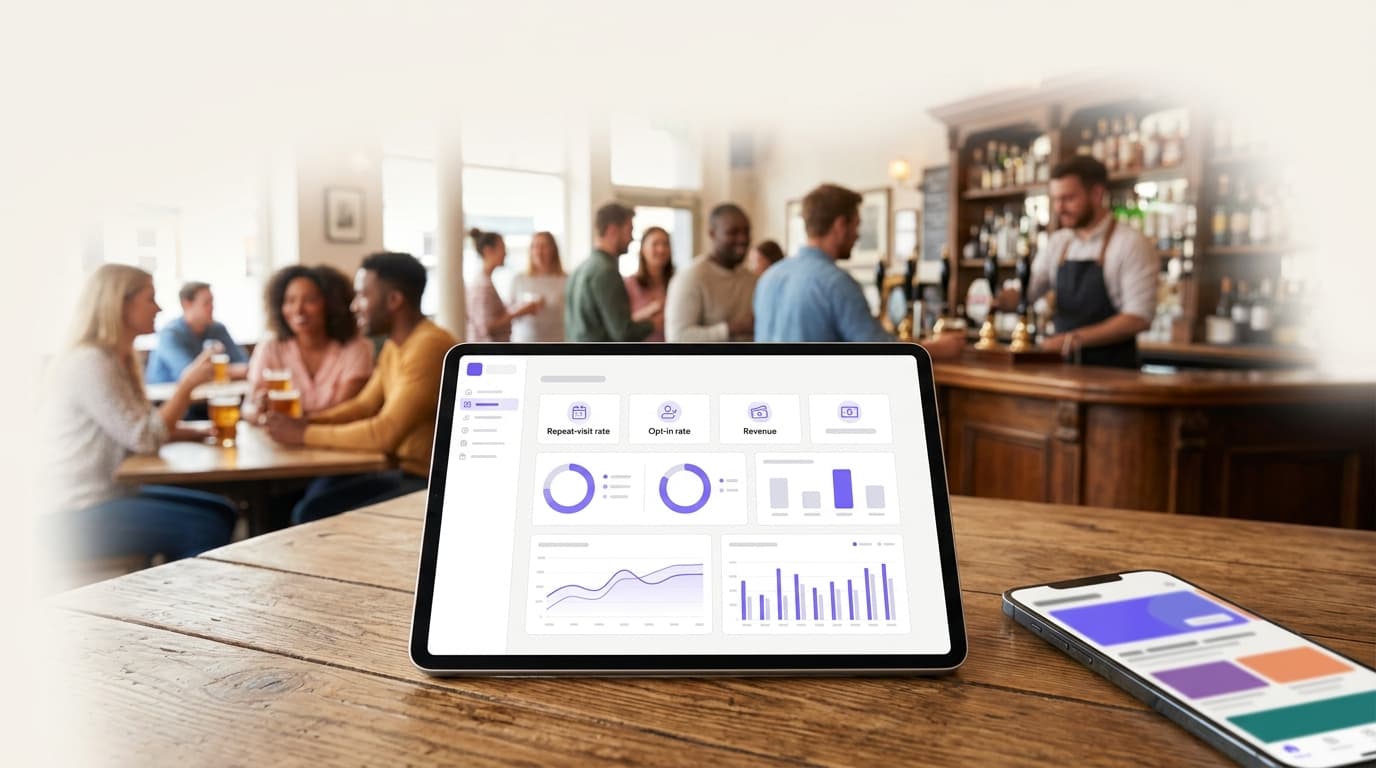
Issue each guest a unique, single-use code from a consented list, and redeem it at the register against that guest. Hold back a random 10% of the list who receive nothing. The offer made money only if the voucher group's spend per guest, minus discount cost, beats the holdout group's. Redemption rate alone proves nothing.
What do digital vouchers for bars do for your venue?
A voucher is a price cut with a name attached. Done well, it brings a guest back on a quiet Tuesday who would otherwise have stayed at home. Done badly, it hands a discount to someone who was already walking through the door on Friday.
The difference is measurement. Digital vouchers for bars beat printed flyers because each code can belong to one guest. A single-use code lets you answer three questions a paper voucher never could:
- Who redeemed, at which location, on which day and with what bill.
- Who came back without redeeming, prompted by the email alone.
- Whether the guests who received the offer visited and spent more than similar guests who did not.
The third question decides ROI. The outcomes worth reporting are repeat visits, incremental gross profit and revenue per send. Redemption count is an activity measure, not a result.
Why the list matters more than the voucher
A voucher campaign is only as good as the list behind it. Mailchimp, Klaviyo and HubSpot send campaigns well, but they wait for you to supply the contacts. In a bar those contacts rarely exist. Most guests pay at the bar, leave no email address and never join a loyalty program.
Purple Engage starts from the other end. Your list builds itself from Guest WiFi logins, where each guest makes a conscious-choice opt-in to marketing. That gives you consented, first-party data with a visit history attached. Each later WiFi login is also a visit signal. You can therefore see whether a guest returned, even if they never showed the code.
The scale behind that signal is substantial. Purple runs guest WiFi at 80,000+ live venues and recorded 440 million logins in 2024 (Purple's own data).
What do you need before you issue your first voucher?
Sort out five things before the first send. Skipping any one of them makes the final ROI figure unreliable.
- A consented list with visit history. Each record needs a marketing opt-in that meets CCPA/CPRA. Article 4(11) defines consent as freely given, specific, informed and unambiguous. Article 7(3) requires withdrawal to be as easy as giving consent, so every send needs a working unsubscribe link. In the US, the TCPA and CAN-SPAM add rules for marketing email and text messages. The FTC and state attorneys general publish guidance on both.
- POS software that records a code against a transaction. You need the code, site, date, time and bill value for every redemption, exportable as a file. If staff can apply the discount without entering the code, your data is fiction.
- Gross margin for whatever the offer discounts. Food and drink margins rarely match. A $5 food offer judged on a blended margin will give you the wrong answer.
- One question per campaign. "Will $5 off food bring lapsed guests back midweek?" is testable. "Drive more visits" is not.
- A licensing check. Drinks promotions carry legal limits that food offers mostly avoid. The rules are set out below.
How do you set up single-use vouchers with your guest WiFi data?
The workflow has five stages. Purple Engage handles the list, the segment and the send. Your POS or voucher provider generates the codes and records redemptions. The code joins the two data sets. For platform configuration, follow Purple's support documentation for Purple Engage.
Build the segment
Pick guests by behavior, not by guesswork. Four segments do most of the work in a bar or restaurant:
- Lapsed: no WiFi login in the past 60 days.
- First-timers: one login, no return visit yet.
- Regulars: three or more visits in 90 days. You usually exclude these from discounts.
- Site-specific: guests whose last visit was at a site with spare midweek capacity.
Split off a holdout group
Remove a random 10% of the segment before the send. They receive nothing. Choose them at random, never by site, last name or sign-up date, or the comparison breaks. Aim for a holdout in the hundreds, not the tens. With 40 guests in the holdout, two extra visits swing the whole result.
Issue one code per guest
Each code should be single-use, carry an expiration date and work only at the sites and times the offer covers. Map every code to one guest record before the send, and keep that mapping file. You need it at the end.
A shared code such as "BAR5" fails this test. It can be screenshotted, passed round a group chat and reused, and you lose sight of who used it.
Redeem at the register
Staff scan or key the code. The POS validates it, applies the discount and voids the code so it cannot work twice. Brief every shift that no code means no discount. One informal discount per night is enough to corrupt a small test.
Reconcile
When the measurement window closes, export redemptions from the POS. Join them to the code map, then to WiFi visit data. You now have three groups: redeemers, recipients who returned without redeeming, and the holdout.
Which voucher format should you use?
| Format | Tied to one guest | Can be shared | Abuse risk | Shows incremental profit | Best suited to |
|---|---|---|---|---|---|
| Printed flyer or table card | No | Yes, freely | High: photocopies and reuse | No | Local awareness for a new opening |
| Shared digital code (e.g. "PUB5") | No | Yes, by screenshot or group chat | Medium to high | No, only total redemptions | Short public promotions where reach matters more than measurement |
| Unique single-use code by email or text message | Yes | Forwarding only, and it works once | Low | Yes, with a holdout group | Win-back, midweek fill, second-visit offers |
| Unique code matched to WiFi visits | Yes | Forwarding only, and it works once | Low | Yes, including returns without redemption | Multi-site groups comparing ROI by location |
Which offers should you send, and when?
One principle governs every decision. Discount where you have spare capacity, to guests who would not have come anyway. Everything else gives margin away.
| Your situation | Offer | When to send | Why it works | What to measure |
|---|---|---|---|---|
| Lapsed guests, no visit in 60 days | $5 off food over $20, valid 14 days | One to two days before the valid period opens | Win-back with a clear reason to return | Visits per guest vs holdout |
| First visit, no return yet | Free side or dessert on the second visit, valid 21 days | Within 48 hours of the first WiFi login | Turns a one-off visit into a second while the visit is recent | Second-visit rate vs holdout |
| Quiet midweek at one location | Two mains for a set price, Monday to Wednesday only | Three days before the valid period | Fills empty tables at low extra cost | Midweek visits at that location vs holdout |
| Event night (trivia, live music) | Free sharing platter for teams of four or more | One week before the event | Lifts group size and spend per head | Event-night visits and spend vs holdout |
| Regulars, three or more visits in 90 days | No discount: early event access or a reserved table | When a new event goes on sale | They already come; a discount only subsidizes them | Visit frequency held steady |
| Friday and Saturday peaks | Do not send a discount | Do not send | A full venue gains nothing from a price cut | Peak covers unchanged |
Keep drinks offers inside the law
State and local liquor control laws, regulated by state Alcohol Beverage Control (ABC) boards, strictly govern alcoholic beverage promotions. Many jurisdictions prohibit unlimited drinks for a fixed or discounted fee, happy hour price changes after a certain time, or free drinks tied to purchase thresholds or sports results. Selling alcohol below cost or giving away free spirits, wine, or beer is illegal in numerous states.
Food-led offers avoid most of these limits. Check any drinks promotion with your legal or licensing advisor before it goes out.
How do you know whether a voucher made money?
Redemption rate is the number most bars report, and it is the wrong one. A redemption tells you a guest used the code. It does not tell you whether they would have come anyway. Only the holdout group answers that.
The calculation
Use WiFi visits to compare the two groups, and POS data to put a value on each visit. Not every guest logs into WiFi on every visit. Because the holdout is random, that undercount affects both groups equally, so the comparison holds.
- Visits per guest for each group: WiFi visits in the window divided by guests in the group.
- Incremental visits: (send group rate minus holdout rate) multiplied by the number of guests in the send group.
- Incremental sales: incremental visits multiplied by the average full-price bill for that site and time of week.
- Incremental gross profit: incremental sales multiplied by gross margin.
- Net offer profit: incremental gross profit minus total discount given minus send cost.
Total discount given is redemptions multiplied by the average discount. For a free item, count its food cost, not its menu price, provided the guest would not have bought it otherwise.
Measure over a window longer than the offer itself. A 14-day offer with a 28-day window catches guests who return after the code expires.
Worked scenario 1: a midweek win-back across a 12-site bar group
Illustrative figures, to show the method.
Situation. A 12-site bar group had quiet Monday to Wednesday evenings. It also had 8,000 opted-in guests with no WiFi login in the past 60 days.
What was done. The group held back a random 800 guests and sent 7,200 a unique code for $5 off food over $20. The code was valid Monday to Wednesday for 14 days. Visits were measured over 28 days.
| Measure | Send group | Holdout group |
|---|---|---|
| Guests | 7,200 | 800 |
| WiFi visits in 28 days | 1,512 | 96 |
| Visits per guest | 0.21 | 0.12 |
| Redemptions | 720 | 0 |
The outcome.
- Incremental visits: (0.21 - 0.12) × 7,200 = 648.
- Incremental sales at a $34 average bill: $22,032.
- Incremental gross profit at 65% margin: $14,321.
- Discount given: 720 × $5 = $3,600.
- Send cost: $200.
- Net offer profit: $10,521, or $2.92 returned for every $1 of discount.
The naive reading would have claimed 720 redemptions × $34, or $24,480 of "coupon revenue". That figure ignores the 12% of lapsed guests who would have returned anyway. It also ignores the discount itself.
The site-level split mattered too. Two sites showed no lift, because their midweek trade was already strong. The group kept the offer at the other 10 sites and dropped it at those two.
Worked scenario 2: an events bar that gave its margin away, then fixed it
Illustrative figures, to show the method.
Situation. A bar runs a weekly trivia night and monthly live music. It sent 20% off the total bill on Saturdays to 4,500 opted-in guests and held back 500.
What happened. The code produced 630 redemptions, which looked like a success. The holdout said otherwise.
- Visits per guest: 0.40 in the send group, 0.39 in the holdout.
- Incremental visits: 0.01 × 4,500 = 45.
- Incremental gross profit: 45 × $45 bill × 65% = $1,316.
- Discount given: 630 × $9 average = $5,670.
- Send cost: $150.
- Net offer profit: minus $4,504.
Saturday was already full. The coupon subsidized guests who were coming regardless.
What was done next. The bar moved the offer to its Tuesday trivia night. Teams of four or more who booked through the email link received a free appetizer platter, with a $4 food cost.
- Visits per guest on trivia nights: 0.12 in the send group, 0.08 in the holdout.
- Incremental visits: 0.04 × 4,500 = 180.
- Incremental gross profit: 180 × $22 bill × 65% = $2,574.
- Discount given: 60 platters × $4 = $240.
- Send cost: $150.
- Net offer profit: $2,184.
Same bar, same list, smaller discount. The only change was sending it to a night with empty tables.
Reading the result
- Net profit positive: keep the offer. Next time, test a smaller discount against the same audience.
- Net profit near zero: change the audience or the night before you change the offer.
- Net profit negative: stop, and check whether you discounted a peak or a regular segment.
Then look further out. Compare visits per guest in both groups over 90 days. If the send group keeps visiting more often after the code expires, the offer built a habit. That gain belongs in your lifetime value estimate.
Pair the numbers with feedback
Visits and profit tell you what happened. Feedback tells you why. A short survey after a coupon visit shows whether returning guests rated food and service well enough to come again at full price. The post-visit feedback survey checklist for hotels and restaurants covers what to ask. If you run several locations, NPS surveys for multi-site restaurant groups explains how to compare loyalty location by location. That helps you spot where an offer brought guests back to a weak experience.
What goes wrong, and how do you avoid it?
Discounting guests who were coming anyway
This is the most expensive mistake, as the second scenario shows. Exclude regulars and peak nights from price offers. Give regulars recognition instead: early access, a reserved table or first refusal on event tickets.
Running without a holdout
Without a holdout, every redemption looks like a win. Hold back 10% on every campaign, not just the first. Guest behavior shifts with seasons, events and weather, so last quarter's baseline will not hold this quarter.
Discounts applied without a code
If staff can key a discount manually, some will, usually with good intentions. Lock coupon discounts to code entry on the POS. Then check that discount totals reconcile with redemption counts at each site.
Codes that never expire
Open-ended codes turn up months later, after the campaign has been judged. Give every code an expiration date, and set the measurement window to end at least two weeks after it.
Training guests to wait for a coupon
Send too many offers and guests stop visiting at full price. Watch the share of visits that use a code in each segment. If that share rises among regulars, pull back the frequency.
Treating redemptions as revenue
A redemption report is not a profit and loss statement. Report net offer profit and incremental visits to your board or owner, with the holdout comparison attached.
Weak consent records
Sending offers to guests without a valid marketing opt-in breaches CCPA/CPRA and the TCPA and CAN-SPAM. The FTC and state attorneys general can fine organizations that break these rules. Capture a conscious-choice opt-in at WiFi login, store when and how each guest agreed, and honor unsubscribes right away.
Frequently asked questions
Can we send bar vouchers from Mailchimp or Klaviyo instead of Purple Engage?
Yes, Mailchimp and Klaviyo can send a coupon email, but neither builds the list for you. In a bar, the list is the hard part, because most guests pay at the bar and leave no contact details. Purple Engage builds a consented, first-party list from guest WiFi logins and attaches visit history to each guest. That visit history lets you compare send and holdout groups. It also shows who came back without redeeming.
Is it CCPA/CPRA compliant to email coupons to guests who logged into our WiFi?
Yes, provided each guest gave a separate, conscious-choice opt-in to marketing at login. CCPA/CPRA requires consent to be freely given, specific, informed and unambiguous, so a pre-checked box does not count. A WiFi login on its own does not count either. In the US, the TCPA and CAN-SPAM also govern marketing email and SMS. Keep a record of when and how each guest consented, and include an unsubscribe link in every send.
Will this work with our existing POS?
Yes, if your POS can record a coupon code against a transaction and export redemptions. You need the code, site, date, time and bill value for each redemption. Purple Engage handles the list, segment and send, and the code joins the two data sets during reconciliation. If your POS cannot validate codes, fix that before your first campaign. Unvalidated discounts make the results meaningless.
Can we bring our existing mailing list across?
Yes, but only the contacts whose consent you can evidence. For each record you need when, where, and how the person agreed to marketing. Contacts without that record should not receive offers, whatever platform you send from. Treat legacy contacts as a separate segment with their own holdout group. Their response may differ from guests who opted in recently through guest WiFi.
How long before we know whether an offer made money?
Allow about five to six weeks for your first test. Setup takes around a week: segment, holdout, codes, and a staff briefing. The offer then runs for 14 days. You measure visits over a 28-day window so that late returners count. Reconciliation takes a day or two once the POS export arrives. Later campaigns reuse the same process, so they move faster.
How much discount per extra visit is reasonable?
Judge it against your margin, not against an industry benchmark. Divide total discount by the incremental visits from your holdout comparison. That gives you the discount cost per extra visit. If the figure is below the gross profit on an average bill, the offer pays. In this guide's first worked example, $3,600 of discount bought 648 extra visits. That is about $5.56 each, against roughly $22 gross profit per visit.
Can bars and taverns run digital drinks vouchers?
Yes, but you must ensure compliance with state and local liquor control regulations. Many jurisdictions restrict happy hour promotions, free drinks, or selling alcohol below cost. Food-led vouchers avoid most of these restrictions. Check any drinks offer with your legal or licensing advisor before it goes out.