
Mailchimp alternatives for restaurants and hospitality
Why this matters for your venue
The core challenge of hospitality marketing is not sending emails; it is collecting the email addresses in the first place. Generic email platforms like Mailchimp are merely 'senders'. They are excellent at dispatching campaigns, but they rely on you to supply the list. For a restaurant, bar, or hotel, building that list manually via comment cards or website pop-ups is slow, error-prone, and difficult to scale.
The economic model of generic tools is also changing. Mailchimp's free plan has now been restricted to just 250 contacts, down from 2,000 in previous years. A moderately busy independent restaurant would exceed this limit in just a few days. Paid tiers scale with list size, so as your marketing efforts succeed, your costs rise in tandem - a counter-intuitive incentive. Beyond pricing, there is a deeper structural issue: these tools have no connection to your physical venue. They cannot tell you which guests have walked through your doors, how often they return, or whether a campaign drove a booking.
The cost of not collecting guest data compounds over time. A guest who visits twice a month and spends an average of $30 per visit is worth far more over a year than a one-off visitor acquired through third-party promotions. You need a tool that acts as a 'builder' - one that actively captures first-party data from customers inside your venue and then attributes your campaigns to their physical return visits.
| Tool Type | Builds List | Sends Campaigns | Attributes Customer Visits | Built-in CCPA/CPRA Compliance |
|---|---|---|---|---|
| Mailchimp | No | Yes | No | No |
| Klaviyo | No | Yes | No | No |
| HubSpot | No | Yes | No | No |
| Purple Engage | Yes | Yes | Yes | Yes |
How it works
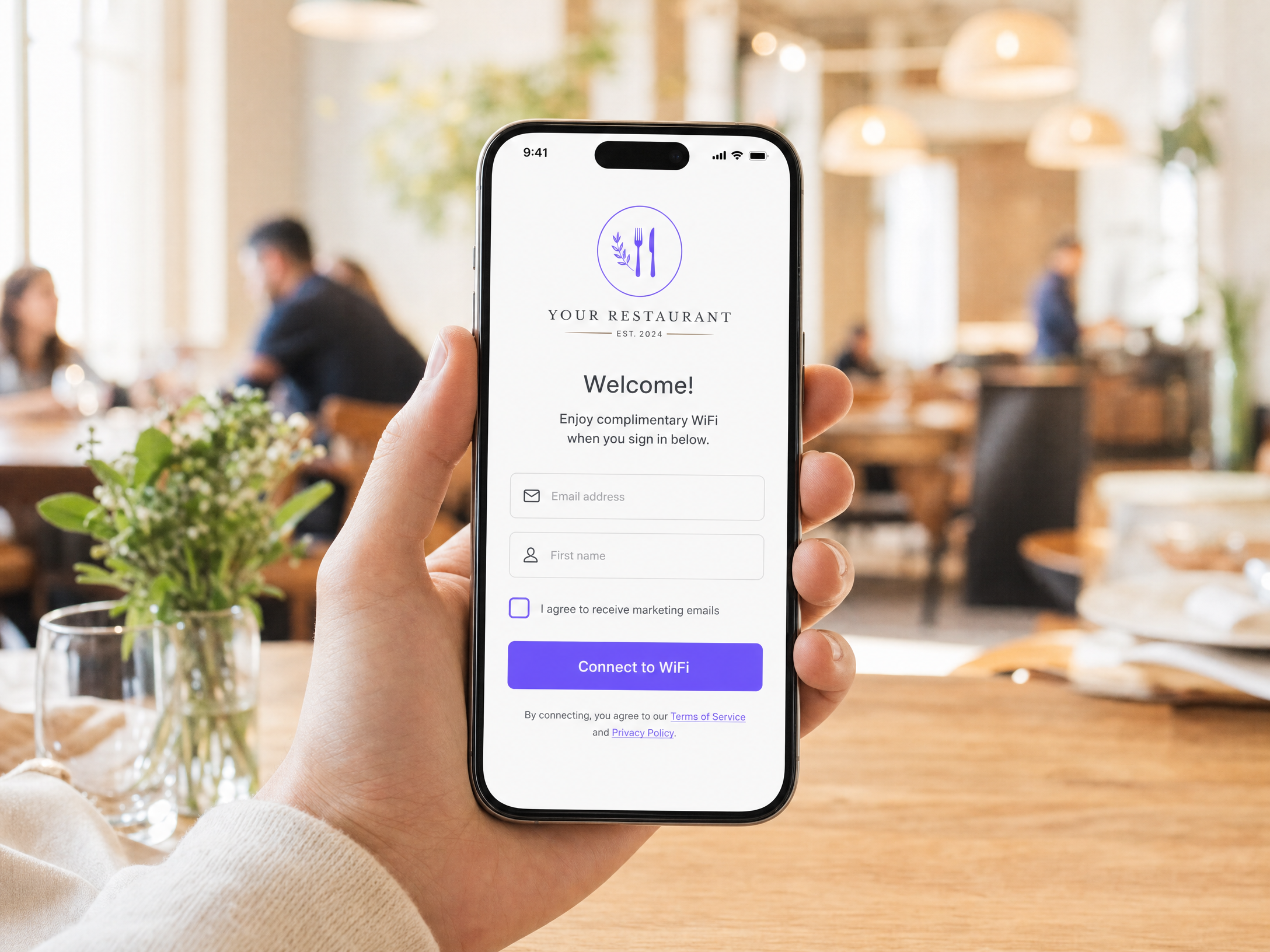
The most effective way to build a verified customer list in a physical venue is guest WiFi. When a guest wants to connect to the internet, you provide internet access in exchange for their contact details via a branded Captive Portal - a login page that appears before they gain internet access.
This method solves the problem of acquiring customers at scale. It converts anonymous customers into known CRM profiles. Because the guest actively inputs their details and ticks an opt-in box, you collect consented first-party data that is fully CCPA/CPRA compliant. According to data from venues using WiFi marketing platforms, guest WiFi platforms typically convert 60-80% of connected devices into email subscribers. This is a list-building rate that no website pop-up or comment card can match.
See how Guest WiFi powers this. Platforms like Purple Engage are designed specifically for this job, integrating data collection directly with an email marketing engine. Purple serves 80,000+ venues globally and recorded 440 million logins in 2024 (Purple internal data, 2024).
How to do this with your guest WiFi
You do not need to change your IT infrastructure to implement this strategy. Purple Engage works as a hardware-agnostic cloud overlay. Whether you use Cisco Meraki, HPE Aruba, Ruckus, Juniper Mist, Ubiquiti UniFi, Cambium, Extreme, or Fortinet, it integrates seamlessly with your existing access points.
The setup follows four steps. Firstly, configure the network by routing your guest WiFi traffic through the Purple platform. Secondly, design the Captive Portal. Keep the form short - ask only for an email address and first name. Every additional field reduces the completion rate; research by Campaign Monitor (2023) shows that conversion rates decrease by 14% for each extra field added. Thirdly, ensure compliance by including a clear, unchecked checkbox for marketing consent. The system logs the opt-in timestamp and IP address, providing you with a complete audit trail under CCPA/CPRA. Fourthly, connect the CRM. As guests log in, their details are automatically added to the Purple Engage CRM, building your database passively during every service.
Venues like Sweetgreen and Under Armour use Purple's platform to collect guest data at scale across all their outlets, turning every WiFi connection into a CRM record.
What to send and when to send it
Once the list begins to build itself, focus on automation. The highest-converting restaurant emails are triggered by guest behavior, not generic monthly newsletters. Restaurant email open rates for highly targeted campaigns hover around 25-35%, while birthday offers reach up to 50%+ (Sequenzy benchmark data, 2026).
The most critical automation to build first is the second-visit trigger. Getting a guest to return for a second visit is the hardest step in hospitality marketing. Set up an automated welcome email to be sent 24 to 48 hours after a guest's first WiFi connection. Include a time-limited offer to encourage that repeat booking - such as a complimentary dessert, a discount on their next visit, or early access to an upcoming event.
The second automation is the birthday offer. Configure the system to send an offer seven days before the guest's birthday. Birthday email redemption rates in hospitality typically range from 15-30% (Sequenzy benchmark data, 2026), making this the highest-converting single automation you will run.
Once these two are live, move on to behavioral segmentation. Use dwell time and visit frequency data collected by the WiFi network. Segment your audience into Regulars (two or more visits a month), Occasionals (one visit every two to three months), and Lapsed (no connection for six months or more). For Regulars, send exclusive tasting menu invitations and early-access event notifications. For the Lapsed segment, send win-back offers with a stronger incentive.
Measuring what works
Generic tools measure success through open rates and click-throughs. These are digital vanity metrics. A 35% open rate tells you someone looked at their cell phone; it does not tell you if they walked into your restaurant.
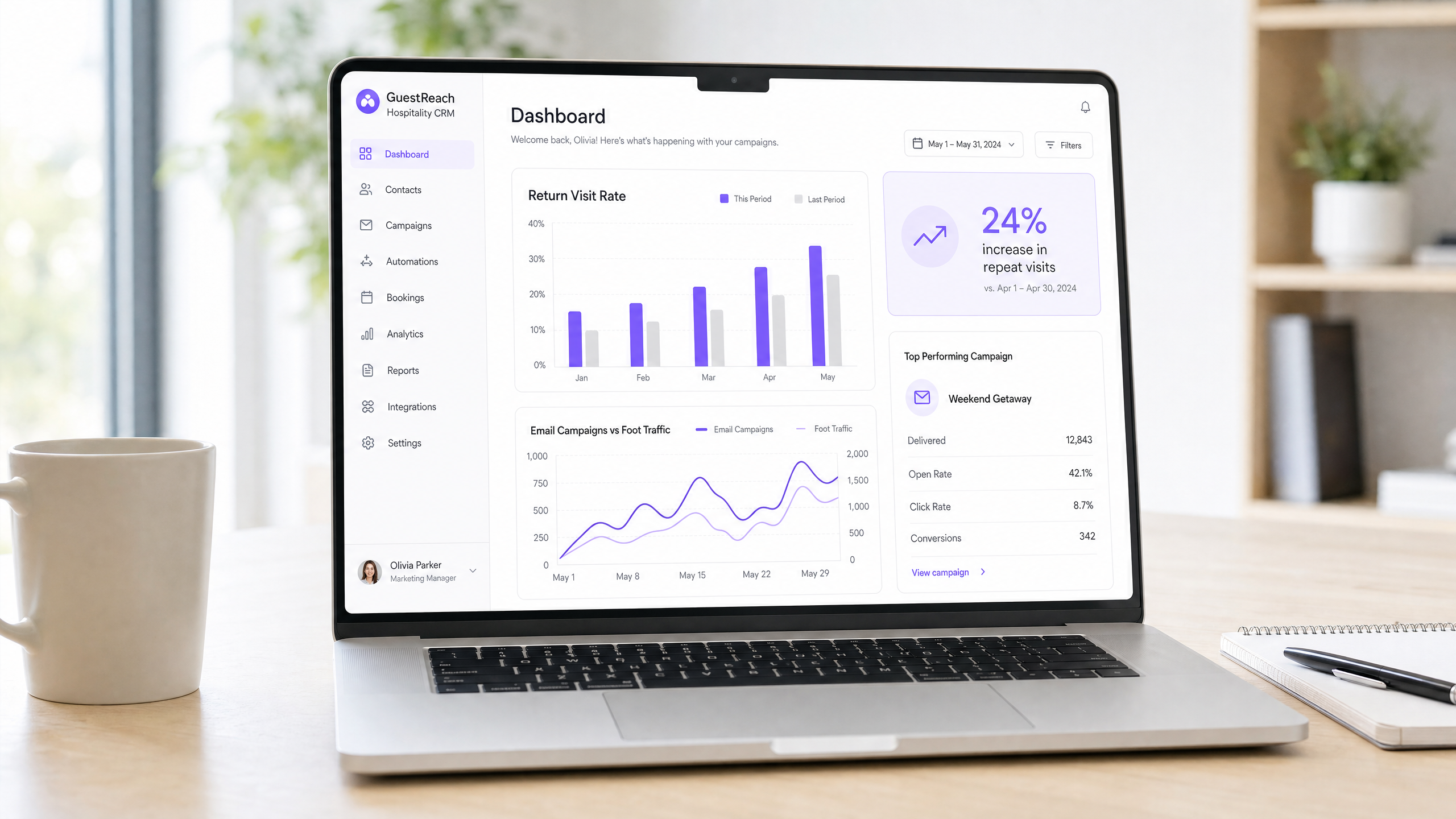
Because a platform like Purple Engage controls the WiFi network, it tracks physical presence. (For our Spanish-speaking operators, see Captura de correo electronico con WiFi de invitados: como funciona y que esperar.) If you send a campaign on Tuesday, and a guest's device reconnects to your network on Friday, the platform attributes that physical visit to the email. You measure success by Return Rate - the actual footfall and revenue generated by your emails. Purple's platform demonstrates an average increase of 24% (Purple internal data, 2026).
Metrics to track include: Return Rate (the percentage of emailed guests who reconnect within 14 days), Revenue Per Send (total attributed spend divided by the number of emails sent), and List Growth Rate (new CRM contacts per week from WiFi logins).
Where to start
Moving from a sender to a builder requires a clear sequence.
- Audit your hardware: Ensure your current access points are supported. Purple Engage works with Cisco Meraki, HPE Aruba, Ruckus, Juniper Mist, Ubiquiti UniFi, Cambium, Extreme, and Fortinet.
- Design your Captive Portal: Keep it branded, simple, and compliant. One email field, one name field, and an unchecked opt-in checkbox.
- Set up your core automations: Create the post-visit welcome email and birthday triggers before going live. These two automations alone will drive measurable repeat footfall.
- Switch over: Route the guest network through the portal and watch the list build itself.
To learn more about the mechanics, read our related guide: Guest WiFi email capture: how it works and what to expect.