
Recency frequency monetary: RFM model guide for venues
Recency frequency monetary (RFM) explained: score guests, interpret segments like Champions and At Risk, and target venue campaigns that bring people back.
U.S. adults spent an average of $236.45 per month at restaurants in 2025, according to Northwestern University's Medill Spiegel Research Center using a November 2025 Prosper Insights & Analytics survey. That spending figure doesn't tell a venue manager which guests will return, who's drifting away, or whose visits are profitable. Recency frequency monetary analysis, usually shortened to RFM, provides a practical starting point by turning guest transaction histories into audiences you can act on.
Table of Contents
- What Recency, Frequency and Monetary Value Mean
- RFM Segments and the Actions They Call For
- How to Calculate RFM Scores Step by Step
- RFM in Practice across Cafés, Bars and Hotels
- Turning RFM Segments into Venue Campaigns
- Where RFM Misleads and How to Correct It
- Start with One Segment and Measure the Return
What recency, frequency and monetary value mean
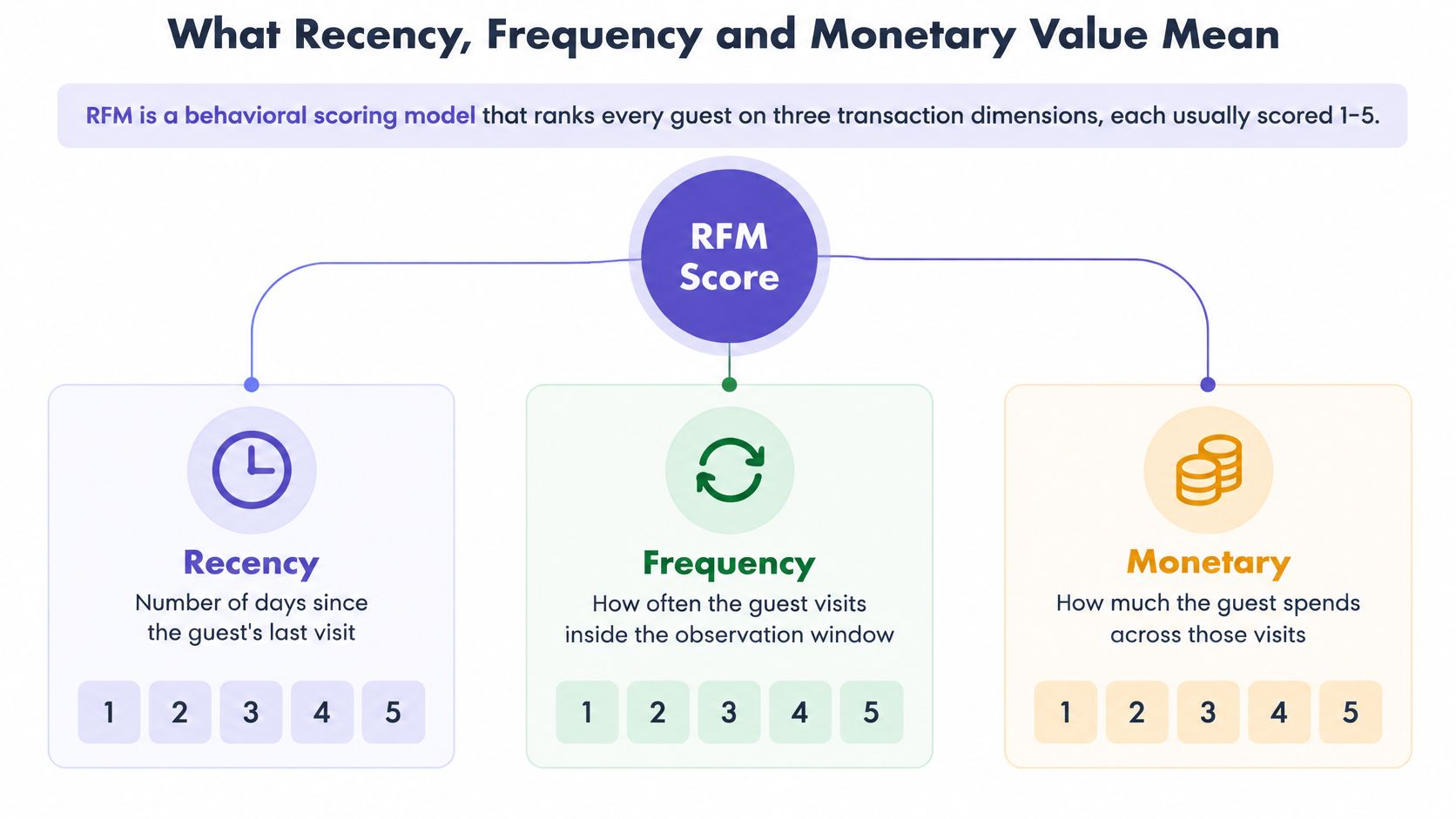
RFM is a behavioral scoring model that ranks guests on how recently they purchased, how often they purchase, and how much they spend. It describes observed behavior, not someone's personal worth or their guaranteed future value.
Say a café manager wants to distinguish an established regular from a guest who stopped by while traveling. Both might have bought the same lunch. Their purchase histories tell different stories.
- Recency measures the elapsed time since the latest qualifying visit, order, or stay. A shorter gap receives a stronger score.
- Frequency counts qualifying visits or transactions within a defined observation window. It distinguishes repeated engagement from an isolated purchase.
- Monetary value measures total or average spending within that window. It estimates economic contribution, provided you define spending consistently.
The infographic separates the raw behavior from the score assigned to it.
Reading a guest profile
For the illustrative scoring scheme used here, each component runs from 1 to 5, with higher scores representing stronger observed behavior. A hypothetical 5-4-5 profile means recent, relatively frequent, and high spending. A 1-5-4 profile describes someone with substantial purchase history who's now quiet.
Those digits are separate labels, not a currency amount or a probability. Don't read the combined code as an ordinary number, where a larger total automatically means a better customer.
POS receipts and completed bookings can supply transaction dates and values. WiFi sign-ins can contribute visit evidence, but a sign-in isn't a purchase, and it doesn't reveal spend unless you can match it to a transaction.
Practical rule: Keep observed visits, completed purchases, and bookings distinguishable, even when they appear in the same guest record.
Scores are relative to the audience, window, and thresholds you select. A strong score at a neighborhood café needn't represent the same behavior as a strong score at a destination hotel.
RFM segments and the Actions they Call for
A guest code becomes useful when a marketer can attach a decision to it. Segments translate behavioral patterns into a reason to contact someone, a suitable offer, and a sensible level of effort.
The following is an illustrative operating scheme, not a universal scoring standard. Its ranges are proposed configuration choices. Several overlap, so an implementation needs explicit precedence rules rather than assigning every matching label.
RFM segments, score patterns and the action each one calls for
| Segment | R score | F score | M score | What it means | Recommended action |
|---|---|---|---|---|---|
| Champions | 4-5 | 4-5 | 4-5 | Recent, frequent and high spending | Reward and protect with VIP access, not routine discounts |
| Loyal customers | 3-5 | 3-5 | 3-5 | Consistent regulars across the dimensions | Upsell, cross-sell and invite to events |
| Potential loyalists | 4-5 | 2-3 | 2-3 | Recent guests without an established habit | Encourage another visit with a relevant invitation |
| New customers | 4-5 | 1 | 1-2 | Recent activity with little history | Run a welcome journey and check actual purchase count |
| Promising | 3-4 | 1-2 | 1-2 | Recent but modest engagement | Nurture with useful content and soft offers |
| Need attention | 2-3 | 2-4 | 3-4 | Valuable spenders drifting away | Send an occasion-led, limited-time invitation |
| About to sleep | 2-3 | 1-2 | 1-2 | Weakening recent engagement | Reactivate around a relevant occasion |
| At risk | 1-2 | 2-5 | 2-5 | Previously active guests going quiet | Test a personalized win-back incentive |
| Can't lose them | 1-2 | 4-5 | 4-5 | Historically strong customers now absent | Prioritize personal outreach |
| Hibernating | 1-2 | 1-2 | 1-2 | Long absent with limited recorded value | Test low-cost seasonal reactivation or suppress promotional spend |
| Lost | 1 | 1 | 1 | Weakest recorded activity across the dimensions | Exclude from routine promotions and apply a contact-sunset policy |
Choose the action before refining the label
Read the table through a few broad patterns. Strong across every dimension means protect the relationship. Strong historical frequency and spend paired with weak recency suggests a recovery opportunity. Strong recency with limited frequency suggests helping a guest establish a reason to return.
Don't let a tidy label override the underlying record. A low frequency score doesn't necessarily mean a single purchase, and a first-time guest can spend enough to fall outside the proposed New customers range. Use purchase count and first-visit status as additional conditions.
For overlapping profiles, evaluate the most specific rule first. Champions should take precedence over Loyal customers; Can't lose them should take precedence over At risk. Treat Lost as an explicit operational decision, not an automatic instruction to delete a record.
This is a practical application of behavioral segmentation: group guests by what they've done, then choose an appropriate response. If neighboring segments receive identical messages and offers, merge them rather than maintaining distinctions nobody uses.
How to calculate RFM scores Step by Step
Build the model from a clean event table, not from an existing mailing list. You need a stable guest identifier, a qualifying event date, an event identifier, and a consistently defined monetary value.
The Springer paper examining RFM and customer lifetime value links frequency and monetary measures positively with future value, while recency works in the opposite direction when expressed as elapsed time. That supports using RFM as a behavioral feature set, not a complete valuation of the relationship.
Build a reproducible calculation
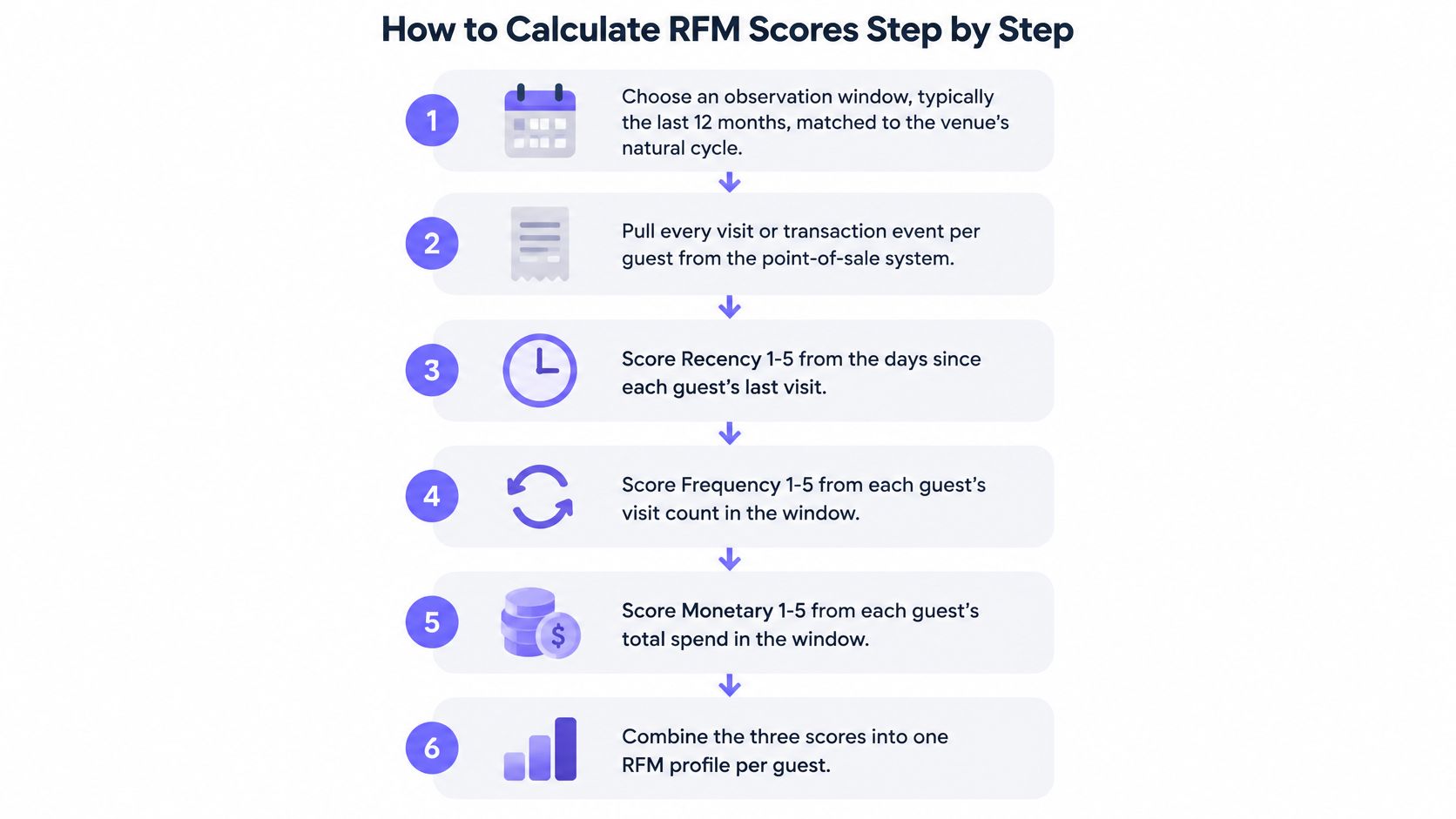
Choose the observation window and scoring date. Select a rolling period that includes the venue's normal buying cycle, and record the date on which you calculate the scores. Keep venue and brand comparisons separate where their purchase patterns differ materially.
Pull and clean qualifying events. Export completed transactions, visits, bookings, or stays according to the behavioral unit you've chosen. Match guest identities, remove duplicate cross-system records, exclude tests and invalid purchases, and account for refunds without treating them as fresh buying activity.
Calculate the raw measures. Recency equals the scoring date minus the latest qualifying event date; frequency equals the qualifying event count within the window; monetary equals total or average net spend within that same window. Preserve a guest's last-known purchase date even when it falls outside the observation period, so long-absent guests don't disappear.
Convert raw values into bands. Rank guests separately on each measure and assign the illustrative scale used in your segment rules, using quantile bands where they create meaningful distinctions. Reverse the direction for recency, and keep identical raw values together rather than forcing equal-sized groups.
Combine the component scores. Store the separate R, F, and M fields alongside the combined code. A weighted summary can help with prioritization, but it shouldn't hide whether a guest's weakness is inactivity, low frequency, or limited spend.
Publish refreshable audiences. Apply your segment rules in a documented order, then send the resulting audiences to the campaign platform. Keep the scoring date and rule version available so colleagues can explain why someone qualified.
The visual workflow provides a compact reminder of the calculation.
Check the inputs before trusting the output
Understanding what POS data contains helps you distinguish a receipt, a line item, and a refund. Counting receipt lines as separate purchases can turn a group meal into an apparent burst of repeat visits.
Total spend and average spend answer different questions. Total spend reflects contribution across the window; average spend reflects transaction size. Choose deliberately and don't change definitions between sites without labeling the difference.
For a small or heavily tied audience, use interpretable fixed bands rather than forcing quantiles. Review thresholds when the customer mix or trading pattern changes. Your finished spreadsheet or platform view should let a marketer inspect the raw behavior behind every code.
RFM in Practice across Cafés, Bars and Hotels
A lapse threshold should reflect an expected return cycle, not merely a convenient date filter. A discussion paper hosted by the University of Tokyo's CIRJE connects RFM measures with underlying purchasing behavior and notes that predictive associations can differ by context; a 45-day gap can signal severe lapse for a daily café customer while being normal for an annual hotel guest.
A café regular who breaks their routine
Say a guest normally buys breakfast on the way to work. Their current absence is unusually long compared with their established gaps, while their historical frequency and spend remain strong.
A friendly invitation to try a new breakfast item is a reasonable test. But first check whether the café changed its opening hours, closed for maintenance, or stopped capturing the guest's usual payment identifier. Missing observations aren't proof that someone chose a competitor.
A useful lapse flag means unusually absent for this guest and venue, not simply absent for the same length of time as everyone else.
A bar guest whose visits follow occasions
A neighborhood bar may see guests around sports fixtures, celebrations, or local events rather than a steady weekly routine. A quieter January after December celebrations doesn't automatically justify an aggressive recovery offer.
Compare the guest's current gap with their previous intervals and the local trading calendar. If their history is sparse, use a relevant venue cohort rather than pretending you know their personal cadence.
Keep the message occasion-led. A fixture announcement or a familiar event returning to the calendar can provide a better reason to visit than a generic discount.
A hotel guest planning a different kind of trip
Hotel stays may depend on annual holidays, business travel, or family occasions. Use booking lead time, previous stay season, and trip pattern to decide when an invitation is useful.
Destination context matters too. For a marketer planning heritage-travel content, Count Kálnoky's Estates' guide to rural Romanian heritage stays is a resource for thinking about the experience a guest might plan around. It isn't evidence for a universal hotel return interval.
Compare booking contribution after actual channel costs rather than assuming every stay with the same room revenue is equally valuable.
Across these scenarios, a frequent, economically valuable guest with a well-established cadence gives you a firmer basis for win-back targeting than an isolated large purchase. For unfamiliar guests, acknowledge uncertainty and use gentler invitations.
Turning RFM segments into venue Campaigns
Give every audience a specific reason to hear from you. A segment name isn't a campaign brief. The brief should identify the guest behavior, the proposed reason to return, the eligible channel, the commercial limit, and the condition that stops the journey.
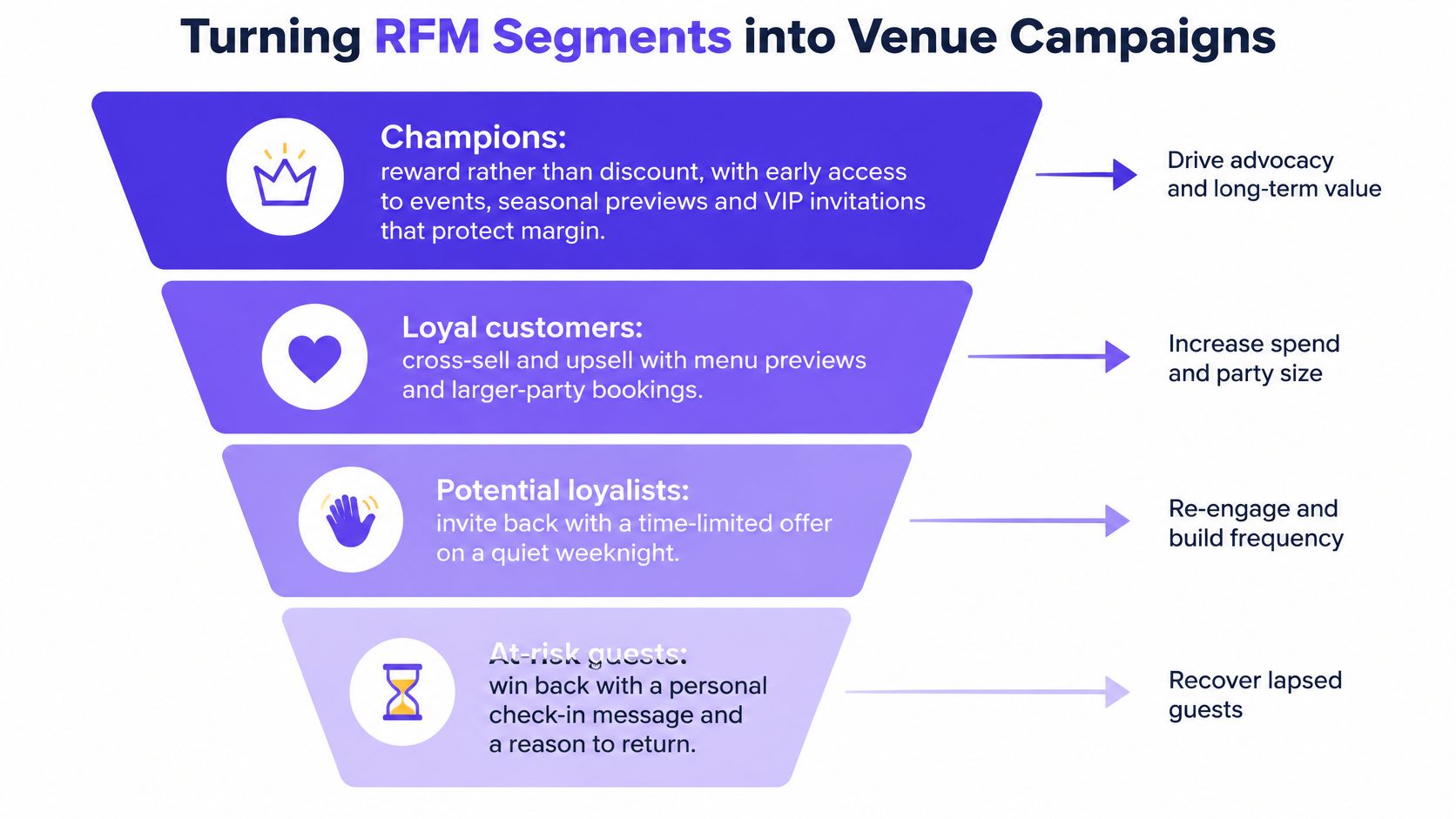
The campaign map below distinguishes relationship-building from recovery.
Protect active relationships
For Champions, make recognition tangible. Offer advance reservations for a tasting menu, early access to an event, or an invitation to preview a seasonal menu. Check capacity with the venue manager before promising access.
For Loyal customers, suggest something adjacent to an established preference. Invite restaurant regulars to a bar tasting, or introduce returning hotel guests to an on-property dining experience. Cross-selling should feel relevant, not like an attempt to promote every outlet.
An event invitation also needs a real event worth attending. For a campus or corporate audience, The Matcha Bike's matcha catering for campus and corporate gatherings provides a concrete example of an experience a planner could consider. Guest preferences and operational suitability should determine whether that idea belongs in the campaign.
For New customers and Potential loyalists, remove uncertainty about returning. Explain how to book, highlight an appropriate occasion, and recommend something connected to the initial visit. Don't assume everyone needs a price incentive.
Recover drifting guests without over-contacting them
Need attention audiences may benefit from an invitation linked to an upcoming occasion. Keep any deadline genuine and ensure staff can honor the offer.
For At risk and Can't lose them, review the guest history before choosing an incentive. A service complaint calls for a thoughtful response, not an automated coupon that ignores the unresolved problem. Personal outreach should also feel helpful rather than revealing an uncomfortable amount of tracking.
For Hibernating and Lost, avoid expensive repeated attempts to revive weak relationships. Use limited, relevant reactivation tests where appropriate, then suppress unresponsive contacts from routine promotional spending.
The accompanying video offers another format for considering venue marketing execution.
Apply eligibility before sending
- Check channel permission. Use email, SMS, or WhatsApp only when the guest has the appropriate permission and channel eligibility.
- Cap contact across journeys. A high commercial score doesn't justify unlimited messages from different sites.
- Stop on changed behavior. Remove someone from a win-back journey when a qualifying return or booking makes the message obsolete.
- Respect operational limits. Apply offer budgets, availability checks, and approval rules before launch.
Record who qualified and who was contacted. Without that distinction, you can't reliably separate targeting decisions from delivery problems or evaluate the campaign's effect.
Where RFM Misleads and how to Correct It
RFM becomes dangerous when a useful shorthand turns into unquestioned authority. Keep the score explainable, preserve the underlying behavior, and make room for evidence that contradicts the label.
RFM predicts the future
RFM describes purchase history. It can support targeting, but it doesn't establish that a particular message will change someone's behavior.
Randomly hold back an eligible control group before sending. Compare return rates over the same observation period, report the uncertainty around the difference, and evaluate contribution after campaign costs. Opens, clicks, and redemptions can diagnose execution, but they don't establish incremental visits.
A weak result also needs interpretation. Check identity matching and delivery before concluding that guests weren't interested, and don't present a noisy estimate as a reliable gain.
One cutoff fits every guest
A single inactivity rule can confuse seasonal behavior with disengagement. Mailrelay's RFM glossary explains the relative nature of RFM scoring and the need to consider the selected audience, thresholds, and seasonal context.
Use a personal cadence where there's enough history, a relevant cohort where there isn't, and an explicit unknown status where neither is defensible. Don't give a precise-looking lapse label to someone whose normal return pattern you haven't observed.
Decision check: Ask what evidence would make you reverse the segment assignment. If the answer is nothing, the model has become a verdict.
Monetary value equals profitability
Revenue can conceal heavy discounting, refunds, channel charges, and expensive service requirements. Separate full-price and promoted purchases, and use contribution margin where reliable cost inputs are available.
Keep basic hospitality independent of commercial ranking. Staff shouldn't provide an inferior standard of service because a guest has low recorded spend.
More segments mean better targeting
Maintain only distinctions your team can use. If separate audiences have the same message, timing, offer, and measurement plan, the extra labels add administration rather than better decisions.
Audit whether offline purchases, shared bookings, or incomplete identity matching systematically push some guests into weak segments. Treat missing information as a data-quality issue, not evidence of low value.
Privacy belongs in that review: 87% of consumers expect retailers to handle personal data responsibly and securely, according to CleverTap's RFM analysis guide. Document treatment rules, restrict access appropriately, and ensure an import or segment refresh never overrides an opt-out.
Start with one segment and measure the return
RFM turns transaction history into an interpretable code; segmentation turns that code into an audience. Start with lapsed regulars rather than launching every possible journey.
Use a narrow first-campaign checklist:
- Define the qualifying behavior. Select guests with established repeat activity whose current absence is unusual for the venue.
- Write a clear invitation. Give them a relevant reason to return, with an offer the venue can deliver profitably.
- Reserve a random control. Hold back eligible guests before sending and keep their treatment consistent during measurement.
- Measure business outcomes. Compare incremental returns and contribution, not just engagement.
Guest feedback can explain outcomes without replacing the control comparison. For group accommodation, Hen Hideaways' guidance on how to measure hen party guest satisfaction offers a useful complementary perspective. Connect those findings to marketing ROI, rather than treating satisfaction alone as proof of campaign return.
Purple Engage combines guest activity in a shared record and supports refreshed audiences and deliberate holdout measurement. Our automatic checks include three or more WiFi visits in 90 days with none in the last 30; that's an operational starting rule, not a universal definition of lapse. We recommend starting with a 14-day attribution window for restaurants, then adjusting to the venue's natural visit frequency.
This week, export your recent transaction history, inspect the underlying records, and select the lapsed-regular audience for a controlled win-back test. Expand to first-return journeys only after you can explain what the initial campaign changed.
Purple Engage brings WiFi, POS, booking, and stay activity into a shared guest history so you can build visit-and-spend audiences and measure incremental returns. Visit Purple Engage to explore how refreshed segments, consent controls, and holdout measurement can support your first RFM campaign.