
Facebook Ads for Hotels: A Step-by-Step Strategy
Learn how to run Facebook ads for hotels that drive direct bookings: consented guest audiences, friction-free creative, value-based bidding, and holdout
Installing the Pixel and switching on retargeting isn't a complete strategy for Facebook ads for hotels. Neither is scaling spend because Ads Manager shows an attractive return. The harder job is deciding which guests you're entitled to reach, giving Meta a commercially useful booking signal, and establishing whether the advertising changed anyone's decision.
Table of Contents
- Why Facebook Ads Still Matter for Hotels
- Set Up Your Catalog, Pixel and Conversions API
- Build Audiences from Consented Guest Data
- Pick Formats and Creative That Cut Booking Friction
- Structure Campaigns and Bids Around Booking Value
- Prove Incremental Bookings with Holdout Measurement
- Your Next Steps for Hotel Facebook Ads
Why Facebook Ads Still Matter for Hotels
A healthy Meta-reported return on ad spend, or ROAS, isn't proof that advertising created additional demand. A guest who already intended to book can still encounter an ad, complete a reservation, and appear in the campaign's results. The distinction is between bookings credited to advertising and bookings caused by advertising.
That doesn't make Facebook an unproductive channel. It means hotel marketers need a better standard of evidence than a screenshot from Ads Manager.
Traveler attention creates an opportunity
The historical evidence explains why the channel deserves consideration: the HSMAI Facebook Hotel Playbook, published in 2020, reported that 76% of U.S. Facebook users used the platform for travel-related activities and that travelers spent five times more time on Facebook than travel websites during trip planning; it also reported a 50x ROAS increase for Stewart Hotel versus standard retargeting and 1.7x higher ROAS for Welk Resorts versus manual retargeting.
Those are historical, individual results, not forecasts for your property. Market conditions, offers, booking windows, and measurement methods all affect the comparison.
The commercial opportunity extends beyond catching someone ready to reserve. Hotels can introduce a destination, demonstrate why a property suits a trip, and stay relevant while travelers compare alternatives. For a destination-specific view of those accommodation choices, the Stay Norwich Apartments hotel-finding guide provides useful context.
The distinction worth keeping visible is simple:
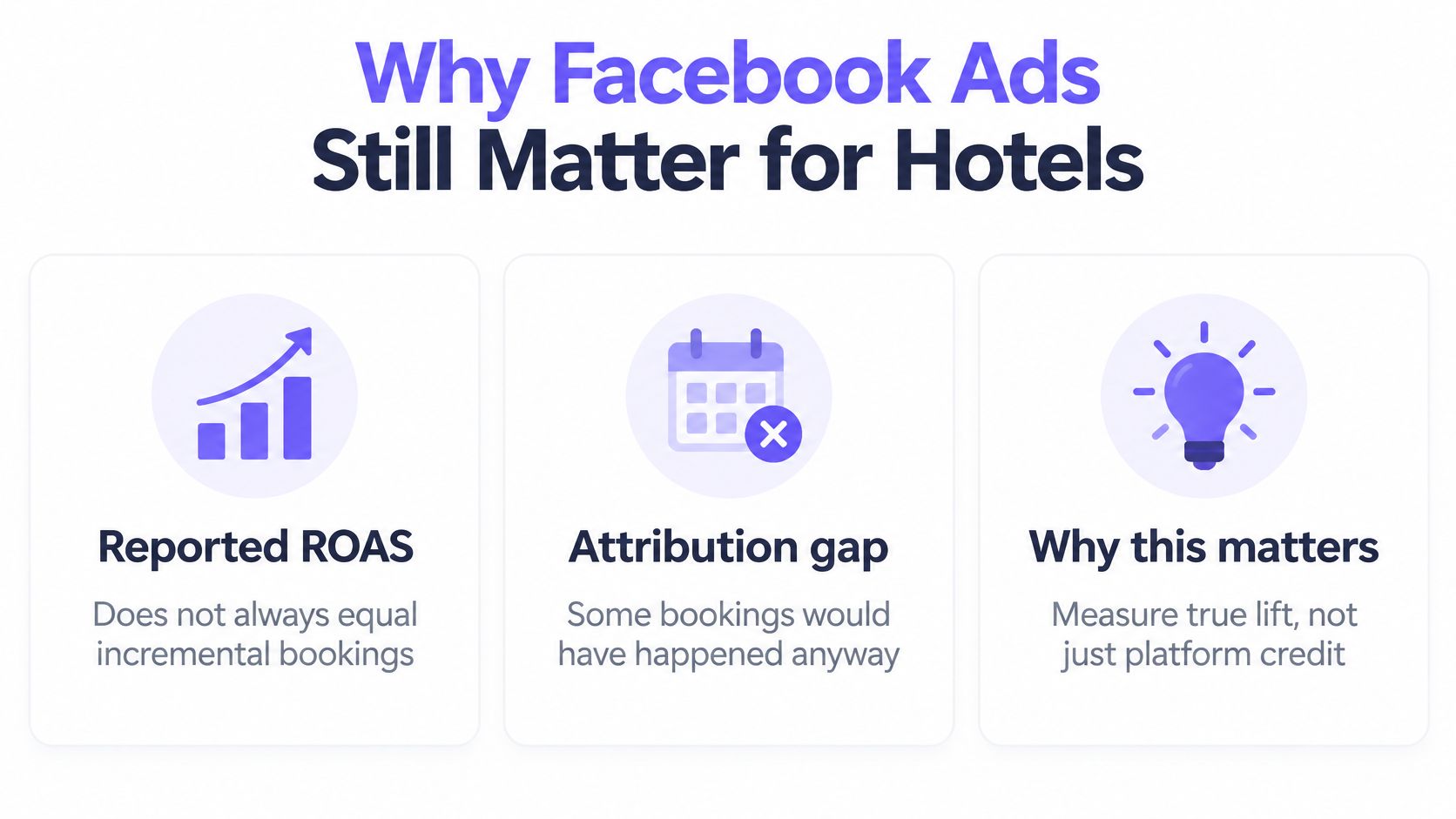
Budget principle: Treat platform ROAS as a reporting view, not permission to increase spend automatically.
A credible hotel strategy connects audience eligibility, creative, bidding, and reservation outcomes. Optimizing only the visible ad account leaves too much of that commercial chain unexamined.
Set Up Your Catalog, Pixel and Conversions API
Build the technical foundation in sequence rather than changing inventory, tracking, and delivery simultaneously. Otherwise, when results change, your team won't know which intervention mattered.
Establish the inventory and event sequence
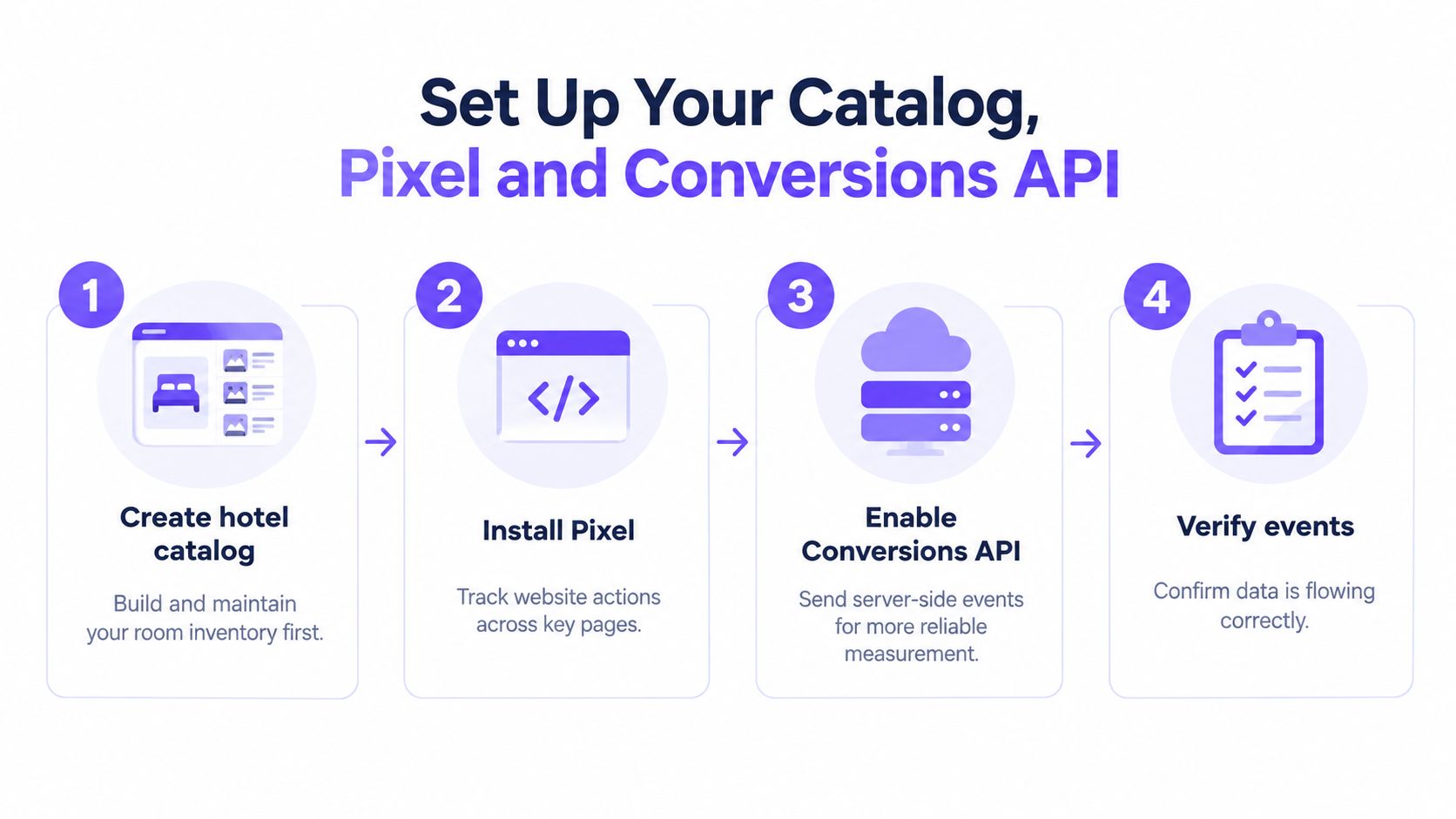
Follow Meta's hotel advertising roadmap: maintain the hotel catalog, configure the Pixel alongside server-side Conversions API tracking, then launch dynamic ads using property and trip fields; its operational guidance also supports checking deduplication and reconciling purchase events over at least a full week.
- Create and maintain the hotel catalog. Agree who owns property names, brands, descriptions, images, destination links, and relevant trip fields such as check-in date. For a hotel group, consistent property identifiers should connect the catalog, booking engine, and reporting.
- Map the booking journey before installing events. Document room-page views, date-and-rate searches or checkout initiation, and confirmed purchases. Distinguish a guest exploring availability from a guest receiving a reservation confirmation.
- Configure browser and server tracking together. The Pixel and Conversions API should describe the same underlying booking actions, not operate as unrelated feeds.
- Launch dynamic advertising after verification. Confirm that the advertised property and booking destination agree before allowing automated delivery.
Use the setup sequence as an implementation checklist:
Make the purchase event commercially accurate
On confirmation, send the actual booking value, not a fixed placeholder. A generic purchase value makes materially different reservations look identical to the optimization system.
For the browser and server versions of a confirmed purchase, use a shared booking or order identifier as the event ID. Pass appropriately normalized and hashed customer identifiers, with the relevant action source. Hashing supports matching; it doesn't replace permission to use guest information.
For implementation context, the Conversions API guide for hospitality marketers is a useful companion when discussing server-side events with your technical team.
Before signing off, reconcile Meta purchase events against the PMS or booking engine. Check missing reservations, duplicate purchases, incorrect currencies, and differences between expected and transmitted value. Inspect event-match and deduplication diagnostics rather than assuming that an active connection means an accurate connection.
A confirmation-page refresh is a useful test case: it shouldn't create another reservation in reporting. Give someone explicit ownership of discrepancies, because a dashboard warning without an accountable operator rarely gets resolved.
Build Audiences from Consented Guest Data
An audience strategy built around a saved collection of travel interests is fragile. Your hotel should retain control over who qualifies for marketing, even when Meta controls more of the delivery.
Review the guest record before treating it as an advertising asset.
Hospitality coverage of Meta's targeting changes reports that detailed-targeting exclusions were removed in March 2025, with interest categories consolidated and some removed options no longer delivering by January 2026. The practical response isn't to find another obscure interest combination. It's to make guest eligibility and campaign purpose explicit outside the ad platform.
Translate hotel behavior into eligibility
Recent checkout, room type, spend band, stay frequency, and lapsed-stay status can inform a useful segment. They shouldn't become an indiscriminate upload of every field held in the PMS.
Build the segment internally, then send only the identifiers needed for matching. A lapsed-stayer campaign needs an eligible audience, not a transferred history of individual receipts and reservation notes.
| Guest signal | Useful campaign application | Governance question |
|---|---|---|
| Lapsed-stay status | Win-back campaign | Is advertising permission still valid? |
| Stay frequency | Retention or prospecting seed | Does the campaign match the original permission? |
| Recent booking | Suppression where appropriate | Could this guest receive an unnecessary acquisition offer? |
| Room type or spend band | Relevant package selection | Can the same decision use less granular information? |
Keep durable opt-outs in the source system. A fresh file import mustn't restore someone who previously withdrew permission. For multinational groups, have privacy specialists confirm the applicable requirements rather than assuming a common upload process makes every market compliant.
For a practical audience-building reference, use the guide to Meta Custom Audiences from consented guest WiFi data.
Compare data-led audiences with automated delivery
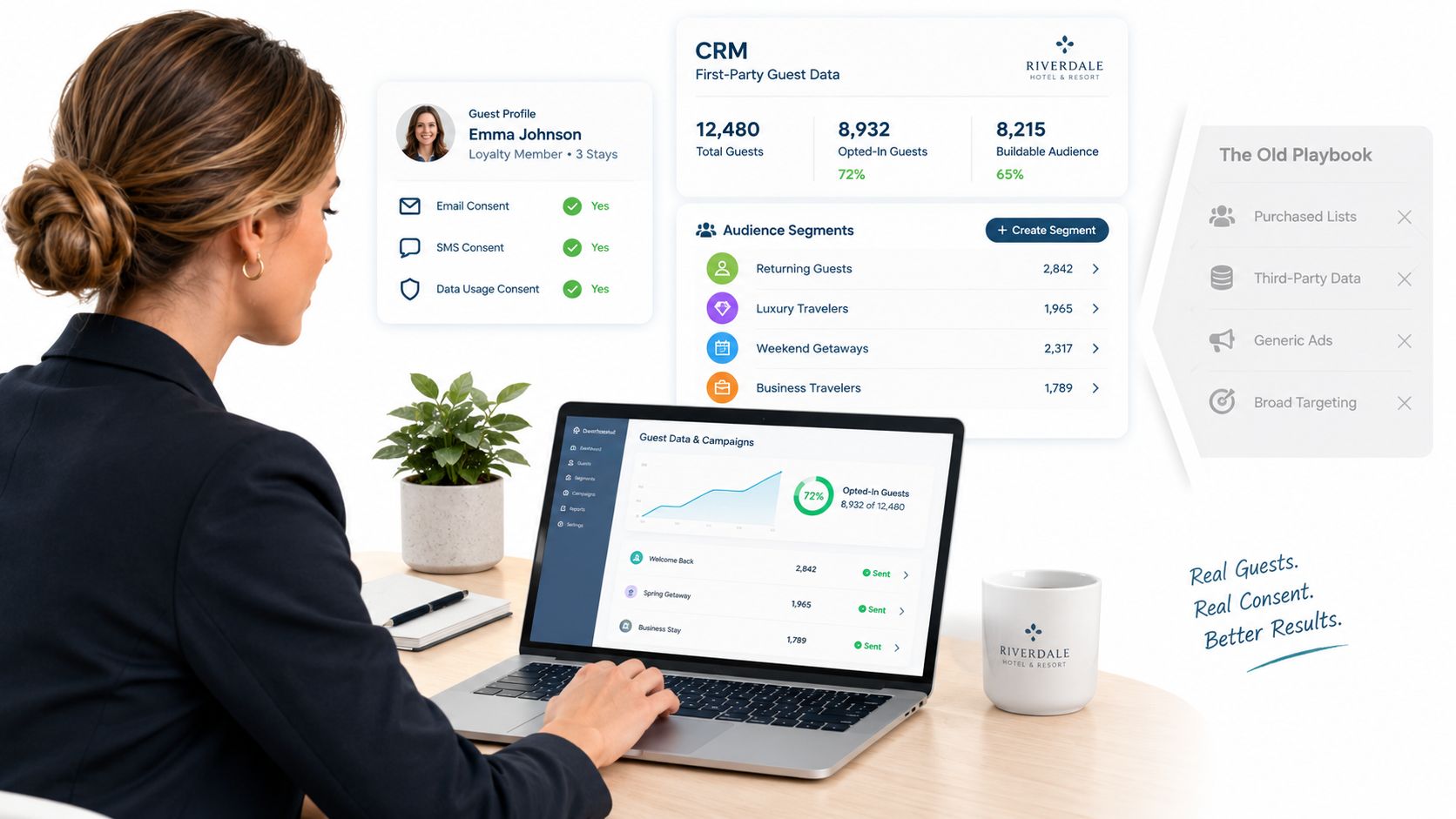
A unified guest platform is an option alongside CRM-led exports or a governed data warehouse. Purple Engage combines WiFi sign-ins, POS receipts, bookings, and stays into a guest record, builds Meta audiences from consented guests, and checks a shared consent ledger at approval and again before sending. Campaigns require human approval, and imports can't reverse opt-outs.
The platform workflow is illustrated below.
Don't assume a carefully assembled first-party audience will outperform broad automated delivery. Test both against the same commercial objective, with separate prospecting and retention purposes.
Automation can reduce manual campaign maintenance while making individual targeting decisions harder to explain. Keep an eligibility record, document permitted exclusions, and verify which audience settings are binding restrictions versus delivery suggestions in the campaign configuration you're using.
Pick Formats and Creative That Cut Booking Friction
A website click isn't always the most useful next action. A traveler comparing destinations may prefer asking about dates or a package before navigating a booking engine.
The clearest evidence in the available hospitality examples is a documented resort lead-ad test and hotel campaign comparison: during 11/03/2022 - 11/17/2022, lead ads generated 3.7 times as many qualified leads, reduced cost per lead by 62%, tripled inquiries, and doubled final bookings versus website-linked campaigns; the same source reports a London luxury hotel campaign targeting travel planners that increased bookings by 40%.
Those results justify testing the format. They don't justify assuming every hotel should replace booking-engine campaigns with lead forms.
Match the format to the decision
| Format | When to test it | Main operational trade-off |
|---|---|---|
| Lead ads | Packages, groups, or inquiries needing qualification | Staff must follow up and record the booking outcome |
| Website conversion ads | Guests ready to check availability and reserve | The booking journey must work well on mobile |
| Dynamic hotel ads | Property-specific consideration and relevant inventory | Catalog information and destination pages need maintenance |
Lead ads reduce the immediate effort of making an inquiry, but they transfer work to the hotel. Define qualification before launch: desired dates, party requirements, property preference, and whether the inquiry fits the offer.
If reservations staff can't respond consistently or connect the inquiry to a reservation, a low cost per lead can conceal an expensive acquisition process. Website campaigns may be preferable when travelers can make a straightforward purchase without assistance.
Show the stay, not just the building
Build creative around a reason to travel and a reason to choose the property. Seasonal packages and local events can provide context, but the offer must remain commercially sensible for the dates advertised.
- Match room imagery to the segment. Show the accommodations the guest can reserve, rather than making every ad depend on the most photogenic suite.
- Make amenities decision-useful. Demonstrate the workspace, breakfast arrangement, pool, or family facilities relevant to the trip.
- State material conditions clearly. Explain package inclusions and restrictions before the guest reaches the final booking step.
- Check dynamic content against inventory. Where your implementation supports rates and availability, verify that the catalog and booking destination agree.
A cheaper inquiry is useful only if the hotel can turn it into a commercially worthwhile reservation.
Test the offer, image, and destination as a connected journey. Sending a specific room-package ad to a generic homepage introduces avoidable uncertainty, even when the creative itself attracts attention.
Structure Campaigns and Bids Around Booking Value
Separate campaigns by commercial job. Prospecting introduces the hotel to potential guests; retargeting addresses active consideration; abandoned-booking recovery addresses an interrupted reservation.
Combining them makes budget decisions harder. A campaign can appear efficient because it reaches familiar, high-intent guests while contributing little new demand.
Three-Lane Meta Campaign Structure for Hotels
| Campaign lane | Audience source | Optimization event | Primary metric |
|---|---|---|---|
| Prospecting | Broad automated delivery or eligible lookalike audiences | Confirmed purchase with actual booking value | Cost per incremental direct booking |
| Retargeting | Recent room-page viewers and date searchers | Confirmed purchase | Cancellation-adjusted direct-booking revenue |
| Abandoned-booking recovery | Checkout initiators without a confirmed purchase | Confirmed purchase | Net recovered booking contribution |
Treat this as a starting structure, not a requirement to create every possible combination of property, brand, and region. Split campaigns when the commercial decision differs, such as inventory priorities or regional acquisition economics. Avoid dividing activity so finely that teams can't interpret results.
Wojo Media's social advertising guide provides broader Facebook and Instagram context; the hotel-specific adaptation is to organize delivery around reservation intent and value.
Give each lane a different budget job
Prospecting needs an acquisition budget, not whatever remains after retargeting claims the strongest reported return. Its performance should reflect the cost of reaching guests who aren't already close to booking.
Retargeting budgets should reflect the eligible audience and the property's need dates. Abandoned-booking recovery should remain proportionate to genuine checkout activity, with confirmed purchasers removed where appropriate.
- Optimize toward booking value. Don't select clicks merely because they're plentiful and easy to report.
- Allow the booking window to mature. Avoid changing bids before the intended travelers have had a reasonable opportunity to reserve.
- Keep bidding constraints realistic. An aggressive efficiency target isn't a substitute for an offer guests want.
- Don't let view-through credit dictate budget. A reported association isn't a suitable standalone scaling rule.
A hotel group's acquisition ceiling should also reflect the value of the guest relationship, not only the initial room transaction. The customer lifetime value guide for restaurants and hotels offers context for that planning decision.
Keep lifetime value assumptions separate from observed campaign revenue. Otherwise, an optimistic retention forecast can make an unprofitable acquisition campaign appear acceptable.
Prove Incremental Bookings with Holdout Measurement
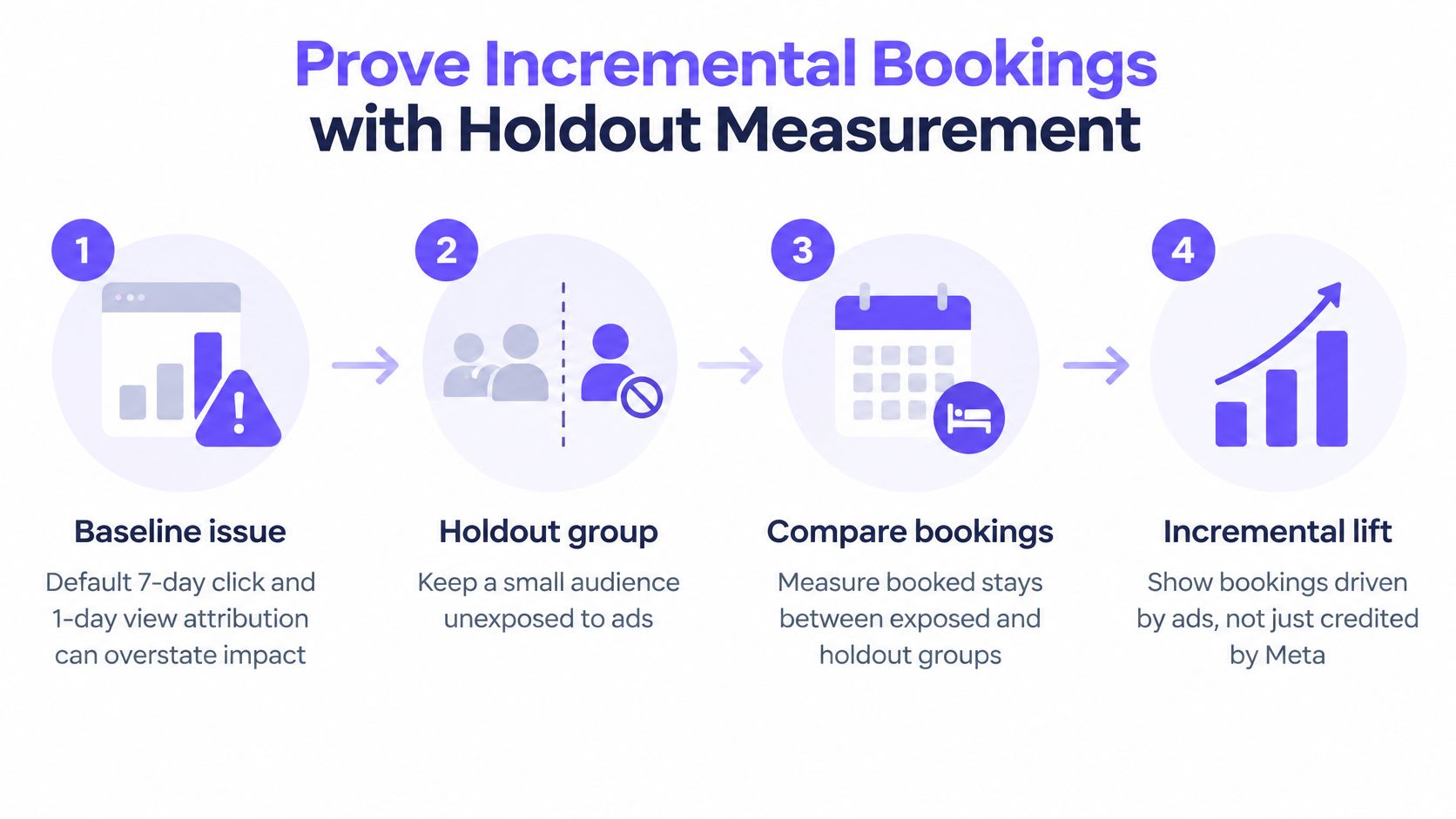
Attribution answers which advertising interactions preceded a reservation. Incrementality asks whether the reservation would have happened without the advertising. Better event matching improves the former, but doesn't establish the latter.
Reporting definitions can also change independently of guest demand: hospitality coverage of Meta measurement changes describes a June 2025 Collection Ads update under which an Instant Experience view no longer counted as a Landing Page View unless the external site fully loaded, and cites a commercial estimate that Pixel-only tracking can miss 20 - 40% of conversions. That estimate isn't independently validated, so don't use it as an automatic correction factor.
Establish the comparison before launch
Use a deliberate holdout workflow:
- Randomize eligible guests or geographic markets. Assign an exposed group and a control group before advertising starts. Choose a design your team can enforce.
- Remove existing bookings and recent converters. Apply the eligibility rules consistently before assignment, and protect the control from the campaign being tested.
- Allow the booking window to mature. Set the evaluation period in advance rather than stopping when the results look favorable.
- Compare booking rate and net revenue. Use PMS or booking-engine outcomes for both groups, allowing for different group sizes.
- Report uncertainty. Present lift with a confidence interval, including inconclusive findings, and examine property or market differences only when the evidence supports them.
The workflow keeps the test focused on outcomes rather than platform credit:
Judge commercial outcomes, not benchmark conformity
For reporting context, hotel and hospitality advertising benchmarks describe the commonly used 7-day click and 1-day view attribution setting and report approximately 0.95% CTR and 0.80% conversion for a hotel benchmark versus 2.90% conversion in a broader hospitality benchmark. Those differences make benchmarks directional, not universal performance targets.
Define success as confirmed, non-canceled direct bookings or contribution margin. Include room revenue, average daily rate, length of stay, commission avoided, and cost per incremental booking. Recognize commission avoided only where the comparison supports that conclusion, not because a reservation was direct.
For preliminary website context, you can find traffic levels for your site through Expressify AI. Traffic estimates aren't booking records and shouldn't become the denominator for a causal lift calculation.
More accurately counted conversions can improve attribution without improving the evidence that advertising worked.
Also watch for control contamination through overlapping campaigns. A holdout that's exposed elsewhere to the same activity no longer provides the comparison you intended.
Your Next Steps for Hotel Facebook Ads
Start with a bounded campaign, not a group-wide overhaul. Choose a property or market with a clear inventory need, an accountable reservations team, and guest data your privacy team has approved for the intended use.
A practical launch checklist
- Audit the reservation signal. Reconcile browser and server purchases against booking records, and assign an owner to unresolved discrepancies.
- Prepare an eligible segment. Use a defined group such as consented lapsed stayers, with exclusions and opt-outs applied before activation.
- Launch a focused prospecting test. Optimize toward confirmed booking value and keep the retention activity distinguishable.
- Pre-register the holdout. Record the assignment method, primary outcome, evaluation period, and decision rule before spending.
- Name the decision-maker. Agree who can approve scaling, pause activity, or extend an inconclusive test.
If guest activity sits across WiFi, POS, bookings, and PMS records, decide how those systems will support the campaign before selecting more ad-account settings. Compare the unified-platform option described above with your existing CRM and data workflow, including approval controls, consent handling, integration availability, and transparent fees.
Avoid making the pilot depend on every system being perfectly connected. Use a defensible eligible audience and a reliable reservation outcome, then expand only when the operating process holds up.
The useful question at the review meeting isn't whether the dashboard looks better. It's whether the exposed group generated enough additional commercial value to justify the spend. Better tracking alone doesn't prove the ads work; a properly designed control group provides the counterfactual you need.
Purple Engage brings consented guest records, Meta audience activation, human campaign approvals, and deliberate holdout measurement into a shared workflow. Visit the platform to discuss a hotel campaign built around an eligible guest segment, transparent fees, and incremental booking outcomes rather than attributed ROAS alone.