
What Is a Suppression List and Why It Matters
What is a suppression list? Learn how it differs from opt-outs, why it matters for compliance, and best practices for keeping your venue marketing lists clean.
A suppression list is a minimal do-not-contact record kept after a guest withdraws permission, so your systems can recognize and honor that refusal in future campaigns across connected channels. It preserves the instruction not to contact someone, without keeping their full marketing profile.
You're preparing a campaign for guests who haven't visited recently. The audience draws from WiFi registrations, restaurant receipts, hotel bookings, and an agency's uploaded spreadsheet. A guest who unsubscribed last week appears again because the spreadsheet marks them as subscribed.
The important question isn't whether your email template contains an unsubscribe link. It's whether every system involved will respect the earlier refusal, even when newer data arrives.
Table of Contents
- The Plain-English Definition of a Suppression List
- Suppression Lists Versus Opt-Outs and Segments
- What Belongs on a Suppression Record
- Channel and Purpose Granularity in Practice
- Suppression Versus Erasure Rights
- Hygiene Practices That Keep Suppression Working
- Why Suppression Is a Venue Marketing Governance Problem
The Plain-English Definition of a Suppression List
For a venue marketing manager asking what is a suppression list, the working answer is a protected exclusion record: enough information to identify someone who must not receive particular communications, together with the instruction your sending systems must enforce.
The FTC and state attorneys general describe suppression lists as do-not-contact lists. They recommend checking new marketing lists against them and clearly marking retained information so it isn't used for the marketing purpose the person rejected, as explained in direct marketing planning guidance.
The operational distinction matters. Removing someone from today's campaign doesn't necessarily protect them from tomorrow's imported audience. Your team needs a record that remains recognizable when another system supplies the same identifier.
Why venues need more than an unsubscribe column
Consider a hypothetical guest who uses the same email address at a cafe's WiFi login and a sister hotel's front desk. Those systems describe different activities, but your marketing tools need to recognize the same contact instruction wherever that address appears.
That doesn't mean treating every matching detail as permission to merge identities. It means defining dependable matching rules and carrying the relevant restriction through the resulting guest record.
The diagram shows the basic relationship between the retained identifier and the instruction it supports.
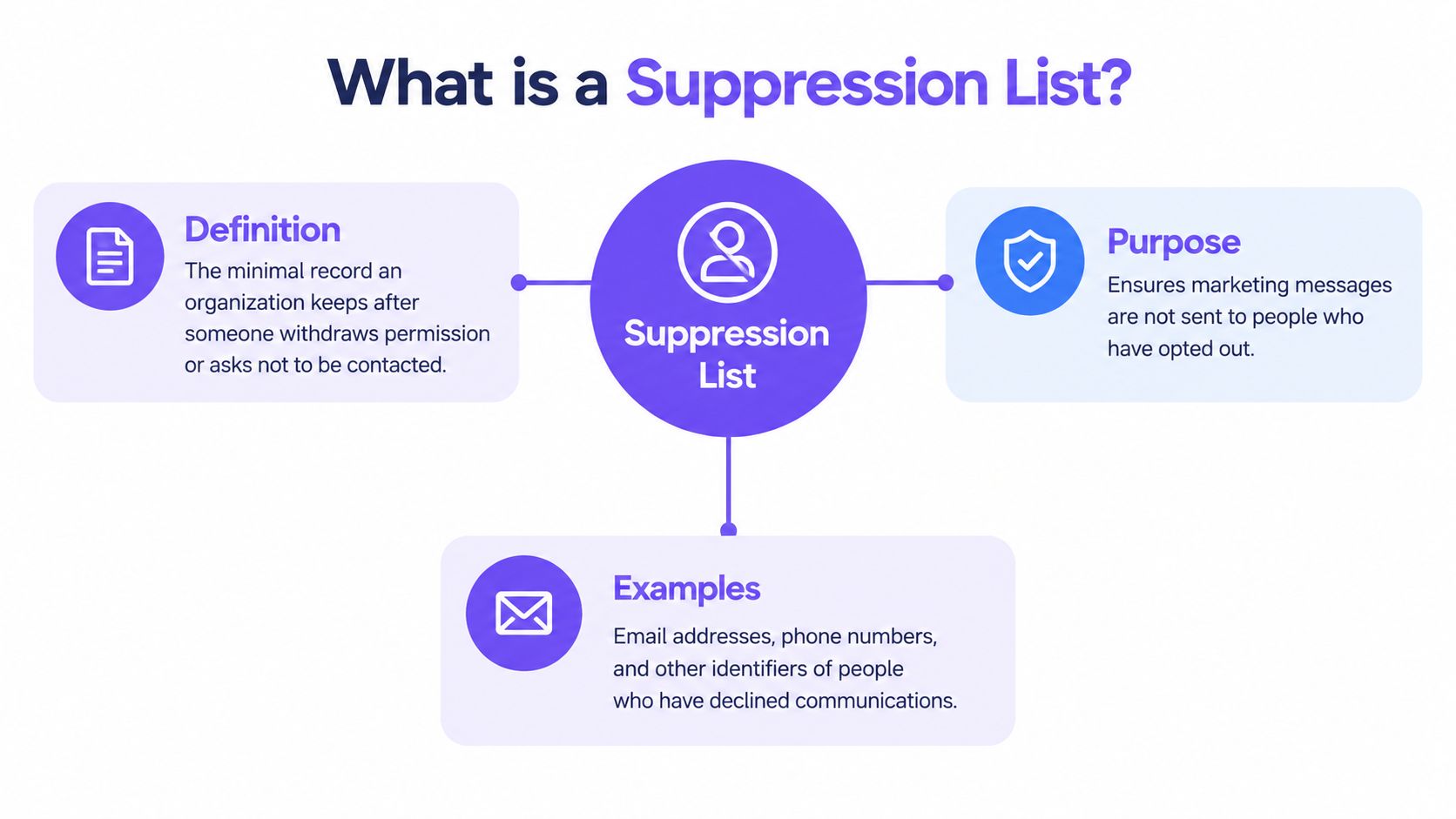
A useful implementation separates the information needed for recognition from the information used for targeting:
- Recognition data lets the system match an incoming email address, cell phone number, or customer identifier.
- Restriction data tells the system which communication it must prevent.
- Evidence explains where that restriction came from and how it has been handled.
For teams documenting those decisions, AuditReady's audit evidence terminology explained provides a useful vocabulary reference. Your own records should remain understandable to someone who wasn't present when the integration was built.
Practical rule: A suppression record exists to enforce a refusal, not to create another audience for marketing.
The harder questions concern scope, evidence, permitted service messages, and removal. Those decisions determine whether your list works as a control or merely sits in a database.
Suppression Lists Versus Opt-Outs and Segments
An opt-out is an action. A segment is an audience. A suppression list is the persistent control that prevents otherwise eligible audience members from receiving prohibited messages.
Confusing them creates a familiar failure: a marketer removes someone from a saved segment, assumes the unsubscribe is handled, and later rebuilds that segment from source data. The contact qualifies again because nothing durable records the exclusion.
Suppression vs opt-out vs segment
| Dimension | Suppression List | Opt-Out Event | Segment |
|---|---|---|---|
| Main function | Enforces a restriction | Records a withdrawal or objection | Selects people matching audience criteria |
| Typical location | Shared eligibility or consent controls | Preference center, message event, or consent history | CRM or campaign builder |
| What changes it | Controlled, evidenced state changes | A guest's action or recorded request | Changes to behavior, attributes, or selection rules |
| Common mistake | Treating it as an editable mailing list | Recording the event without applying it elsewhere | Assuming exclusion from one audience prevents all contact |
| Question answered | May this message be sent? | What did the person request? | Who matches this campaign idea? |
Suppose a restaurant marketer creates a segment of guests interested in private dining. An unsubscribed guest might still match that interest. Their relevance to the offer doesn't make them eligible to receive it.
The distinction also changes how you investigate problems. If the request was never recorded, inspect event capture. If it was recorded but ignored, inspect propagation and eligibility checks. If the guest appeared in a draft audience but was excluded before delivery, the control may have worked correctly.
Audience membership is a suggestion for targeting, not permission to send.
Make ownership explicit
Assign responsibility for each part of the workflow. Front-of-house teams need a reliable route for recording requests, CRM administrators need to preserve them, and campaign owners need to understand exclusion reasons.
A practical starting point is this guide to managing consent and unsubscribes for venue email. Use it alongside your integration map rather than treating unsubscribe handling as an email-template task.
The same guest can legitimately remain eligible for a booking confirmation while being suppressed from promotional email. The underlying model is blocked for this purpose, not active or inactive.
What Belongs on a Suppression Record
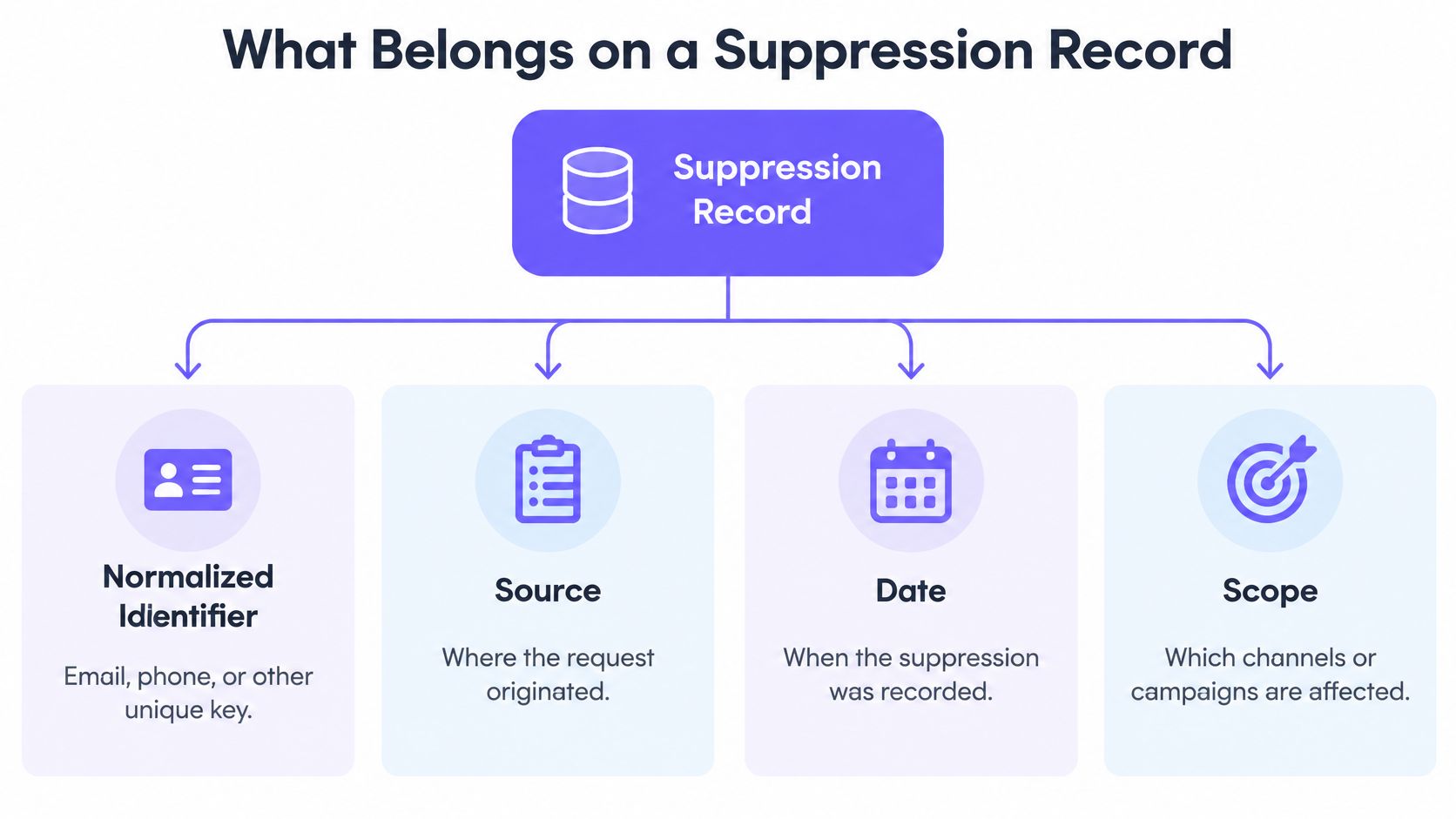
An email address in a hidden spreadsheet can identify a contact, but it can't explain which messages are blocked or why. A usable suppression record needs enough structured information for separate systems to reach the same decision.
For a venue group, I'd design the record around the fields below. These are implementation recommendations, not a reason to retain the guest's complete history.
| Field | Why it matters |
|---|---|
| Normalized identifier | Allows consistent matching of the email, cell phone number, or customer key |
| Channel and purpose | Separates promotional email from SMS, WhatsApp, or service communications |
| Reason code | Distinguishes an unsubscribe, objection, complaint, or delivery failure |
| Timestamp | Establishes when the event occurred and was recorded |
| Source event | Connects the restriction to a preference submission, platform event, or staff-recorded request |
| Scope | Defines the relevant brand, legal entity, venue, or broader boundary |
| Jurisdiction | Helps the team apply the appropriate rules and review process |
The visual summarizes the core identification and evidence fields.
Separate permission problems from delivery problems
A hard bounce isn't an unsubscribe. The former indicates a delivery problem, typically a permanent failure; the latter records a person's instruction. Both can justify exclusion, but they shouldn't share an unexplained blocked flag.
Amazon SES illustrates this distinction through account-level suppression for BOUNCE, COMPLAINT, or both, with operations to manage suppressed destinations in its suppression list documentation. Permanent delivery failures should also be distinguished from temporary failures that may warrant controlled retries.
For a hospitality group spanning restaurants, hotels, and coworking spaces, scope needs particular care:
- Brand-wide objection should carry the stated brand-wide restriction, not become a local venue preference.
- Delivery event should retain its technical cause so administrators don't mistake it for withdrawn consent.
- Manual request should identify the originating interaction without copying unnecessary personal details into notes.
Use an append-only history or auditable state transitions. A correction should explain what changed and who authorized it, rather than erase the previous event. That gives administrators a defensible record when an import and a guest request appear to conflict.
Channel and Purpose Granularity in Practice
A hotel guest unsubscribes from promotional email, then makes another reservation. They still expect their booking confirmation. A single blocked flag leaves staff choosing between sending unwanted marketing and withholding a useful service message.
The distinction is easier to understand at the reception desk.
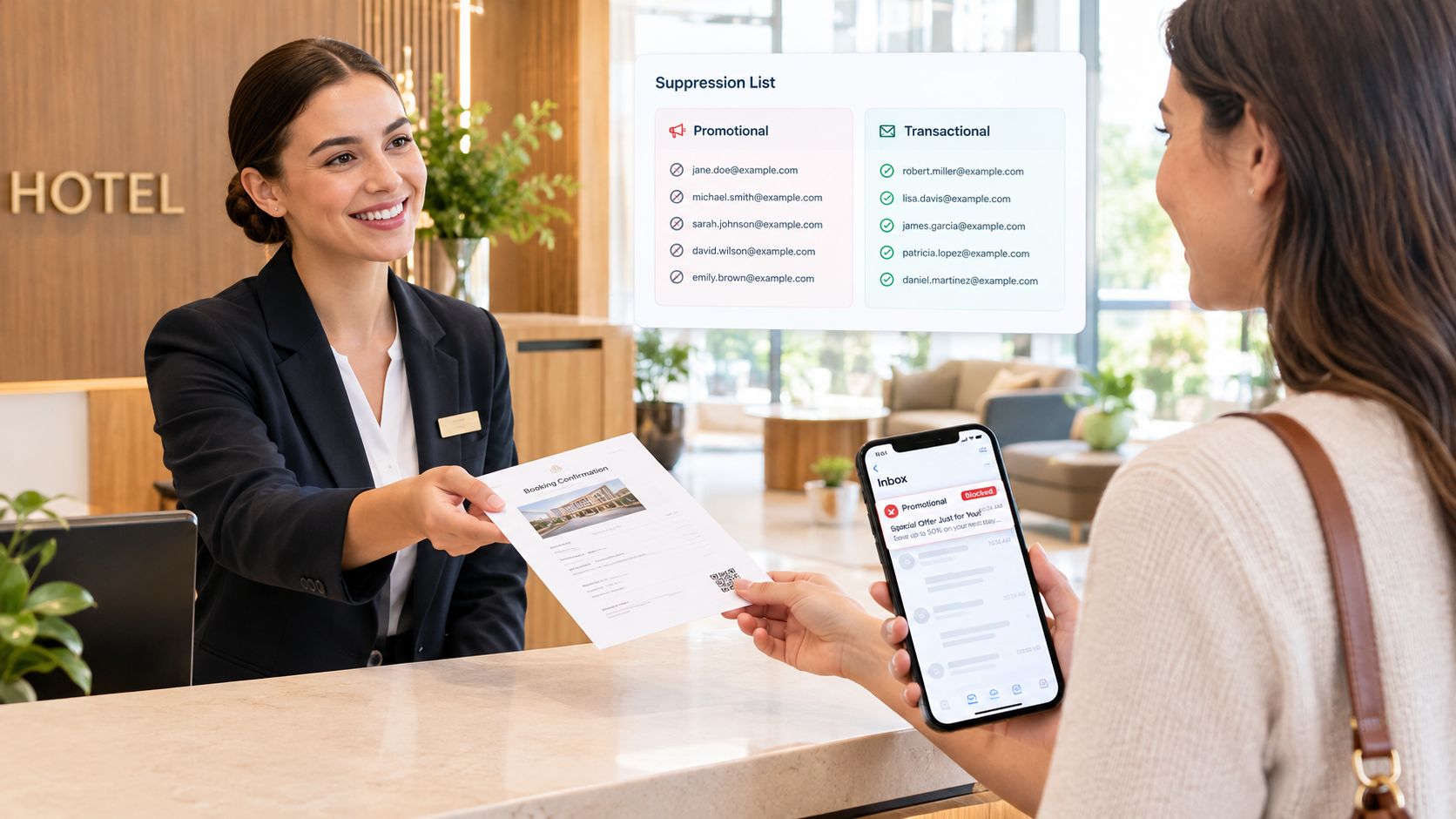
The better model is a channel-and-purpose matrix. Record what the guest has rejected, then assess each proposed communication against that scope. Don't assume permission for another channel merely because it wasn't mentioned.
Classify the message before evaluating eligibility
The following hypothetical decisions show how that matrix works. They aren't substitutes for checking the applicable legal requirements.
| Guest instruction | Proposed communication | Operational decision |
|---|---|---|
| Stop promotional email | Seasonal restaurant offer by email | Suppress |
| Stop promotional email | Confirmation of an existing reservation | Assess separately as a service message |
| Stop all marketing | Promotional WhatsApp message | Suppress |
| Stop marketing SMS | Promotional email | Check email permission independently |
| Object to marketing broadly | Upload to an advertising audience | Apply the objection to that marketing use |
A review request also needs a defined purpose and eligibility rule. Don't classify every automated message as transactional because a visit triggered it. Likewise, adding a substantial promotional offer to a service message deserves scrutiny rather than automatic exemption.
The channel-and-purpose compliance discussion addresses this separation and the importance of unsubscribe and complaint handling. For operators, the practical task is to make the classification explicit in campaign templates, customer journeys, and connected senders.
Keep the distinction between service expectations and marketing preferences in mind while reviewing this video.
Offer choices without weakening refusals
Preference centers can let guests choose narrower interests or channels. They must not make an explicit unsubscribe disappear because another field changed.
- Fresh permission needs an affirmative, evidenced action covering the relevant purpose.
- A new reservation establishes a service interaction, not an instruction to undo an earlier marketing refusal.
- A complaint needs controlled handling, not automatic clearance when a profile is edited.
Mailbox filtering and sender reputation make this operationally important as well as a privacy concern. Your team should handle complaints as exclusion events, not just dashboard metrics.
Suppression Versus Erasure Rights
Deleting everything can feel like the safest response to a privacy request. It can also remove the identifier your systems need to recognize that the person must not receive further marketing.
Erasure and suppression solve different problems. A valid erasure request may require removal of a guest profile and marketing history. Preserving a narrowly justified do-not-contact identifier can help prevent that person from being unintentionally reintroduced through another source.
Minimize the record, not the seriousness of the request
The nuanced approach is data minimization, not a blanket exemption from erasure. The suppression and deletion discussion from Tomba addresses the risk of losing opt-out information when all records are removed.
Consider a hypothetical hotel guest who requests erasure and no further marketing. The team removes their stay-linked marketing profile, but a later WiFi registration supplies the same email address. Without an appropriately retained exclusion identifier, the marketing system may treat that address as newly available.
The comparison below illustrates the tension. It should not be read as suggesting that erasure is optional or wrong.
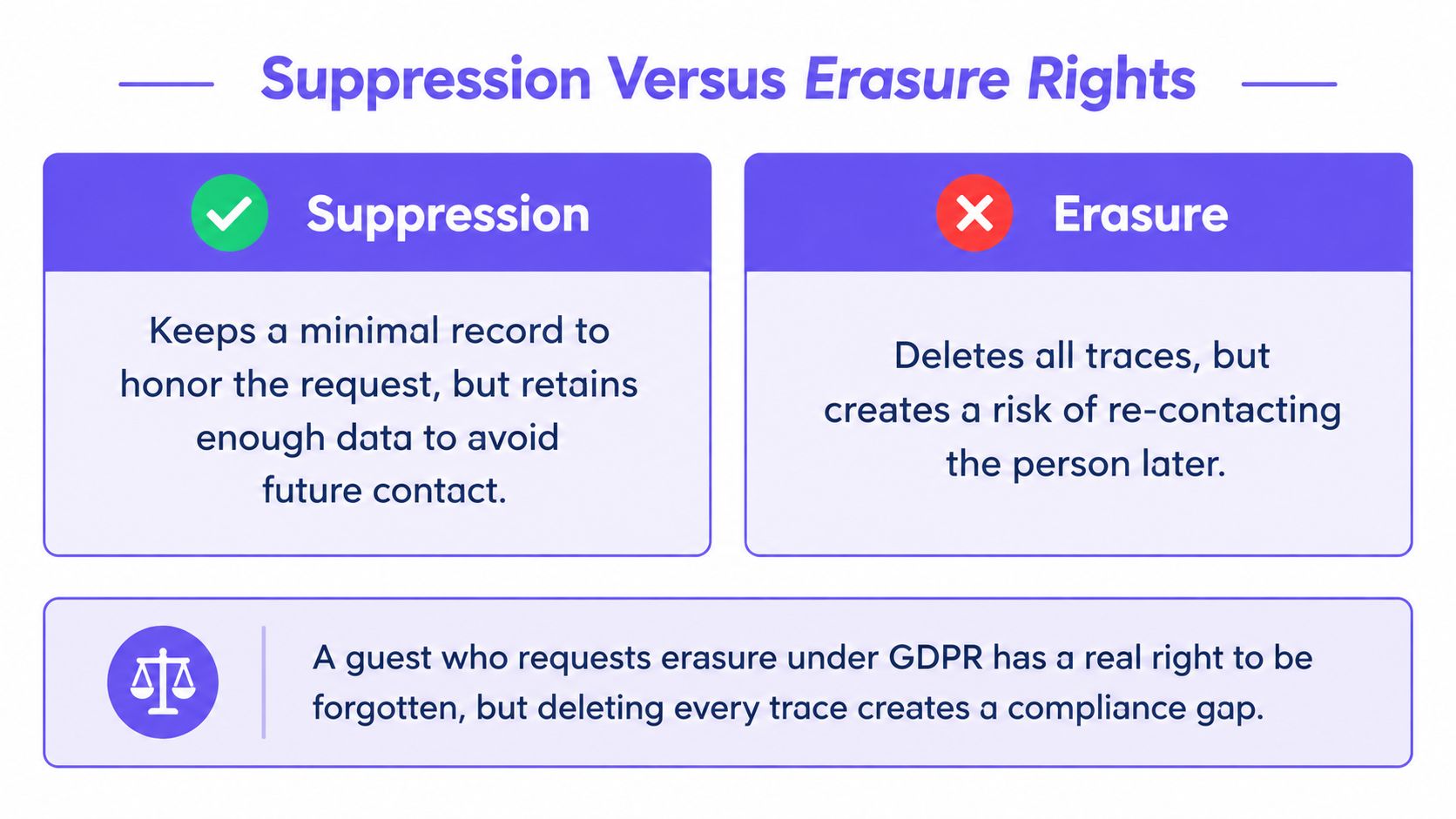
A retained suppression identifier can still be personal data. The business therefore needs a documented purpose, appropriate access controls, retention reasoning, and a process for reviewing or deleting records when retention is no longer justified.
Privacy safeguard: Keep what you need to honor the objection, not what you might want for future targeting.
Give privacy teams an executable decision
An erasure workflow should produce clear instructions for system owners, rather than a general ticket saying delete customer.
- Identify what must be erased. Separate marketing history, profile attributes, and the minimum exclusion information under review.
- Document any retention decision. Explain the purpose and applicable justification, with privacy or legal review where needed.
- Restrict access. Campaign builders shouldn't use retained identifiers to enrich profiles or create targeting opportunities.
- Define the end condition. Specify how the team reviews retention and handles closed records.
The CCPA/CPRA-compliant venue email checklist can help connect that decision to campaign operations.
An append-only ledger supports accountability, but it isn't an instruction to preserve every personal detail forever. Design the event history and identifier retention together. Otherwise, the engineering team may preserve too much evidence while the marketing team still lacks a reliable exclusion control.
Hygiene Practices That Keep Suppression Working
A suppression list needs enforcement points, not just storage. I recommend making those points visible in your operating procedure, integration tests, and campaign approval screen.
Put checks where mistakes enter
- At import, preserve existing restrictions. A POS file's subscribed field mustn't overwrite an established opt-out. Apply the same rule to WiFi re-sign-ins, booking feeds, and CRM syncs.
- At segmentation, distinguish matching from eligibility. A guest may satisfy a lapsed-visitor condition without being contactable. Show that distinction rather than treating every match as sendable.
- At approval, expose exclusions. Give the reviewer exclusion reasons alongside the proposed audience. They should be able to question an unexpected result without manually overriding a guest's refusal.
- At dispatch, evaluate current status. A scheduled audience is a snapshot. A guest who withdraws permission after approval still needs to be blocked.
- At audit, reconstruct the decision. Retain enough event evidence to explain which restriction applied when the system evaluated the message.
These checks are especially important with AI-drafted campaigns. Suppose an automated opportunity plan identifies guests likely to return, including someone who has already opted out. The generated plan must pass the same eligibility controls as a human-built campaign; persuasive reasoning about relevance isn't permission.
Test ordinary operations, not just unsubscribe links
Include journal entries and manual guest notes in your review. If staff record a refusal only as free text, the sending platform can't reliably enforce it. Provide a structured action that creates the appropriate suppression event, with the note serving as context rather than the control itself.
For agencies and advertising integrations, inspect both directions of synchronization. Exporting eligible contacts isn't enough if the destination never receives subsequent exclusions. Keep service-message eligibility separate when testing these pathways.
Prefer idempotent writes, where receiving the same event again doesn't create conflicting outcomes. Structured reason codes, timestamps, and event provenance make this easier to test than inconsistent free-text notes.
Use the email deliverability basics for venues alongside these governance checks. Delivery troubleshooting should confirm that exclusions worked, not focus only on the messages that reached an inbox.
Why Suppression Is a Venue Marketing Governance Problem
Suppression belongs alongside consent capture, campaign approval, and measurement design. The marketer needs a usable audience, the privacy team needs an enforceable instruction, and IT needs dependable rules across connected systems.
The scale of do-not-contact screening is substantial. The FTC's National Do Not Call Registry had more than 258 million active registrations and received over 2.6 million complaints during fiscal year 2025, according to its Do Not Call resources. That registry concerns telephone marketing, not universal rules for every channel, but it illustrates why businesses need repeatable screening rather than a one-time cleanup.
Align responsibility with suppression scope
Technical boundaries don't always match guest expectations. Amazon SES documents separate global and account-level suppression behavior, alongside tenant-level controls, in its suppression architecture guidance. The design lesson is to choose scope deliberately rather than inherit it accidentally from whichever sending account a venue uses.
For a venue group, I'd evaluate restrictions in a documented order:
- Broad objections first, followed by relevant channel restrictions.
- Brand or tenant controls next, followed by delivery-event exclusions.
- Campaign eligibility last, only after the required restrictions have been applied.
That ordering also helps measurement. If your team can't explain who was eligible and who was excluded, interpreting campaign outcomes becomes harder.
Every new integration should therefore have an owner, a suppression test, and a failure procedure. Treat AI-generated plans, agency uploads, and ad syncs as additional routes through the same governed process, not exceptions to it.
Purple Engage combines WiFi, POS, booking, and stay data into a unified guest record, with a shared consent ledger checked at approval and again before sending; imports can't reverse opt-outs. Visit Purple Engage to explore the platform, and bring your guest-data flow and suppression test cases to the discussion so you can assess how those controls fit your venues.