
What Is Segmentation? a Guide for Venue Marketers
What is segmentation? Learn how venues group guests by behavior, demographics and recency, frequency and value, with examples and best practices.

Segmentation is dividing a guest base into groups that share measurable traits so each group receives a different, specific action.
You're preparing a campaign, and the easiest option is sitting in front of you: send the same promotion to everyone. But your list includes loyal regulars, guests who haven't returned, and people who've only just discovered your venue. The useful question isn't just who belongs together. It's who should receive this message, through which permitted channel, and how you'll know whether it brought them back.
Table of Contents
- Why Every Guest Should Not Get the Same Message
- What Segmentation Means in Plain Terms
- Demographic and Behavioral Segments Compared
- Recency, Frequency and Value Segments Explained
- Segment Examples for Restaurants, Hotels and Retail
- Best Practices for Building Segments You Can Trust
- Choosing a Segmentation Approach and Your Next Step
Why Every Guest Should Not Get the Same Message
A restaurant group has a quiet trading period coming up. The marketing manager prepares a discount email and selects the entire guest list. Every location needs bookings, so sending broadly feels reasonable.
Look more closely at the recipients, though. A regular already has a reservation. A former guest stopped visiting after a disappointing meal. A new visitor joined the WiFi but hasn't had time to decide whether they like the restaurant.
The same discount addresses none of those situations particularly well. The regular may use it against a reservation they'd already planned. The dissatisfied guest may need someone to acknowledge their feedback. The newcomer may appreciate a useful introduction more than another offer.
Start with the guest's situation
These are hypothetical guests, not campaign results. Their differences show why a mailing list isn't necessarily a useful audience.
- The regular might benefit from an invitation to something new, rather than a discount on their usual order.
- The lapsed guest needs a reason to reconsider, provided the team has resolved any outstanding complaint.
- The newcomer may need hours of operation, booking information, or a welcome message relevant to the location they visited.
Your first job is to identify the difference that changes your next action. If the message would stay identical regardless of the group, the split may not be useful.
Practical rule: Don't create a segment unless you can explain what you'll do differently for its members.
Segmentation doesn't mean every campaign needs an elaborate offer. Sometimes the right decision is to send helpful information. Sometimes it's to exclude a guest from the campaign entirely.
That's the shift from distributing messages to managing relationships. You stop asking how many contacts you can reach and start asking whether contacting them makes sense.
What Segmentation Means in Plain Terms
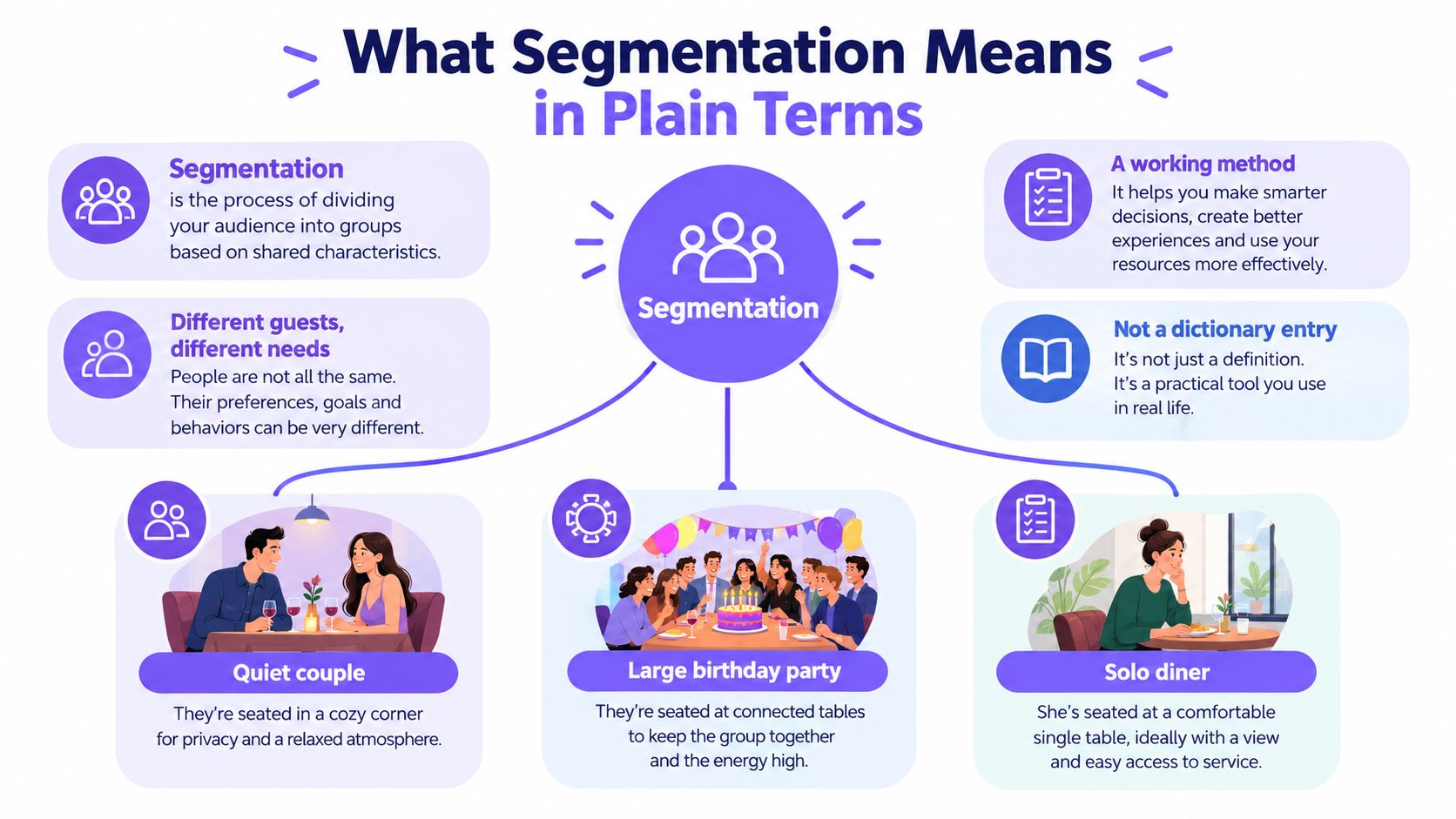
A good host doesn't treat every booking as interchangeable. A quiet couple might appreciate a tucked-away table. A large birthday party needs space together. A solo diner may prefer a comfortable counter seat.
The host notices a meaningful difference, then makes a practical decision. Customer segmentation applies similar reasoning to a guest database, using recorded characteristics, behavior, needs, or predicted responses instead of assumptions.
The illustration below connects those different needs to the host's decisions.
A working method, not a database label
Market segmentation became a formal marketing concept in July 1956, when Wendell R. Smith published his paper in the Journal of Marketing. He described treating a heterogeneous market as smaller, relatively homogeneous groups and distinguished segmentation from product differentiation, as documented in this history of marketing milestones.
In plain language, product differentiation asks how your offer differs from competitors' offers. Segmentation starts by asking how your customers differ from one another, then considers what those differences mean for your offer.
A hotel advertising its distinctive restaurant is emphasizing differentiation. A hotel choosing different messages for local diners and returning overnight guests is applying segmentation.
What makes a group useful
A label such as “engaged guests” sounds helpful but leaves too much unexplained. Does engaged mean someone visited, opened an email, answered a survey, or made a purchase?
A usable segment needs clearer boundaries:
- Distinct: Its members share a difference that matters to the decision.
- Identifiable: Your records contain enough evidence to apply the rule.
- Reachable: You have an appropriate, permitted way to reach them.
- Actionable: The team can deliver something relevant and evaluate the response.
Keep the host analogy in mind. Noticing that guests have different needs isn't the whole job. The host must also have a suitable table available.
When someone asks, “What is segmentation?”, the most useful answer therefore includes both the grouping and the decision. A database label describes people. A working segment helps your team decide what to do for them.
Demographic and Behavioral Segments Compared
Knowing who a guest is can help you write a message. Knowing what they've done often gives you a clearer reason to send it.
Demographic segmentation groups guests by profile details, such as age band or household type. Behavioral segmentation uses recorded activity, such as visits, spending, bookings, stays, and survey responses.
Neither approach tells you everything. Profile information can provide context without revealing intent. Behavioral records can show an action without explaining the motivation behind it.
Demographic versus behavioral segmentation for venues
| Segment type | Basis for grouping | Venue example | Action it supports |
|---|---|---|---|
| Demographic | Recorded profile characteristics | Guests who have supplied household information relevant to a family offer | Adapt the content when that information genuinely matters |
| Behavioral | Recorded actions and interactions | Guests whose visit history shows they've stopped returning | Consider a win-back message |
| Value-based behavioral | Spending and purchase history | Repeat guests with high recorded spending | Consider retention or a relevant cross-sell |
| Geographic | Location or primary venue | Guests associated with a particular restaurant | Send information for that site |
Zip code is usually better treated as geographic information than demographic information. That distinction matters less than being clear about what a field tells you.
A nearby zip code doesn't prove someone visits regularly. An age band doesn't prove they prefer a particular menu. Don't turn a broad characteristic into an unsupported personal preference.
Choose the difference that changes the action
Suppose you want to encourage guests to return after a gap. Visit history gives you a more direct starting point than age or household type.
For example, a guest with no recorded visit in 45 days could qualify for a win-back journey. McKinsey recommends starting with roughly eight to ten behaviorally based segments, then adding more granular microsegments through customer journeys in its guidance on digital personalization at scale.
Treat that as a manageable starting framework, not a requirement to fill a quota. A smaller set of clearly understood groups is preferable to elaborate categories nobody can explain.
Before choosing a segment type, ask:
- Decision: What are we trying to change?
- Evidence: Which recorded characteristic is relevant to that decision?
- Limit: What can't we safely infer from that characteristic?
Use demographic information when it improves relevance. Use behavior when the action depends on what the guest has done. Combine them only when the additional condition changes the decision, rather than making the audience smaller.
Recency, Frequency and Value Segments Explained
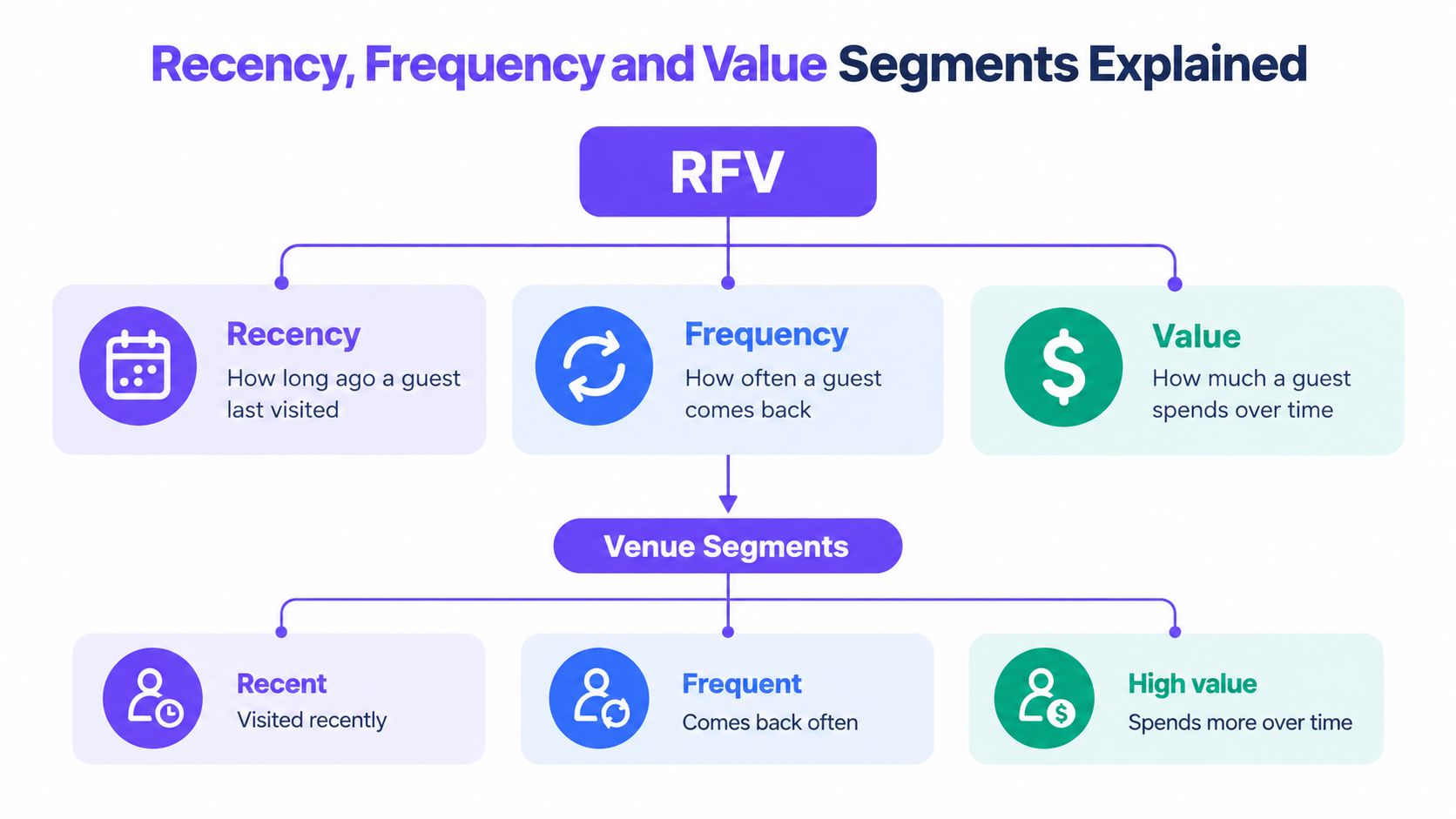
Recency, frequency and value, often shortened to RFV, turn transaction and visit history into practical questions. How recently did the guest come? How often do they return? How much do they spend?
These measures describe different things. A recent guest isn't necessarily a regular, and a frequent guest isn't necessarily a high spender.
The diagram separates the dimensions before combining them into guest groups.
Read the dimensions together
Consider a café guest who used to visit frequently but has gone quiet. Compare them with a hotel guest who has just completed a high-spend stay.
The cafe guest's changed pattern may justify a return invitation. The hotel guest may be better suited to post-stay communication. Spending alone wouldn't explain that difference.
- Recency helps identify where the guest stands now.
- Frequency helps distinguish an established pattern from an occasional visit.
- Value provides spending context, using a clearly defined measure.
Define the observation period before comparing guests. Also decide whether value means recorded revenue, average purchase value, or another measure. Don't call someone profitable because they spent heavily if you haven't considered costs.
Keep the evidence current
Recency-based groups become stale when new activity isn't reflected in eligibility. A guest who returns shouldn't remain classified as inactive because the campaign uses an old export.
A unified record can bring WiFi, POS, booking, stay, and survey events together. But those events aren't interchangeable: a WiFi sign-in indicates a recorded connection, while a receipt records a purchase.
Use the strongest available evidence for the behavior you're measuring. Don't silently treat every interaction as a sale.
For a related framework, the guide to RFM segmentation for restaurants and hospitality explores recency, frequency, and monetary value in more detail.
Keep these distinctions in mind when viewing the accompanying video.
A useful RFV rule should describe the guest's current condition, not permanently assign them an identity. People move between groups as their behavior changes.
Segment Examples for Restaurants, Hotels and Retail
A segment definition becomes easier to evaluate when you write the actual campaign beside it. These hypothetical scenarios show the operating decisions, not claimed results.
Each starts with an observable event. Each also includes a reason to stop sending.
A restaurant invitation tied to the right site
A restaurant group wants to promote a seasonal event. The sensible audience is guests associated with the hosting location, not everyone who has ever visited the group.
| Decision | Example |
|---|---|
| Eligibility rule | Guests with a recorded meal at the hosting restaurant during the relevant recent period |
| Message | An invitation naming that restaurant and explaining the event |
| Suppression | Exclude guests already booked for the event or recently contacted about it |
| Outcome | Incremental event bookings or attended visits |
Keep the location visible in the rule and the message. A guest shouldn't have to open a booking page to discover that the event is somewhere they've never visited.
A hotel follow-up after a completed stay
A hotel could consider guests who have checked out and haven't made another reservation. Anchor the timing to the completed stay, rather than when someone happened to export the list.
The message might offer a relevant reason to return, informed by information the guest deliberately provided. Don't assume the reason for their previous trip from the room bill alone.
- Suppress when circumstances change: Remove guests with a new booking, an unresolved service issue, or a relevant contact restriction.
- Measure the intended behavior: Look for additional completed bookings, while distinguishing them from inquiries and cancellations.
- Keep the property relevant: Use the previous stay location unless the guest's stated interests support another choice.
A retail welcome with an important evidence limit
A shopping venue may want to welcome visitors who joined guest WiFi but have no matched purchase.
That last phrase matters. No matched purchase isn't proof of no purchase. The guest may have paid without identifying themselves, or the retailer's transaction data may not be connected.
A suitable message could introduce the venue's services or invite a return visit without claiming the person left empty-handed. Suppress visitors who have already received the welcome message or whose later activity makes it irrelevant.
Measure an observable outcome, such as a matched return visit or purchase, while recording what your systems can't see. Honest measurement starts with honest segment names.
Best Practices for Building Segments You Can Trust
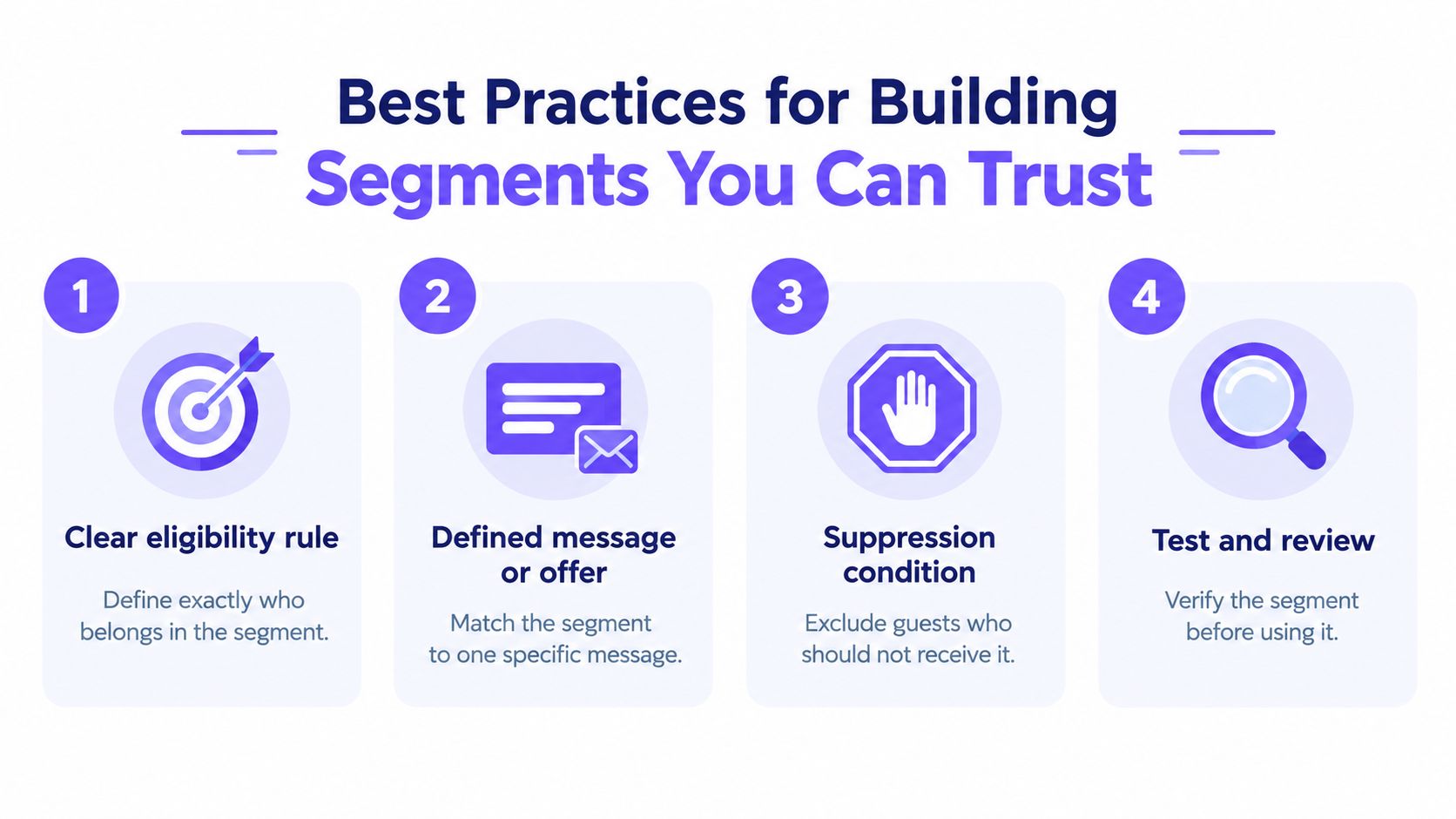
Write the segment rule so a colleague can explain it without opening a query editor. If the team can't agree on who qualifies, the audience isn't ready.
Then separate membership from contact permission. A guest may satisfy a spending or visit rule without being eligible for the channel or purpose you have in mind.
The checklist below covers the basic operating requirements.
Check permission at activation
Consent-aware segmentation means asking more than whether an email address exists. Check the collection purpose, the permitted channel, relevant retention rules, and the guest's current preferences before activation.
Recent US privacy research identifies five consumer privacy segments and reports that comfort with sharing location data in exchange for value fell by 12 percentage points among Skeptical Protectionists and 23 points among Conditional Consumerists since 2023, according to Forrester's consumer privacy segmentation findings.
The practical lesson is restraint. More detailed data doesn't automatically justify more personal messaging.
- Record eligibility clearly: State the qualifying evidence and relevant location.
- Define the intended action: Specify the message, channel, and purpose.
- Apply suppression consistently: Honor opt-outs and exclude guests whose circumstances have changed.
- Recheck before sending: A previously eligible guest may no longer be contactable.
- Review the outcome: Keep, revise, or stop the segment based on business impact.
The same discipline belongs in your approach to first-party data for venues.
Separate description from causation
A high-value segment describes valuable guests. It doesn't prove those guests need a message to return.
Randomly assign eligible guests to a contacted group and a held-back control group, then observe both over the same conversion window. Keep overlapping campaigns from reaching the control group in ways that undermine the comparison.
A guest returning after an email is an observation. A difference against a suitable control group is evidence of incremental impact.
Guidance on promotion performance and incrementality explains why holdouts are useful for measuring promotion impact rather than merely reporting activity among recipients.
Report the estimated difference with an uncertainty range and account for offer costs. Opens and clicks can help diagnose a campaign, but they aren't a substitute for additional visits, bookings, or purchases.
Choosing a Segmentation Approach and Your Next Step
The right operating approach depends on how much guest activity you need to reconcile and how reliably your team can maintain the controls.
A spreadsheet can help you inspect a proposed audience. Separate point tools may already support useful campaigns. A unified guest record becomes relevant when the decision depends on activity spread across those systems.
Compare the work behind the audience
| Approach | Where it helps | Work your team must manage |
|---|---|---|
| Manual spreadsheet exports | Inspecting records and testing simple rules | Refreshing data, reconciling identities, and rechecking permission before activation |
| Separate point tools | Acting on activity captured within each tool | Coordinating exclusions, contact history, and measurement across systems |
| Unified guest record | Evaluating rules against connected guest history | Maintaining identity matching, data quality, and appropriate use of each event |
Don't choose solely on how quickly you can build a list. Ask how quickly you can correct it when a guest books, returns, complains, or opts out.
A connected record doesn't remove the need for judgment. If the source data is incomplete, the segment still needs a clearly stated limitation. If a rule has no useful action attached, joining more systems won't fix it.
Put the operating model into practice
Purple Engage combines WiFi sign-ins, POS sales, reservations, forms, files, messages, and survey answers into a guest record matched by email. Its segments can use visits, spend, and survey answers and update themselves as activity changes. Teams can measure extra visits against a held-back group with a range, and use the platform for a single venue or a multi-site group.
Our recommendation is to scope segments by primary venue, so a guest associated with Chicago doesn't receive an irrelevant New York promotion. That keeps the audience definition connected to the place the guest knows.
For campaigns that continue beyond an isolated send, use customer lifecycle marketing to consider how the next action should change as the guest's relationship develops.
Start this week with a short working session:
- Select your most valuable guest behaviors: Focus on actions your systems can observe.
- Write an eligibility rule for each: Include the evidence, relevant venue, and condition that ends membership.
- Prepare the test before launch: Set the holdout, conversion window, suppression rules, and outcome measure.
Keep the initial rules understandable. You're building a repeatable decision process, not trying to describe every possible guest.
Purple Engage offers self-updating segments based on visits, spend, and survey answers, with held-back measurement to estimate extra visits. Visit Purple Engage to explore how connected guest records can support more relevant audiences and a clearer test of whether your campaigns brought people back.